Geometry
Applying the Pythagorean Theorem to Non-Right Triangles
Students use on any triangle even when no angle is marked .
Quick check
Why students make it
The formula looks like a general side-length rule because it is simple and familiar. Students may also assume the longest side is always a hypotenuse, but a hypotenuse exists only in a right triangle.
The rule done right
The Pythagorean Theorem applies only to right triangles, where and are the legs and is the hypotenuse. For a non-right triangle, use the Law of Cosines, , or another appropriate triangle rule.
Related resources
-
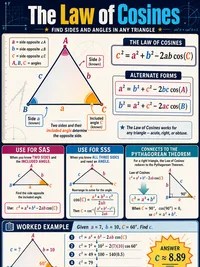 Math, The Law of Cosines Infographic
-
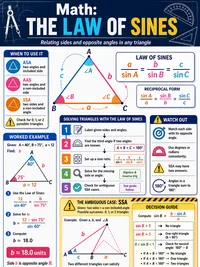 Math, The Law of Sines Infographic
-
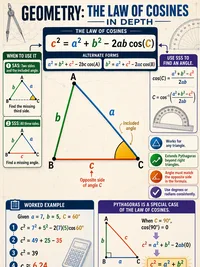 Geometry, The Law of Cosines in Depth Infographic
-
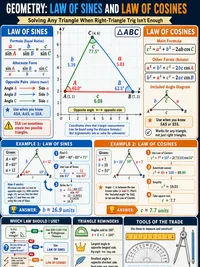 Law of Sines & Law of Cosines Infographic
-
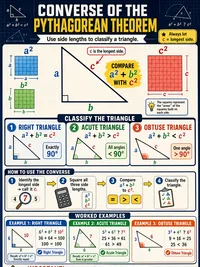 Geometry, The Converse of the Pythagorean Theorem Infographic
- Law of Cosines Worked Examples Cheat Sheet
- Pythagorean Theorem & Distance Formula Cheat Sheet
- Triangles Cheat Sheet
- Triangle Theorems & Proofs Cheat Sheet
- Triangle Inequality and Side Angle Relationships Cheat Sheet
- Law of Sines and Cosines Worksheet
- Math, The Pythagorean Theorem Worksheet
- Trigonometry Right Triangles Worksheet
- Geometry, Triangles (High School) Worksheet
- Geometry, Three Trig Ratios (SOH CAH TOA) Practice Worksheet
- Triangle Solver Tool
- Pythagorean Theorem Explorer Tool
- Right-Triangle Trigonometry (SOH-CAH-TOA) Solver Tool
- Pythagorean Theorem Lab Lab
- Similarity & Triangle Trigonometry Lab Lab
- Angle Builder Lab Lab
Continue learning
- Geometry, Geometric Mean in Right TrianglesStudy poster
- Geometry, Proving the Pythagorean TheoremStudy poster
- Special Right Triangles ExplorerTool
- Special Right Triangles (30-60-90 and 45-45-90)Cheat sheet
- Why Does a Mirror Flip Left and Right but Not Up and Down?Explainer
- Fleming's Left for Motor, Right for GeneratorMemory aid