Right-Triangle Trigonometry (SOH-CAH-TOA) Solver
Solve any right triangle from two known sides or angles. See the SOH-CAH-TOA reasoning, the inverse trig and Pythagoras steps, and a to-scale labeled diagram.
Known quantities
Pick any two known quantities. The solver works out the rest. The right angle is always at vertex C.
To-scale diagram
Solved triangle
How it works
The right angle sits at vertex C, so the hypotenuse c is the longest side. Leg a is opposite angle A, leg b is opposite angle B, and the two acute angles always add to 90 degrees. Pick any two known quantities and the solver finds the rest.
When you know two sides, Pythagoras gives the third side and inverse trig gives the angles. When you know one side and one acute angle, the sine, cosine, and tangent ratios give the remaining sides.
The diagram is drawn to scale. In angle-plus-side mode the legs are labeled opposite and adjacent relative to angle A, and the two sides used in the active ratio are highlighted.
Curriculum alignment
This tool supports high-school geometry and precalculus work on right-triangle trigonometry, including the SOH-CAH-TOA ratios and the inverse trig functions used to recover angles.
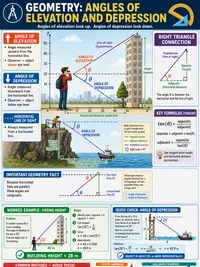
It fits coursework on the Pythagorean theorem, similar triangles, and applied problems such as ramps, ladders, and lines of sight. Advanced students can use it to check the special 30-60-90 and 45-45-90 cases.
How SOH-CAH-TOA works
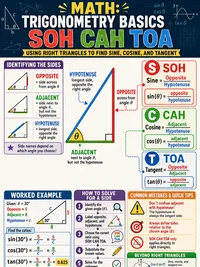
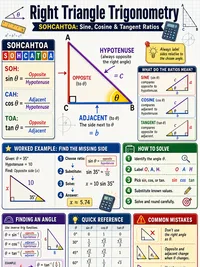
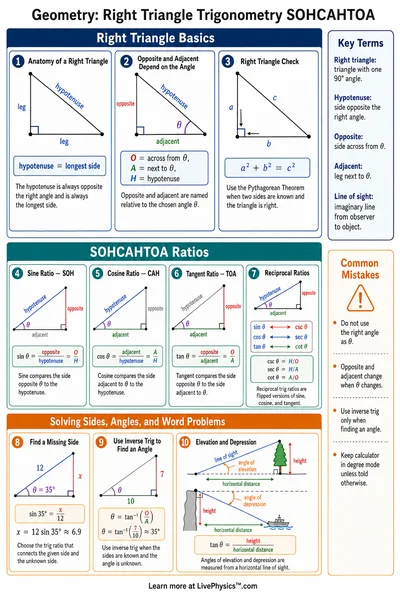
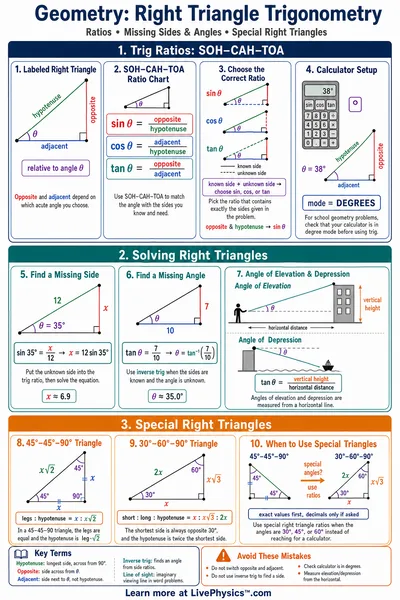
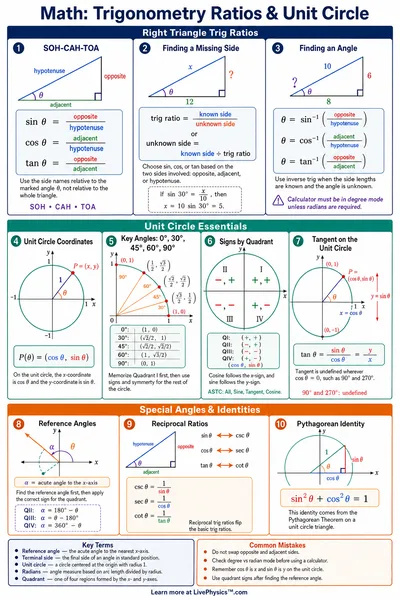
SOH-CAH-TOA is a memory aid for the three primary trig ratios. Each ratio compares two sides of a right triangle relative to one acute angle. The side across from the angle is the opposite, the side next to it (that is not the hypotenuse) is the adjacent, and the longest side is the hypotenuse.
Sine equals opposite over hypotenuse. sin A = opp / hyp = a / c. Use it when the opposite leg and the hypotenuse are involved.
Cosine equals adjacent over hypotenuse. cos A = adj / hyp = b / c. Use it when the adjacent leg and the hypotenuse are involved.
Tangent equals opposite over adjacent. tan A = opp / adj = a / b. Use it when both legs are involved and no hypotenuse is needed.
To find an unknown angle, apply the inverse functions. For example A = sin⁻¹(a / c), A = cos⁻¹(b / c), or A = tan⁻¹(a / b). The other acute angle follows from B = 90° − A.
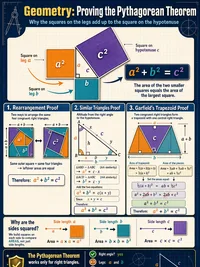
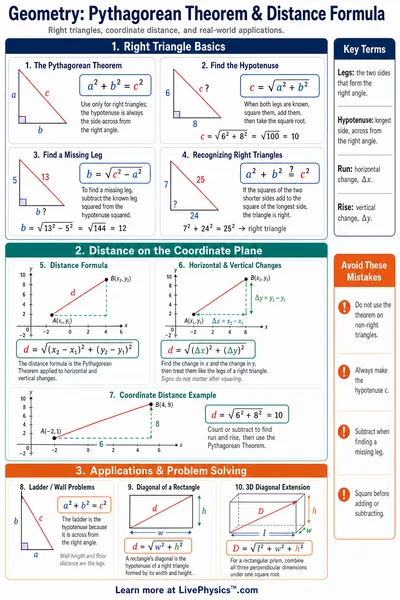
When two sides are known and you need the third, use the Pythagorean theorem c² = a² + b² for the hypotenuse, or a = √(c² − b²) for a missing leg. Every right triangle satisfies a² + b² = c².