Math
Assuming a Bigger Denominator Means a Bigger Fraction
Students think is bigger than because is bigger than .
Quick check
Why students make it
Students use whole-number thinking on the denominator. They forget that the denominator tells how many equal pieces the whole is split into, so a bigger denominator means smaller pieces when the numerator stays the same.
The rule done right
For fractions with the same numerator, the fraction with the smaller denominator is bigger. For example, because fourths are larger pieces than eighths.
Related resources
-
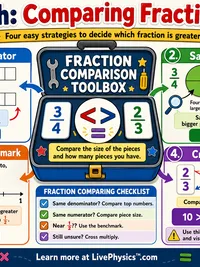 Comparing Fractions Infographic
-
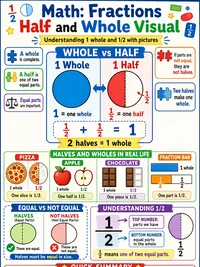 Fractions, Half and Whole Infographic
-
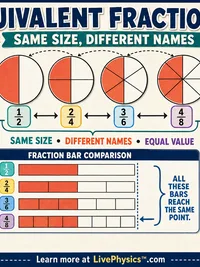 Equivalent Fractions Infographic
-
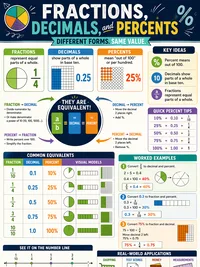 Fractions, Decimals & Percents Infographic
-
 Math, Comparing and Ordering Rational Numbers Infographic
- Fractions, Decimals & Percents Cheat Sheet
- Mixed Numbers & Improper Fractions Cheat Sheet
- Adding & Subtracting Fractions Cheat Sheet
- Math, Fractions Numerator and Denominator Worksheet
- Unit Fractions, 1/2, 1/3, 1/4, 1/6, and 1/8 Worksheet
- Comparing Fractions with the Same Denominator Worksheet
- Fractions, Parts of a Whole Worksheet
- Comparing Fractions with Unlike Denominators Worksheet
- Fraction Wall & Equivalent Fractions Builder Tool
- Fractions on a Number Line Tool
- Fraction Operations Visualizer Tool
- Fraction as Division & Sharing Stories Tool
- Fraction Operations & Equivalents Lab Lab
- Recipe Fractions & Mixing Lab Lab
- Place Value, Decimals & Scientific Notation Lab Lab