Line Plot & Fraction Data Lab
Add X marks to a fraction number line, discover which measurement appears most often, and record your data to practice building and reading line plots.
Guided ExperimentLine Plot & Fraction Measurements
Before adding marks, predict which measurement (in fourths) will appear most often in your data.
Write your hypothesis in the Lab Report panel, then click Next.
Fraction Number Line Plot
Controls
Data Table
(0 rows)| # | Measurement | X Marks | Running Total |
|---|
Reference Guide
Line Plots
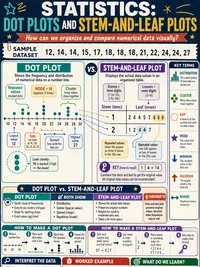
A line plot shows the frequency of values on a number line using X marks. Each X represents one data point.
The position with the tallest stack of X marks is the value that appears most often in the data set.
Fractions as Measurements
Halves, fourths, and eighths express measurements smaller than 1 inch. One-fourth (1/4) is half of one-half.
On a ruler, the shortest tick marks between whole numbers show fourths and eighths of an inch.
Reading the Stack
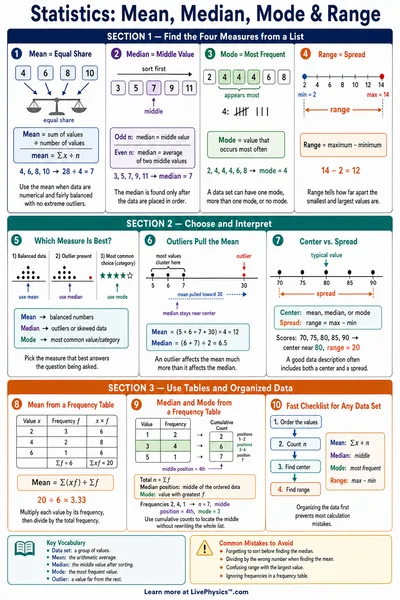
The tallest stack of X marks is the most common value. This is called the mode of the data set.
When stacks are roughly the same height, the data is spread out. When one stack is much taller, most measurements are the same.
Adding Fractions
To find the total count of all measurements, add all the X marks together. Each X stands for one measurement.
When adding fractions with the same denominator, add the numerators and keep the denominator the same. For example, 1/4 + 3/4 = 4/4 = 1.