Understanding Clinometer Simulator
A clinometer measures how steeply you have to look up to see the top of something. That angle, together with one distance measured along the ground, is enough to find a height you could never reach with a tape. Surveyors, foresters and geologists all use the same idea.
Any angle needs a fixed direction to be measured from. The clinometer takes its direction from gravity. A weighted thread hanging from the centre of a protractor always points straight down, however the instrument is held.
When you tilt the sighting tube up, the protractor turns with it but the thread does not. The thread therefore moves across the scale by exactly the angle of the tilt. The mark under the thread gives the angle of elevation.
Scales are numbered in two ways. Some read 0° when the tube is level, and the reading is the angle itself. A plain protractor reads 90° when level, so a reading of 50° means an elevation of 90 minus 50, which is 40°.
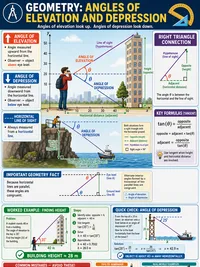
The height comes from a right angled triangle. Its base is the level distance from you to the point under the top, and its upright side is the part of the object above your eye. The tangent of the angle is the upright side divided by the base.
Multiplying the distance by the tangent therefore gives the height above eye level. The triangle starts at your eye and not at your feet. Your eye height has to be added at the end.
Suppose you stand 25.0 m from a tree and read 40°, with your eye 1.5 m above the ground. The tangent of 40° is 0.839, and 25.0 times 0.839 is 21.0 m. Adding 1.5 m gives a height of 22.5 m.
The scale is marked in whole degrees, so the reading may be a degree out. At 41° the same sum gives 23.2 m, a change of about 0.7 m, or 3 percent. That is the real uncertainty of the method, whatever the calculator displays.
The size of that uncertainty depends on the angle. Close to the object the angle is steep and the tangent changes very fast, so that between 80° and 81° it grows by more than 10 percent. Far away the angle is shallow and one degree is a large share of the reading, so the best place to stand is where the angle is near 45°.
The thread is light, and wind sets it swinging. It helps to shield it, wait for it to settle and have a partner read the scale while you keep the top in view.
The method assumes the ground is level between you and the object. It also assumes the distance was measured to the point directly below the top, which for a leaning tree is not the foot of the trunk. On a slope, a second sighting to the base is needed.
Looking down works in the same way. From a cliff or a window the thread swings to the other side of zero and gives an angle of depression. If the height of your eye above the water is known, dividing it by the tangent gives the distance out to a boat.