Understanding Earthquake Magnitude Calculator
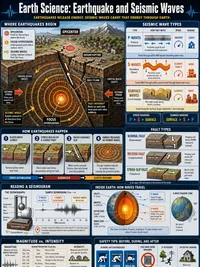
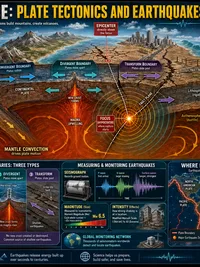
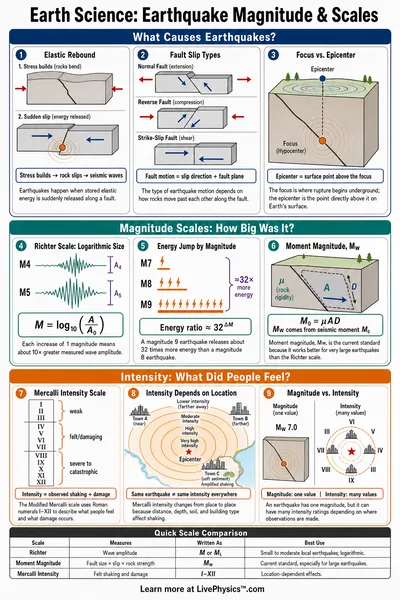
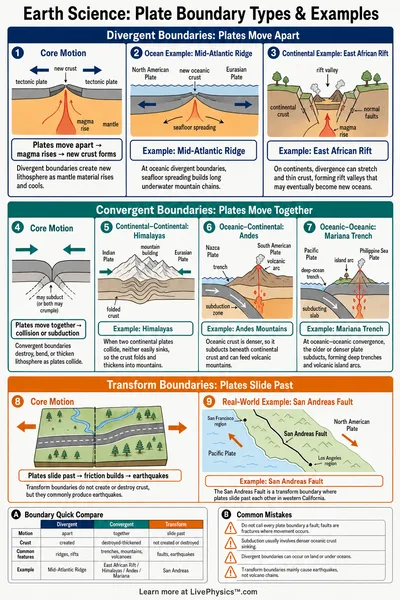
Earthquakes begin when stress builds along a fault in Earth’s crust. Rocks can bend only so far before they suddenly slip, releasing stored energy as vibrations that travel through the ground.
Magnitude describes the size of the earthquake at its source. It is based on measurements of the waves and does not change from town to town, even though people in different places may feel very different shaking.
The original Richter scale used the height of seismic waves recorded by a particular type of instrument. Scientists correct that wave height for the distance between the station and the earthquake, since waves become weaker as they spread out.
Modern scientists usually use moment magnitude for large earthquakes. It estimates the physical fault movement by considering the area that slipped, the distance of slip, and the strength of the rocks involved.
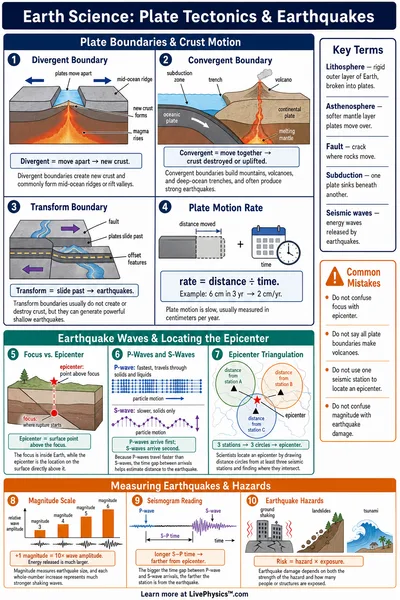
Magnitude scales are logarithmic, which makes small number changes important. A rise of one whole magnitude means about ten times greater wave amplitude and about thirty two times more released energy.
This pattern explains why an earthquake of magnitude eight is far more serious than one of magnitude six. The difference is two magnitude steps, so the larger event releases roughly one thousand times as much energy.
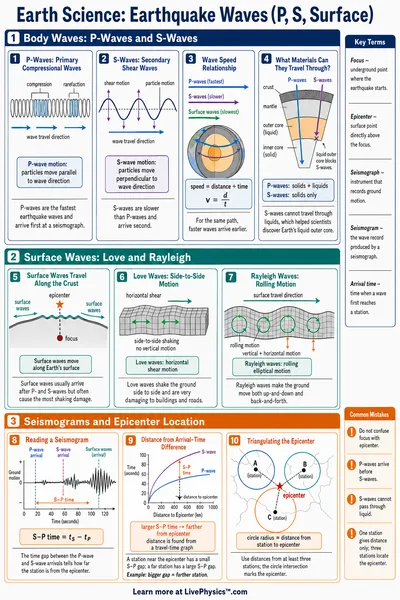
Seismographs record ground motion as a line that moves up and down over time. The first small waves often arrive before stronger waves, and scientists use the timing difference to estimate how far away the earthquake occurred.
A single station cannot locate an earthquake precisely. Scientists compare arrival times from several stations, then use the overlap of distance estimates to find the likely source area beneath the surface.
Modified Mercalli intensity measures observed effects rather than energy released. It describes things such as light shaking, objects falling, cracked walls, damaged roads, and whether people can remain standing.
Intensity depends strongly on local ground conditions. Soft sediment can amplify shaking, while solid bedrock often shakes less, so two nearby neighborhoods may experience different damage from the same earthquake.
Buildings matter as much as the shaking itself. Older structures with weak connections can fail during motion, while buildings designed to bend safely and absorb energy are more likely to protect people.
When studying earthquake data, keep magnitude, energy, and intensity separate in your mind. Pay attention to the measurement method, the distance from the fault, local soil, building quality, and uncertainty in early reports.