Poetry Analysis Tool
Read a poem closely. Detect the rhyme scheme, mark stress to find the meter, and tag the literary devices. Five short public-domain poem excerpts are included as presets.
Poem Editor
Pick a preset or paste your own poem. One line per line.
Tip. Keep one verse line per line so rhyme and meter detect correctly.
Rhyme Scheme
Each line gets a letter. Same letter means rhymes with each other.
- 1Shall I compare thee to a summer's day?day
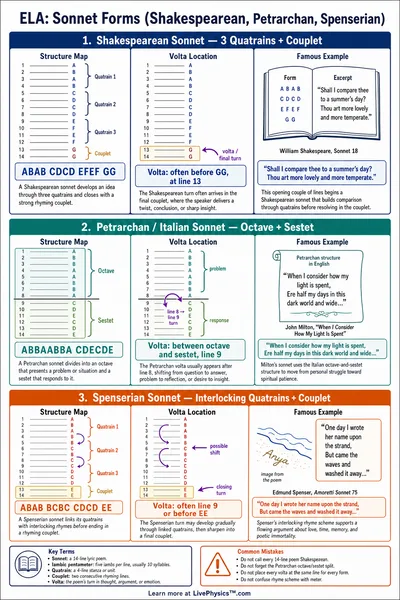
- 2Thou art more lovely and more temperate:temperate
- 3Rough winds do shake the darling buds of May,may
- 4And summer's lease hath all too short a date.date
Scansion
Click a syllable to flip its stress. Dot = unstressed. Slash = stressed.
- Line 1IambIambIambIambIamb
- Line 2IambIambIambIambIambMixed
- Line 3IambIambIambIambIamb
- Line 4IambIambIambIambIamb
Annotations
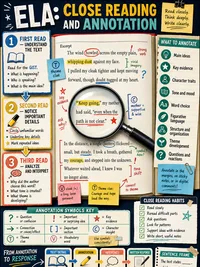
Pick a device, then drag-select text in a line to tag it.
- 1Shall I compare thee to a summer's day?
- 2Thou art more lovely and more temperate:
- 3Rough winds do shake the darling buds of May,
- 4And summer's lease hath all too short a date.
Tagged items (0)
No annotations yet. Drag-select text above to tag a device.
Analysis Summary
- Form
- Quatrain
- Stanzas / Lines
- 1 stanza, 4 lines
- Dominant Meter
- Iambic Pentameter
- Rhyme Scheme
- ABAB
Devices Used (0)
Tag at least one line in the annotation layer to track devices.
What do the form, meter, rhyme, and devices add up to? Write a short response.
Poetry Quick Reference
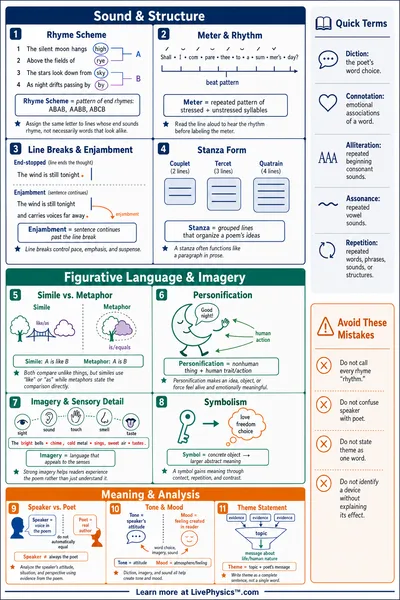
Meter and Feet
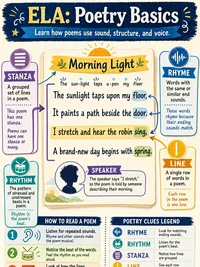
A foot is a small unit of rhythm built from stressed and unstressed syllables. The most common feet in English are disyllabic (two-syllable) or trisyllabic (three-syllable).
- Iamb. Unstressed then stressed. The everyday rhythm of English, used in most sonnets.
- Trochee. Stressed then unstressed. Common in nursery rhymes and chants.
- Anapest. Two unstressed then a stressed. Often feels galloping or energetic.
- Dactyl. Stressed then two unstressed. The reverse of an anapest.
- Spondee and pyrrhic. Two stressed or two unstressed in a row. Used sparingly for emphasis or speed.
A line described as "iambic pentameter" has five iambs, ten syllables total, alternating unstressed and stressed.
Rhyme Schemes
A rhyme scheme labels each end-of-line rhyme with a letter. Lines that rhyme share the same letter.
- AABB. Couplets. Each pair of consecutive lines rhymes. Often light or song-like.
- ABAB. Alternating rhyme. Common in ballads and many lyric poems.
- ABBA. Enclosed rhyme. The outer pair frames the inner pair.
- ABCB. Common ballad form. Only the second and fourth lines rhyme.
- Free verse. No fixed rhyme scheme. Lines may still use slant rhyme or internal rhyme.
Sound Devices
Sound devices use repeated consonant or vowel sounds to create rhythm, mood, or emphasis.
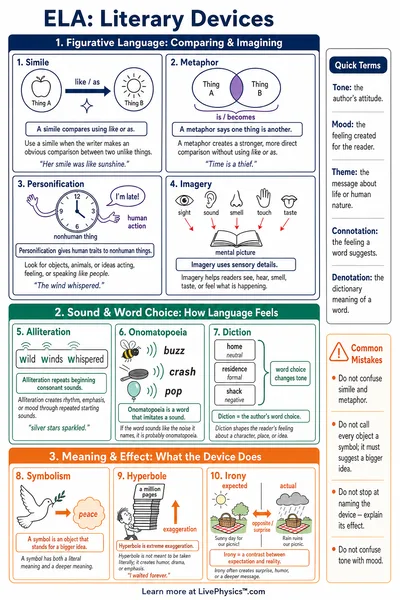
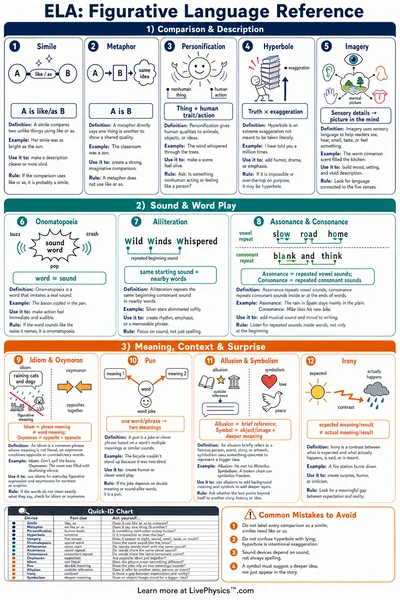
- Alliteration. Repeated initial consonant sounds across nearby words. Example, "rough winds."
- Assonance. Repeated vowel sounds inside nearby words.
- Consonance. Repeated consonant sounds anywhere in nearby words.
- Onomatopoeia. Words that imitate the sound they describe. Example, "buzz" or "splash."
- Caesura. A deliberate pause inside a line, often marked by punctuation.
- Enjambment. A sentence that runs from one line into the next without a pause.
Figurative Language in Poetry
Figurative language describes one thing in terms of another to create meaning beyond the literal words on the page.
- Metaphor. A direct comparison. "Hope is the thing with feathers."
- Simile. A comparison using "like" or "as."
- Personification. Giving human traits to an object or idea. "The fog comes on little cat feet."
- Imagery. Sensory description that helps the reader see, hear, smell, taste, or feel the scene.
- Symbol. A concrete object that stands for an abstract idea, such as a dove for peace.
- Hyperbole. Deliberate exaggeration for effect.
- Apostrophe. A direct address to a person who is absent, dead, or to an idea.