Paragraph Organizer
Arrange scrambled sentences into a well-structured paragraph. Practice identifying topic sentences, supporting details, and conclusions across 8 exercises from elementary to high school.
How Plants Make Food
Topic Photosynthesis · 5 sentences
1
The plant uses sunlight, water, and carbon dioxide to make its own food.
2
The food the plant makes is a type of sugar that gives the plant energy to grow.
3
Without photosynthesis, there would be no oxygen for animals and humans to breathe.
4
Plants are unique because they can make their own food through a process called photosynthesis.
5
Inside each leaf are tiny green parts called chloroplasts that capture sunlight.
0/8 complete
Exercises
Writing Reference
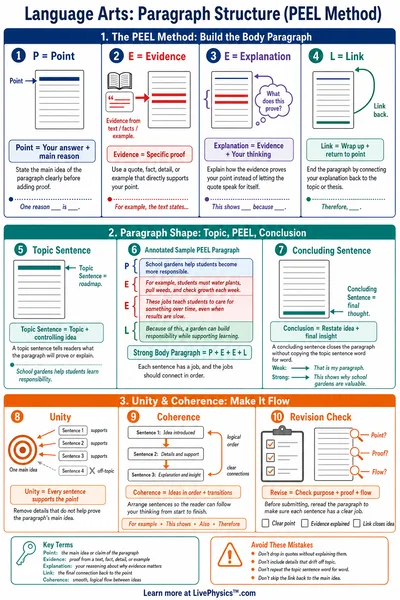
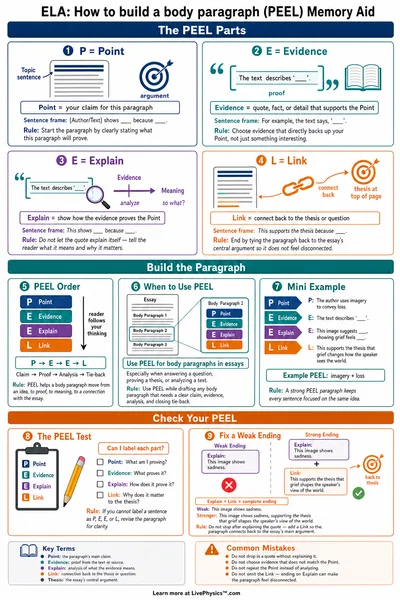
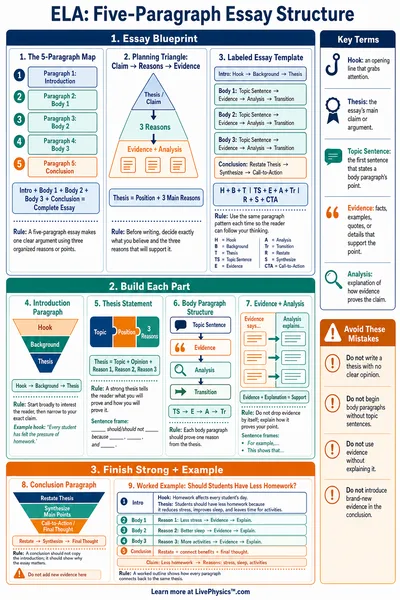
Paragraph Structure
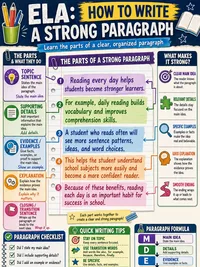
- Topic sentence - States the main idea of the entire paragraph. It answers the question, what is this paragraph about?
- Supporting sentences - Provide evidence, examples, or explanation that develops the main idea.
- Concluding sentence - Wraps up the paragraph by restating the main idea in new words or explaining why it matters.
Transition Words
- To begin First, To start, Initially
- To continue Next, Then, After that, Additionally
- To contrast However, On the other hand, Although
- To show cause Because, As a result, Therefore
- To compare Similarly, Likewise, In the same way
- To conclude Finally, In conclusion, Ultimately, Therefore
Topic Sentences
- A strong topic sentence introduces exactly one main idea - not two or three.
- It is broad enough to need support but specific enough to focus the paragraph.
- Supporting sentences answer "how?" or "why?" about the topic sentence.
- If you can remove a sentence without weakening the paragraph, it may not belong in this paragraph at all.
Related Content
Related Tools
MAP Growth Grade 3 Reading Practice
Original independent MAP Growth Grade 3 Reading skill practice with explanations, adjustable difficulty and first-attempt progress; no official RIT score.
MAP Growth Grade 3 Language Usage Practice
Original independent MAP Growth Grade 3 Language Usage skill practice with explanations, adjustable difficulty and first-attempt progress; no official RIT score.
MAP Growth Grade 4 Reading Practice
Original independent MAP Growth Grade 4 Reading skill practice with explanations, adjustable difficulty and first-attempt progress; no official RIT score.
MAP Growth Grade 4 Language Usage Practice
Original independent MAP Growth Grade 4 Language Usage skill practice with explanations, adjustable difficulty and first-attempt progress; no official RIT score.
Related Labs
Reading Comprehension Lab
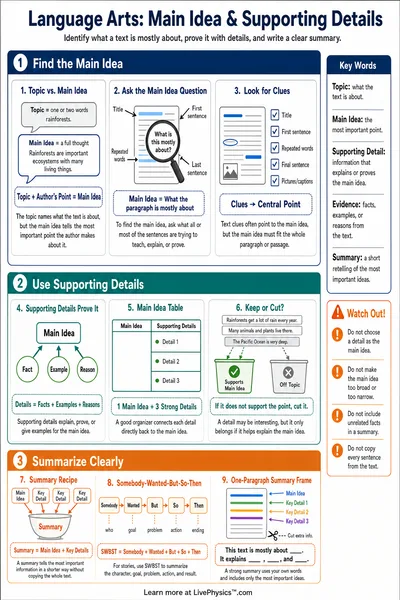
Timed reading practice with annotation tools and 6 passages. Answer scaffolded questions covering main idea, detail, inference, vocabulary, and author's purpose. Tracks accuracy across attempts for grades 6-10.
Reading Strategies Lab
Practice active reading across three non-fiction passages. Make text connections, ask before/during/after questions, form predictions, and write summaries using guided strategy prompts.
Grammar Patterns Lab
Practice identifying and correcting 10 grammar error types, subject-verb agreement, run-ons, fragments, comma splices, misplaced modifiers, and more. Bank of 33 exercises with fuzzy-match correction scoring for grades 6-10.
Claim-Evidence-Reasoning Lab
Build structured arguments using the CER framework across three debate topics. Write a claim, add evidence with reasoning, acknowledge counter-claims, and measure your argument's strength.