Vocabulary Word Map
Select any of 40 academic vocabulary words to see a visual map of its definition, part of speech, synonyms, antonyms, example sentence, and word roots. All grades from elementary through high school are covered.
Word Map
analyze
verb
middle schoolTo study something carefully by breaking it into smaller parts to understand it better.
verb
A verb expresses an action, occurrence, or state.
"We will analyze the poem's structure, word choice, and tone in class today."
Greek 'analyein' = to unloose, break apart
Vocabulary Strategies
How to Use Word Maps
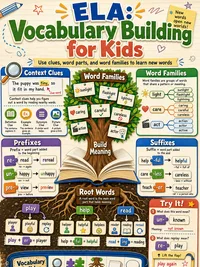
Word maps build stronger memory by linking a new word to multiple pieces of information at once. Instead of memorizing a definition alone, you connect the word to its meaning, related words, and real usage.
- Read the definition out loud.
- Say two synonyms and explain how each is slightly different.
- Write your own example sentence.
- Study the etymology to understand the word's building blocks.
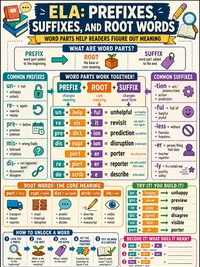
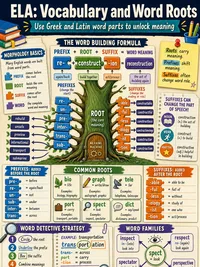
Common Latin and Greek Roots
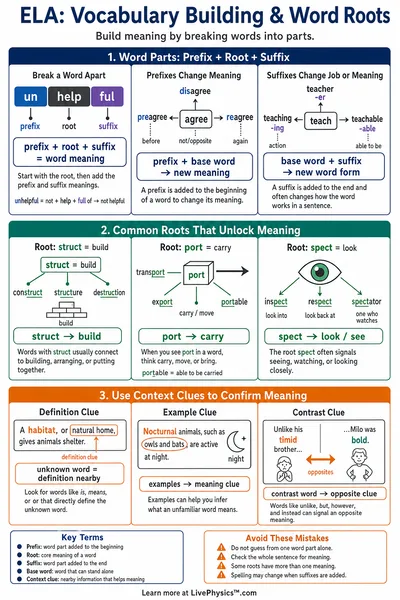
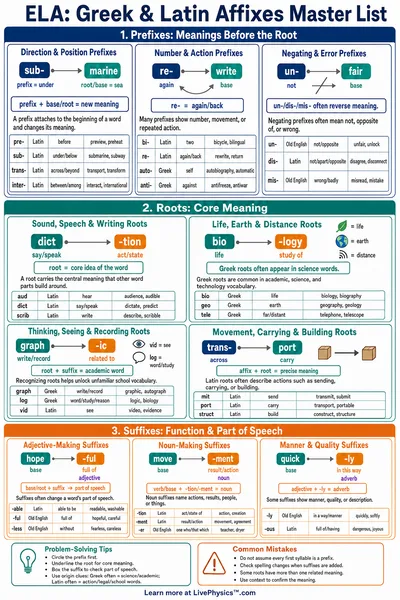
Most academic English vocabulary comes from Latin or ancient Greek. Knowing a root unlocks the meaning of dozens of related words.
- chron (Greek) - time, chronic, chronicle
- port (Latin) - carry, transport, export
- bene (Latin) - well, benefit, benevolent
- spec/scop (Latin) - see, spectacle, speculate
- logy (Greek) - study of biology, chronology
- contra (Latin) - against, contradict, contrary
Context Clues and Word Families
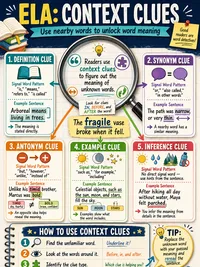
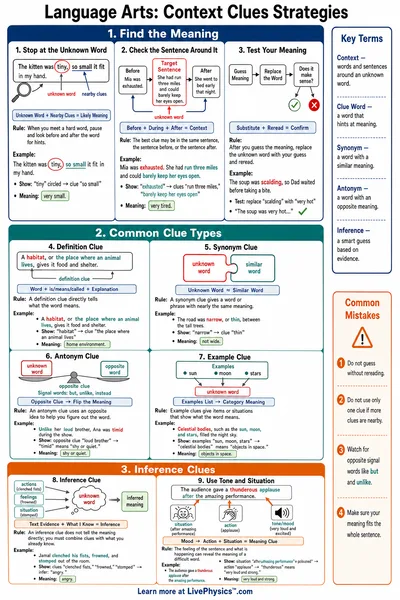
When you encounter an unfamiliar word in reading, use these strategies to understand its meaning.
Context clues - Read the surrounding sentences. The author often hints at meaning through examples, restatements, or contrast words like "but" and "unlike."
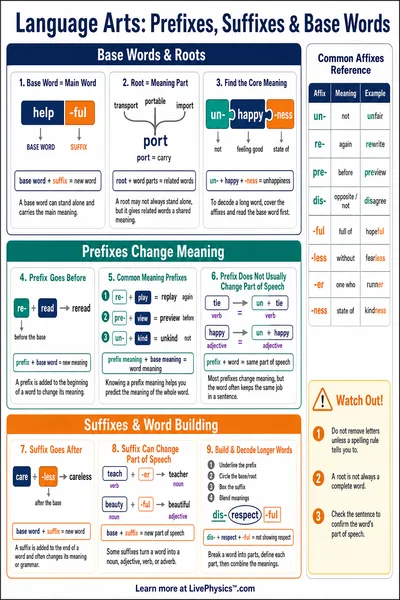
Word families - Related forms share the same root. If you know "analyze," you already understand "analysis" and "analytical." Look for the chips below the definition in each word map to see the full family.
Practice tip - Use the Print button to create a word map worksheet and fill in blank boxes from memory.