Poetry Analysis Lab
Pick a short poem, highlight the language that catches your ear, and tag the device. Then work through a seven-step TPCASTT analysis and save each attempt as a trial in the data table.
Guided ExperimentTag every sound device in your chosen poem
Which sound devices (alliteration, assonance, consonance, onomatopoeia) do you expect to find in your chosen poem? Why might the poet have used them?
Write your hypothesis in the Lab Report panel, then click Next.
Choose a Poem
Controls
Current poem Sonnet 18 (opening quatrain) by William Shakespeare
Use the chip palette below to tag devices, then write your TPCASTT analysis. Save each attempt to compare across poems.
1. Pick a device, then highlight text in the poem
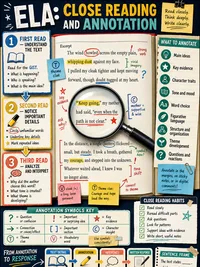
Drag across a word or phrase inside any line, choose the device chip, and click Tag Selection on that line.
2. Sonnet 18 (opening quatrain)
by William Shakespeare- 1
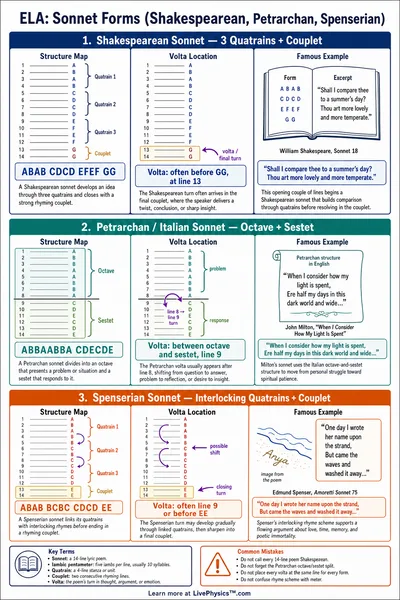
Shall I compare thee to a summer's day?
- 2
Thou art more lovely and more temperate:
- 3
Rough winds do shake the darling buds of May,
- 4
And summer's lease hath all too short a date.
No annotations yet. Highlight a phrase, choose a device chip, and click Tag.
3. TPCASTT Analysis
TPCASTT stands for Title, Paraphrase, Connotation, Attitude, Shift, Title (revisit), and Theme. Aim for at least 20 characters of substantive analysis per box.
Before you read the poem, what does the title make you think it will be about?
Restate the poem in your own words, line by line if it helps.
Look beyond the literal. Note imagery, figurative devices, sound, and word choice.
How does the speaker feel? Use precise tone words (wistful, defiant, tender).
Where (which line) does the tone or argument turn? What signals the change?
Now that you have read the poem, what new meaning does the title carry?
State the theme as a complete sentence. Use an abstract noun (hope, mortality, identity).
4. Score & Save Attempt
0
Devices tagged
0/7
Sections filled
0
Rubric score
Not yet
Level
What does each dimension measure?
- Annotation variety. 5+ annotations with at least 3 distinct devices.
- Form completeness. All seven TPCASTT boxes filled.
- Paraphrase depth. 60+ characters in the Paraphrase field.
- Theme quality. Theme includes an abstract noun.
- Tone and shift. Both Attitude and Shift boxes complete.
Data Table
(0 rows)| # | Trial | Poem | Devices Tagged | TPCASTT Sections | Rubric Score (out of 20) |
|---|
Reference Guide
The TPCASTT Method
T - Title (first reading). Predict what the poem is about based on the title alone.
P - Paraphrase. Restate the poem in plain language, line by line if it helps.
C - Connotation. Look at imagery, figurative devices, sound, and word choice.
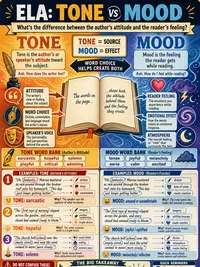
A - Attitude. Identify the speaker's tone using precise tone words.
S - Shift. Find the line where the tone or argument turns.
T - Title (revisit). Reread the title with the whole poem in mind.
T - Theme. State the central insight as a complete sentence.
Sound Devices
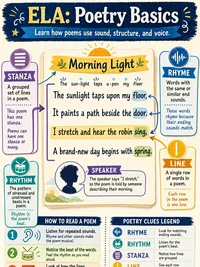
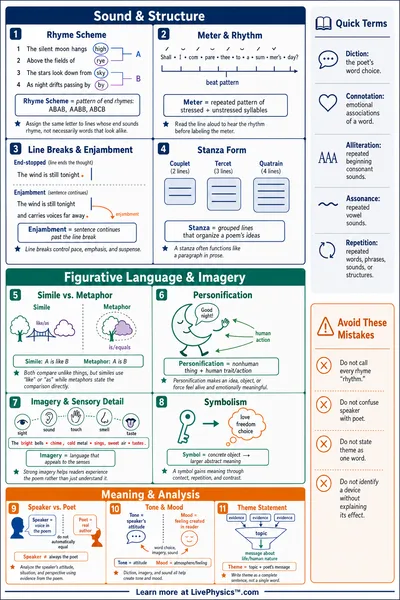
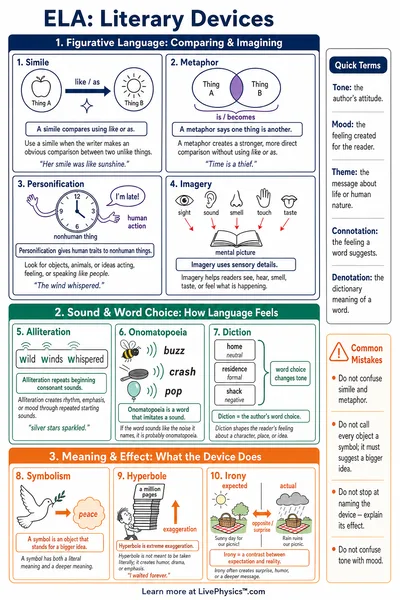
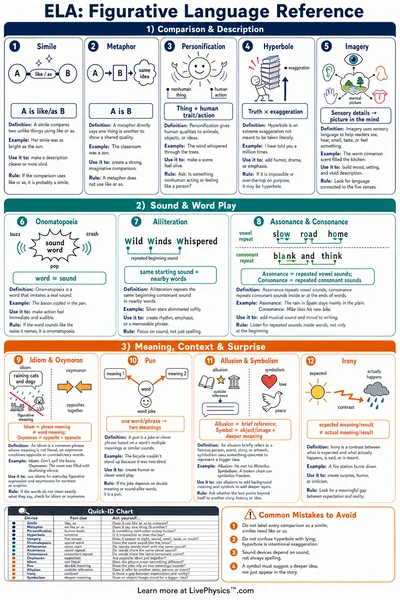
Alliteration. Repetition of the same initial consonant sound in nearby words. "Rough winds" in Sonnet 18 is a quick example.
Assonance. Repeated vowel sounds inside words. "Hope is the thing" leans on a long o.
Consonance. Repeated consonant sounds at any position in nearby words.
Onomatopoeia. Words whose sound imitates what they describe. Buzz, hiss, thud.
Repetition. A word or phrase repeated for emphasis or rhythm.
Figurative Language Devices
Metaphor. A direct comparison without "like" or "as." Sandburg writes that the fog comes on little cat feet.
Simile. A direct comparison using "like" or "as." Shakespeare opens with "shall I compare thee to a summer's day."
Personification. Giving human qualities to non-human things. Rough winds shake the buds of May.
Imagery. Sensory language that paints a picture in the reader's mind.
Symbol. A concrete thing that stands for an abstract idea. Frost's crow and snow stand in for sudden grace.
Hyperbole. Deliberate exaggeration for effect.
Apostrophe. Addressing an absent person, abstraction, or object directly.
Enjambment. A line of verse that runs over into the next line without pause.
Caesura. A pause inside a line, often marked by punctuation.
Identifying Theme
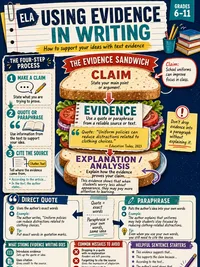
A theme is the central insight the poem makes about life. It is not the same as a subject. "Hope" is a subject. "Hope endures when the rest of life falls silent" is a theme.
Strong theme statements share three traits.
- They use an abstract noun such as hope, loss, identity, or change.
- They are complete sentences, not single words.
- They state an idea the poem leaves the reader with, not a plot summary.
When you write the Theme box, draft a one-sentence statement that another reader could use to recognize the poem's argument without seeing the title.