Quadratic Equation Solver
Solve , see the parabola graph, roots, vertex, and step-by-step solution. Updated in real-time.
Results
Roots(One Repeated Root)
Vertex
Axis of Symmetry
Y-Intercept
Discriminant
Reference Guide
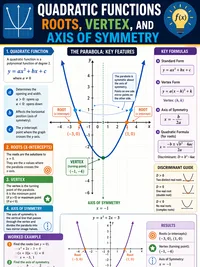
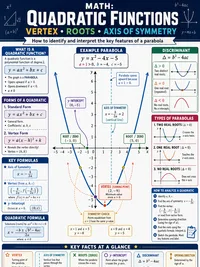
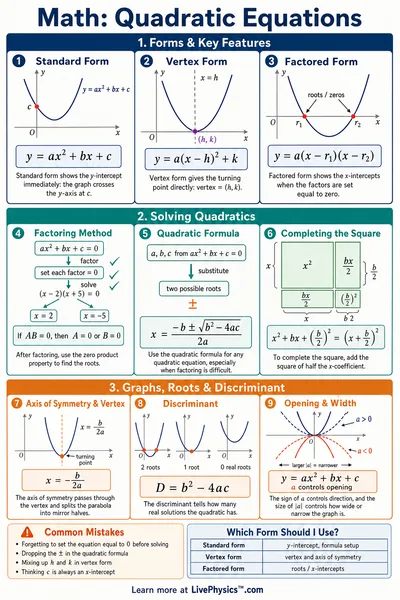
The Three Forms
Standard Form
Easiest to identify a, b, c for the quadratic formula.
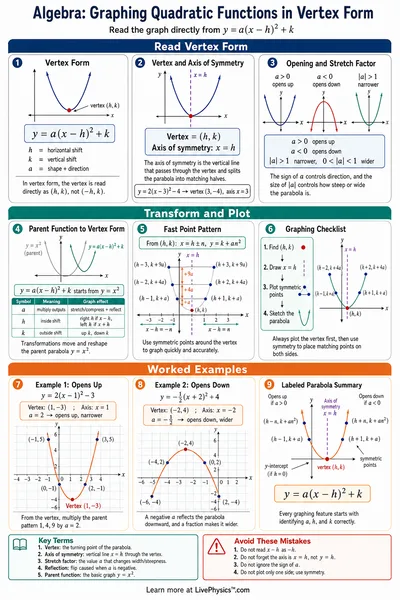
Vertex Form
Directly shows the vertex (h, k) and direction of opening.
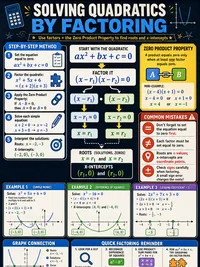
Factored Form
Directly shows the roots. Only possible when roots are real.
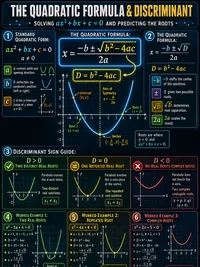
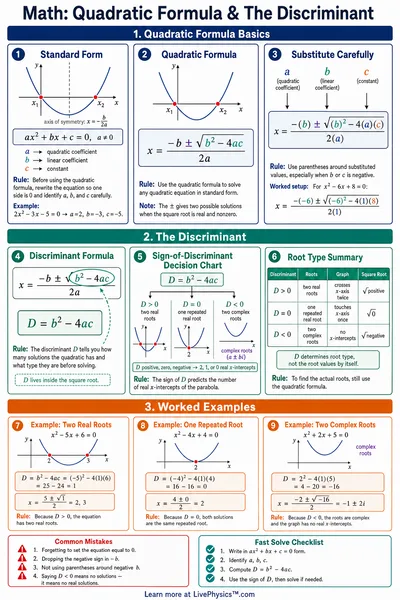
The Quadratic Formula
Use this when the equation can't be easily factored.
Steps
- Identify a, b, and c from standard form
- Calculate the discriminant
- Substitute into the formula and simplify
Understanding the Discriminant
Two distinct real roots. Parabola crosses x-axis twice.
One repeated root. Parabola touches x-axis at vertex.
Two complex roots. Parabola doesn't cross x-axis.
Vertex & Axis of Symmetry
Vertex formula
Axis of symmetry The vertical line
Parabola opens upward, vertex is the minimum
Parabola opens downward, vertex is the maximum
Related Content
Related Tools
MAP Growth Grade 3 Math Practice
Original independent MAP Growth Grade 3 Math skill practice with explanations, adjustable difficulty and first-attempt progress; no official RIT score.
MAP Growth Grade 4 Math Practice
Original independent MAP Growth Grade 4 Math skill practice with explanations, adjustable difficulty and first-attempt progress; no official RIT score.
MAP Growth Grade 5 Math Practice
Original independent MAP Growth Grade 5 Math skill practice with explanations, adjustable difficulty and first-attempt progress; no official RIT score.
MAP Growth Grade 6 Math Practice
Original independent MAP Growth Grade 6 Math skill practice with explanations, adjustable difficulty and first-attempt progress; no official RIT score.
Related Labs
Quadratic Functions & Parabolas Lab
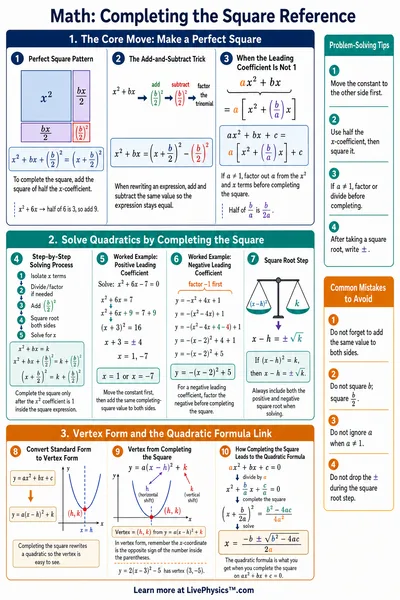
Explore standard, vertex, and intercept forms of quadratic functions. Find the vertex, axis of symmetry, roots, and discriminant. Complete the square and compare all three forms with an interactive parabola graph
Coordinate Geometry & Conics Lab
Prove quadrilateral properties using coordinates (distance, slope, midpoint). Explore parabolas, ellipses, hyperbolas, and circles. Classify conics from general equations using B²−4AC
Polynomial & Rational Functions Lab
Analyze polynomial roots, end behavior, and turning points. Explore rational functions with vertical/horizontal/oblique asymptotes and holes using interactive JSXGraph plots
Equation Balance & Intro Algebra Lab
Solve linear equations with a visual balance scale. Apply inverse operations step by step, handle variables on both sides, and verify solutions by substitution