Sign in to save

Bookmark this page so you can find it later.

Sign in to save

Bookmark this page so you can find it later.

Telescope Optics Explorer

Three modes: single telescope analysis with an optical ray diagram, side-by-side comparison of two telescopes, and an eyepiece finder that shows results for seven standard eyepiece focal lengths. Six presets from 10×50 binoculars to the Hubble Space Telescope.

Mode

Presets

mm
mm
mm
550 nm
380 nm750 nm

Optical Diagram

D = 200 mmf = 1200 mmf/6.025 mmEP48.0×

Optical Properties

200 mm | f/6.0 | 25 mm EP
48.0×
200 mm aperture, 1200 mm focal length
Rayleigh Resolution
0.69 ″
Dawes Limit
0.58 ″
Magnification
48.0×
Focal Ratio
f/6.0
True FOV
1.04°
Exit Pupil
4.17 mm
Limiting Magnitude
13.5 mag
Light Gathering
816×
Max Useful Mag
400×
Min Useful Mag
28.6×
Resolution
0.69″
Light Gathering
816×
Limiting Mag
13.5
Max Mag
400×

Reference Guide

Resolution and Dawes Limit

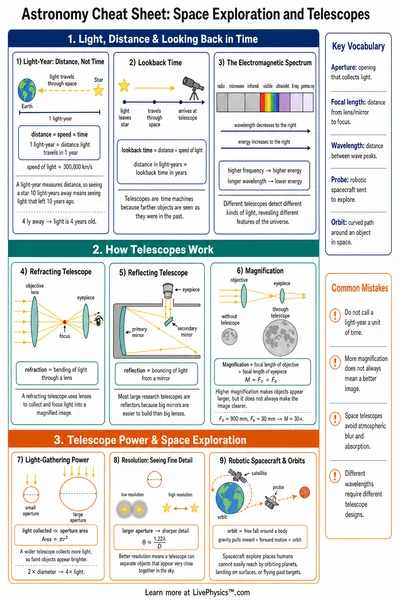
The Rayleigh criterion gives the smallest angle a telescope can resolve, set by diffraction at the aperture.

θ=1.22λD\theta = 1.22\,\frac{\lambda}{D}

In arcseconds, multiply by 206 265. For visible light (550 nm) through a 200 mm aperture, resolution is about 0.69″.

The Dawes limit is an empirical formula for resolving equal-brightness double stars.

θDawes=116D(mm)\theta_{\text{Dawes}} = \frac{116}{D\,(\text{mm})}

Magnification and Field of View

Magnification equals the objective focal length divided by the eyepiece focal length.

M=fobjfeyeM = \frac{f_{\text{obj}}}{f_{\text{eye}}}

The true field of view (TFOV) seen through the eyepiece equals the apparent field (AFOV, typically 50°) divided by magnification. Higher magnification gives a narrower view.

TFOV=AFOVM\text{TFOV} = \frac{\text{AFOV}}{M}

Maximum useful magnification is roughly 2× the aperture in mm. Above that, you magnify atmospheric blur more than detail. Minimum useful is D/7, where the exit pupil equals the eye's dark-adapted pupil (7 mm).

Light Gathering and Limiting Magnitude

A telescope collects light in proportion to the area of its aperture compared to the dark-adapted eye (7 mm pupil).

LGP=(DDeye)2\text{LGP} = \left(\frac{D}{D_{\text{eye}}}\right)^2

A 200 mm telescope gathers about 816 times more light than the naked eye, allowing you to see objects roughly 7.3 magnitudes fainter.

mlim=2+5log10(Dmm)m_{\text{lim}} = 2 + 5\,\log_{10}(D_{\text{mm}})

The limiting magnitude formula estimates the faintest star visible through the scope under ideal conditions.

Choosing Eyepieces

The exit pupil is the diameter of the light cone leaving the eyepiece and entering your eye.

EP=DM\text{EP} = \frac{D}{M}

If the exit pupil exceeds 7 mm (dark-adapted pupil), light is wasted. If it falls below about 1 mm, the image becomes uncomfortably dim and eye floaters become visible.
Eyepiece useTypical focal length
Wide-field / sweeping 32 - 40 mm
General observing 17 - 25 mm
Planetary detail 8 - 12 mm
High-power doubles 4 - 6 mm

Related Content

Related Tools

Earthquake Magnitude Calculator
Four modes: magnitude scales (Richter Mₗ, moment magnitude M𝑤, energy), energy comparison (each step = 31.6× more energy, logarithmic bar chart), Modified Mercalli Intensity I-XII with descriptions, and Richter magnitude from seismograph amplitude. Presets include Minor M3 through Great M8, 1906 San Francisco M7.9, and 2011 Japan M9.1.
Carbon Footprint Calculator
Estimate annual CO₂ emissions from transportation (car miles, fuel type, flights), home energy (electricity, heating, AC), diet (meat consumption, food waste), and lifestyle (shopping, recycling). Pie chart breakdown, country comparison bar chart, trees-to-offset and equivalent-driving metrics. Five presets: Average American, Eco-Conscious, Heavy Commuter, Frequent Flyer, Work from Home.
Star Lifecycle Visualizer
Three modes: interactive HR diagram with 23 real stars (click to see properties), stellar evolution pathway from nebula to end state (white dwarf, neutron star, or black hole based on initial mass), and star properties calculator (luminosity L∝M^3.5, radius, lifetime t∝M^-2.5, apparent magnitude). Six presets: Sun, Red Dwarf (0.3 M☉), Sirius A (2 M☉), Blue Giant (20 M☉), Betelgeuse (15 M☉), Supergiant (50 M☉). Includes spectral class colour strip and SVG star visualization.
H-R Diagram Explorer
Three modes: plot a single star on the Hertzsprung-Russell diagram from temperature, radius, and mass (Stefan-Boltzmann luminosity, spectral class O-M, absolute magnitude, HR region); compare multiple stars side by side; and browse the spectral atlas with typical properties for each class. 23 reference stars plotted, 6 presets from Proxima Centauri to Rigel.