Tessellation & Tiling Studio
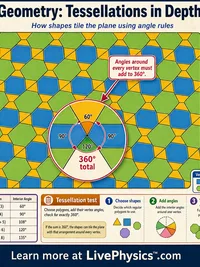
Move the slider to test which regular polygons tile the plane on their own, then switch tilings to see triangles, squares, hexagons, and the semi-regular Archimedean patterns rendered as repeating shapes. A highlighted vertex shows the angles meeting there adding up to exactly 360 degrees.
Which regular polygons tessellate?
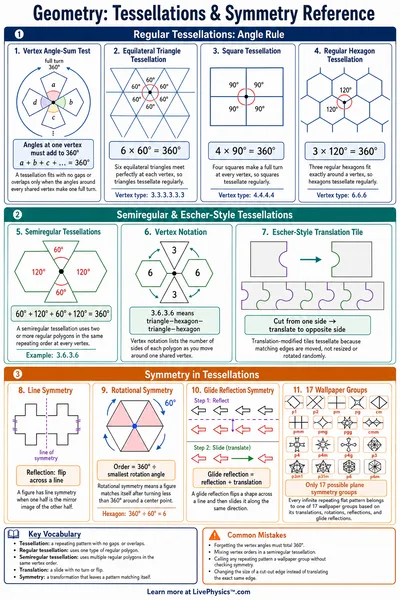
A regular polygon tiles the plane alone only when copies meet at a point and their interior angles add up to exactly 360°.
Only the triangle, square, and hexagon tile the plane alone, because only 60°, 90°, and 120° divide 360° into a whole number of copies.
Tiling viewer
Pick a tiling. Each repeating pattern fills the plane edge to edge. The highlighted vertex shows the polygons meeting there and that their angles sum to exactly 360°.
The Mathematics of Tessellation
What a Tessellation Is
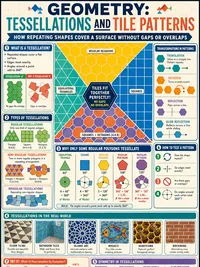
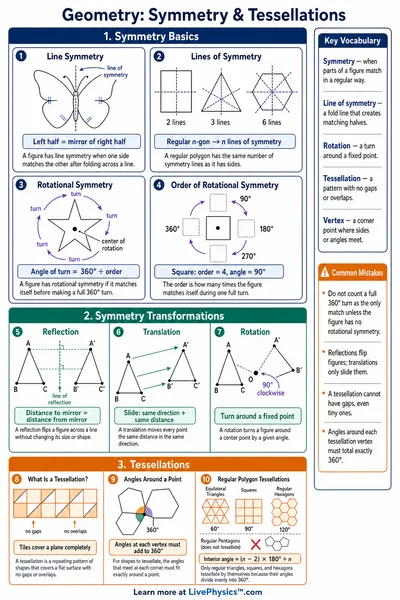
A tessellation, or tiling, covers a flat surface with shapes that fit together with no gaps and no overlaps and continue forever in every direction. Floor tiles, brick walls, and honeycomb are everyday tessellations.
A tiling is called edge to edge when each shape shares a full edge with its neighbor, never a partial edge. All of the tilings in this studio are edge to edge.
The 360 Degree Vertex Rule
Wherever corners of shapes meet at a point, called a vertex, the interior angles must add up to exactly 360 degrees. If they sum to less, a gap is left. If they sum to more, the shapes overlap.
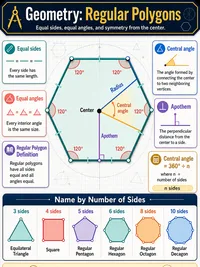
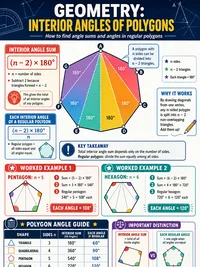
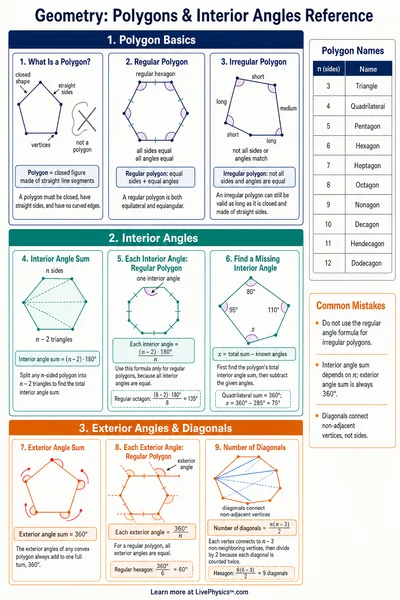
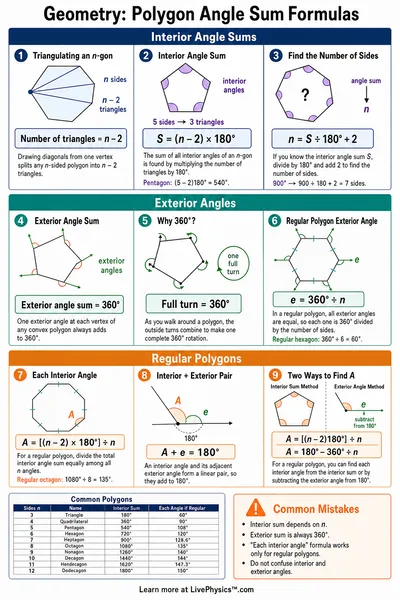
The interior angle of a regular polygon with n sides is (n - 2) × 180° ÷ n. A square has four 90 degree corners that meet four to a vertex, which is why 4 × 90° = 360°.
Why Only Three Regular Polygons Tile Alone
For copies of a single regular polygon to meet exactly at a vertex, 360° must divide evenly by the interior angle. That happens only for three shapes.
| Polygon | Interior angle | Copies at a vertex |
|---|---|---|
| Triangle | 60° | 6 |
| Square | 90° | 4 |
| Pentagon | 108° | 3.33 (gap) |
| Hexagon | 120° | 3 |
The pentagon fails because 360° ÷ 108° = 3.33..., which is not a whole number, so three pentagons leave a wedge of empty space.
Semi-Regular and Vertex Configuration Notation
A semi-regular or Archimedean tiling uses two or more kinds of regular polygon, arranged so that every vertex looks the same. There are exactly eight of them.
Each tiling is named by its vertex configuration, which lists the polygons around one vertex in order. The trihexagonal tiling is written 3.6.3.6, meaning a triangle, a hexagon, a triangle, and a hexagon meet at each corner.
The truncated square tiling 4.8.8 pairs squares with octagons, so 90° + 135° + 135° = 360° at each vertex.