Understanding Binary Tree Traversal Visualizer
Each node in a binary tree can point to no more than two children, called left and right. This limit gives the structure a clear shape, even when some nodes have only one child or none. A child is itself the root of another smaller tree.
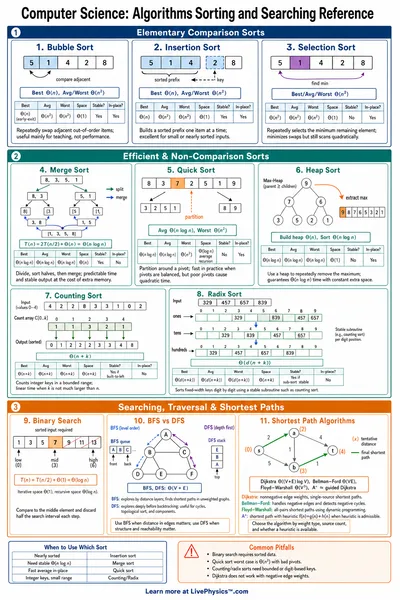
In a binary search tree, values smaller than a node belong on its left side, while larger values belong on its right side. That rule lets a program discard half of the remaining choices at each well balanced step. The rule is local, yet it applies through every subtree.
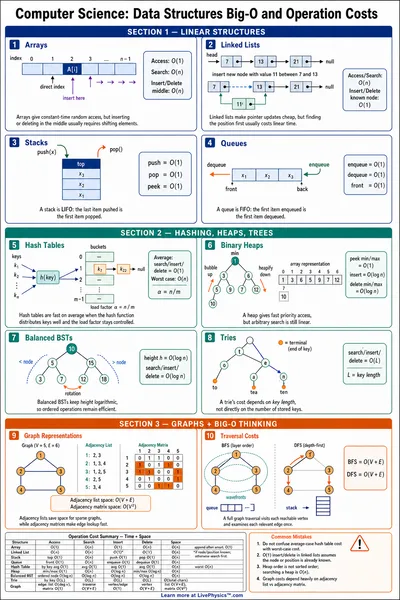
Traversal does not depend on the search tree rule. It works on any binary tree, but a badly unbalanced search tree can resemble a linked list and make searching much slower. Balanced trees keep their height relatively small.
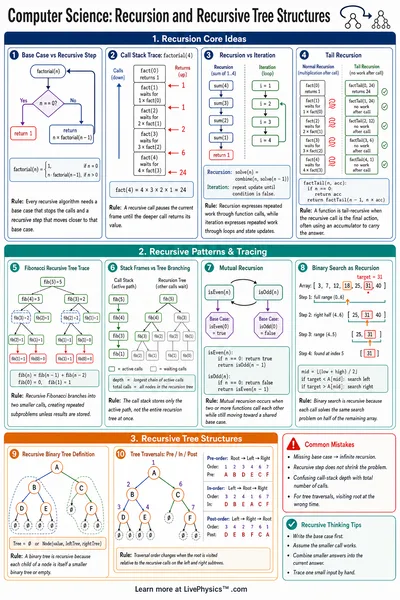
Many traversal methods are naturally written with recursion. A function handles one node, calls itself for a child subtree, then returns when that subtree has no more nodes to visit. The empty child is the base case that stops the calls.
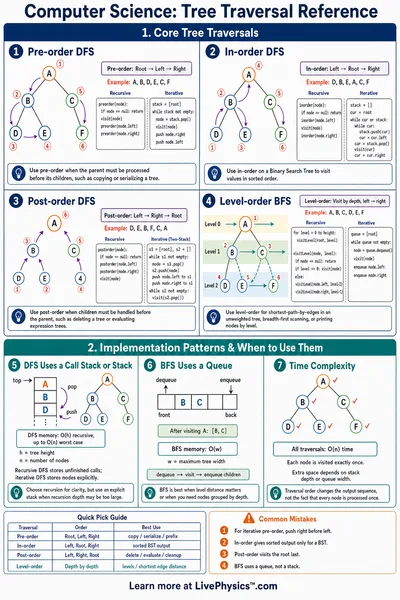
Inorder processes the left subtree before the node, then processes the right subtree. For a valid binary search tree, the resulting values appear in sorted order, which makes this traversal useful for checking the ordering rule. It can produce a sorted report without running a separate sorting algorithm.
Preorder handles a node before either of its subtrees. It is useful when saving or copying a tree because the first value encountered can describe the root of each subtree. The root-first choice preserves the tree's branching pattern in the visit sequence.
Postorder waits until both subtrees are handled before processing their parent. This order suits deletion, since a program can remove children before removing the links and data held by the parent. It is common in expression trees, where child calculations must finish first.
Level-order moves across one depth of the tree before going deeper. It normally uses a queue, where the first node added is the first removed, rather than recursion's return path. This makes it the standard breadth-first method.
When a node leaves the queue, its existing children enter at the back. This preserves left to right order within a level and explains why nearby nodes are visited close together.
During a visual trace, follow the highlighted edge as carefully as the highlighted node. The edge shows whether the algorithm is descending into a child or returning to a parent after finishing work.
Different programs need a rule for duplicate values, because a search tree must decide which side receives an equal value. A visualizer may place equals consistently on one side, but other code may store a count in one node.
Trees appear in folder systems, expression evaluators, autocomplete indexes, and decision processes. Learning the visit order matters because it affects output, memory use, and the moment when a program safely performs an action.