Students practice using income, expenses, savings goals, and simple decision-making to create realistic budgets and saving plans.
Read each problem carefully. Show your work in the space provided and explain your reasoning when asked.
Practice making budgets, tracking spending, and building savings habits
Financial Literacy - Grade 6-8
- 1
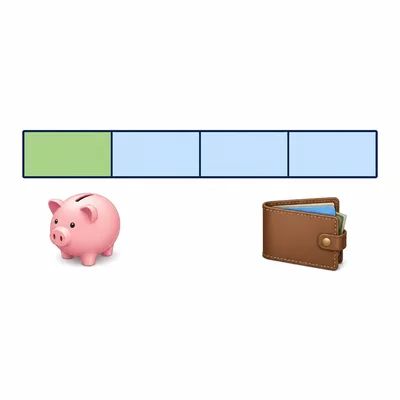
Maya earns $60 each week from babysitting. She wants to save 25% of her weekly income. How much should Maya save each week, and how much will she have left to spend?
- 2
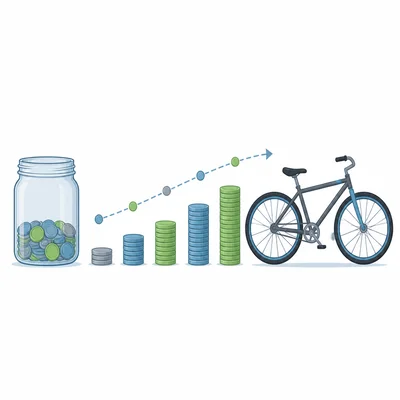
Jordan has $120 saved. He wants to buy a bike that costs $300. If he saves $30 each month, how many more months will it take him to reach his goal?
- 3
A student has a monthly allowance of $80. The student spends $20 on snacks, $15 on games, and $10 on school supplies. How much money is left at the end of the month?
- 4
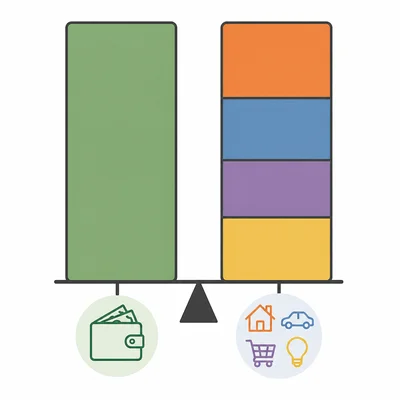
Look at this simple monthly budget: Income: $100. Savings: $20. Food: $25. Entertainment: $30. School supplies: $15. Is the budget balanced, under budget, or over budget? Explain.
- 5
Elena wants to save $150 for a new tablet. She already has $45. She can save $15 each week. Write an equation that shows how many weeks, w, she needs to save, then solve it.
- 6
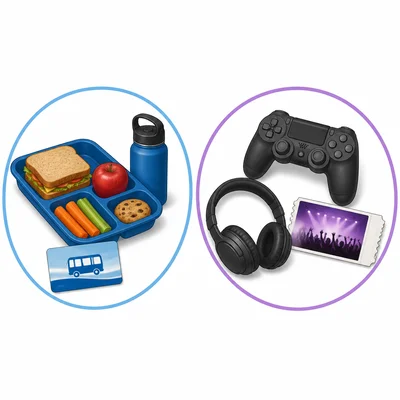
Which is a need and which is a want: buying lunch for school, buying a new video game, paying for a bus pass, and buying concert tickets? Sort each item and explain one choice.
- 7

Sam receives $40 for a birthday. He wants to use the 50-30-20 rule: 50% for needs, 30% for wants, and 20% for savings. How much money should go into each category?
- 8
A school club is planning a party. The club has $200. Decorations cost $35, snacks cost $85, and games cost $50. How much money will the club have left after paying for everything?
- 9

Lena is comparing two savings plans. Plan A saves $10 each week. Plan B starts with $25 and saves $5 each week. After 6 weeks, which plan has more money saved?
- 10
A student buys a $14 movie ticket and a $6 snack. The student pays with a $25 gift card. How much money remains on the gift card?
- 11

Tariq wants to save for a $96 pair of shoes. He plans to save $12 per week. Make a savings table for weeks 1 through 4, then state whether he will have enough after 4 weeks.
- 12
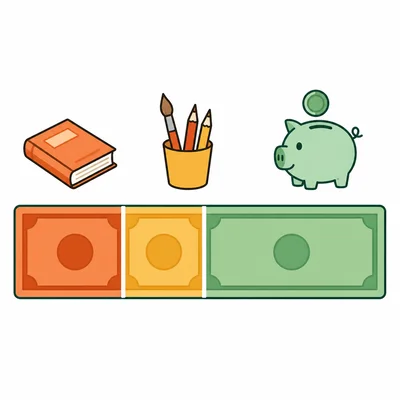
Nia has $75. She spends $18 on a book and $22 on art supplies. She wants to save the rest. What percent of her original money will she save? Round to the nearest whole percent.
- 13
A budget shows $50 for clothing each month. In March, Kai spends $62 on clothing. How much over budget is Kai, and what is one way Kai could adjust next month?
- 14
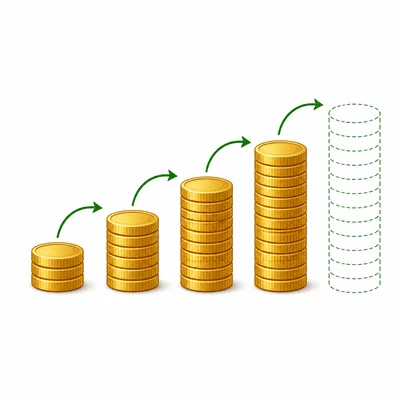
A savings account balance is shown for four months: January $40, February $65, March $90, and April $115. How much is being added each month, and what would the balance be in May if the pattern continues?
- 15

Write a short budget plan for someone who earns $100 in a month and wants to save at least $20. Include at least three spending categories and make sure the total does not go over $100.