Practice analyzing sequences and series using limits, convergence tests, Taylor series, and power series intervals of convergence.
Read each problem carefully. Show your reasoning, including the convergence test or method you use.
Convergence, divergence, and power series
Calculus - Grade advanced
- 1
Determine whether the sequence a_n = (3n^2 - 5)/(2n^2 + n + 1) converges. If it converges, find its limit.
- 2
Determine whether the sequence b_n = (-1)^n n/(n + 1) converges or diverges.
- 3
Use the nth-term test to determine whether the series sum from n = 1 to infinity of n/(n + 2) diverges.
- 4
Determine whether the geometric series sum from n = 0 to infinity of 5(2/3)^n converges. If it converges, find its sum.
- 5
Determine whether the p-series sum from n = 1 to infinity of 1/n^(3/2) converges or diverges.
- 6
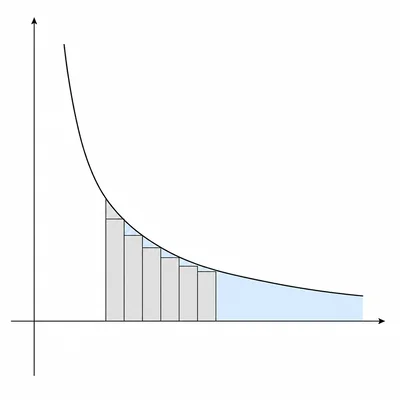
Use the integral test to determine whether the series sum from n = 2 to infinity of 1/(n ln n) converges or diverges.
- 7
Use the comparison test to determine whether the series sum from n = 1 to infinity of 1/(n^2 + 4) converges or diverges.
- 8
Use the limit comparison test with sum from n = 1 to infinity of 1/n to determine whether the series sum from n = 1 to infinity of (3n + 1)/(n^2 + 5) converges or diverges.
- 9
Determine whether the alternating series sum from n = 1 to infinity of (-1)^(n + 1)/n converges absolutely, converges conditionally, or diverges.
- 10
Use the ratio test to determine whether the series sum from n = 1 to infinity of n!/5^n converges or diverges.
- 11
Use the root test to determine whether the series sum from n = 1 to infinity of (4n/(5n + 1))^n converges or diverges.
- 12
Find the radius and interval of convergence for the power series sum from n = 0 to infinity of (x - 2)^n/3^n.
- 13
Find the radius and interval of convergence for the power series sum from n = 1 to infinity of n(x + 1)^n/4^n.
- 14
Write the first four nonzero terms of the Maclaurin series for e^x, then use it to approximate e^0.2.
- 15
Find the Taylor series for f(x) = 1/(1 - x) centered at x = 0, and state its interval of convergence.