Practice identifying assumptions, conclusions, and logical steps in direct and indirect proofs.
Read each problem carefully. Write clear logical steps and justify each conclusion. Show your work in the space provided.
Writing logical arguments using direct proof and proof by contradiction
Math - Grade 9-12
- 1
State the hypothesis and conclusion of this conditional statement: If a number is divisible by 6, then it is divisible by 3.
- 2
Write a direct proof of the statement: If n is an even integer, then n + 4 is even.
- 3
Write a direct proof of the statement: If a and b are odd integers, then a + b is even.
- 4
A student begins a proof with this sentence: Assume x is an integer and x is divisible by 10. What type of proof is the student most likely writing if the goal is to prove x is divisible by 5?
- 5

Write the first sentence of an indirect proof of this statement: If two lines are perpendicular, then they intersect at a right angle.
- 6
Use an indirect proof to prove: If n is an integer and n is odd, then n is not divisible by 2.
- 7
Decide whether a direct proof or an indirect proof is more natural for this statement, and explain your choice: There is no smallest positive real number.
- 8
Complete the missing step in this direct proof: If n is divisible by 4, then n is even. Assume n is divisible by 4. Then n = 4k for some integer k. Since 4k = 2(____), n is even.
- 9
Write the contrapositive of this statement: If a triangle is equilateral, then it is isosceles.
- 10
Prove the statement by proving its contrapositive: If n squared is even, then n is even.
- 11
Find the error in this proof: Claim: If n is even, then n + 1 is even. Proof: Assume n is even, so n = 2k. Then n + 1 = 2k + 1, which is even. Therefore, n + 1 is even.
- 12
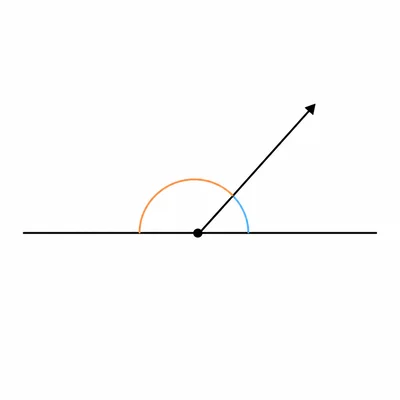
Use an indirect proof to prove: If two angles form a linear pair, then they cannot both be acute.