Practice making smart money choices by sorting needs and wants, planning savings, and deciding when to spend.
Read each problem carefully. Think about the best money choice. Show your work in the space provided.
Practice choosing between needs, wants, saving, and spending
Financial Literacy - Grade 2-3
- 1

Mia has $5. She can buy a notebook for school for $3 or a toy ring for $3. The notebook is needed for class tomorrow. Which choice should Mia make first, and why?
- 2

Jay earns $2 each week for helping at home. He wants to save $8 for a soccer ball. How many weeks will Jay need to save if he saves all of his money each week?
- 3

Circle the items that are needs: winter coat, candy bar, toothbrush, video game, lunch.
- 4

Lena has $10. She wants a book that costs $6 and stickers that cost $4. Can she buy both items? Explain your answer.
- 5

Aiden has $7. He can spend $5 on a toy car today, or he can save the $5 toward a $12 art set. What is one good reason to save the money instead of spending it today?
- 6
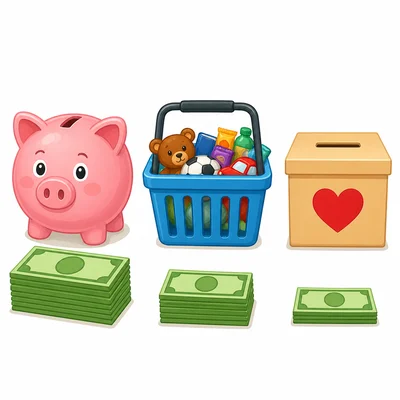
Look at this money plan: Save $3, Spend $2, Give $1. How much money does the plan use in all?
- 7

Sofia wants a jump rope that costs $9. She has already saved $4. How much more money does she need to save?
- 8

Ben gets $6 for his birthday. He spends $2 on a snack. How much money does Ben have left?
- 9

Nora sees a puzzle for $8. She has $8, but she is also saving for a bike bell that costs $10. If she buys the puzzle, how much money will she have left for the bike bell?
- 10

A class is collecting coins for a field trip. Sam brings 3 quarters. Each quarter is worth 25 cents. How many cents did Sam bring?
- 11

Which choice shows saving? Choice A: Kim puts $4 in her piggy bank. Choice B: Kim spends $4 on gum. Explain your answer.
- 12

Eli has $12. His money plan is to save half and spend half. How much should Eli save, and how much should he spend?
- 13
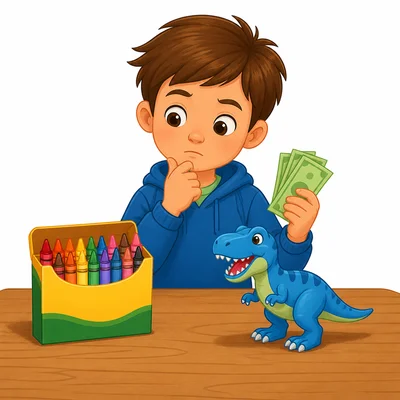
Grace wants to buy crayons for $3 and a small toy for $5. She has $6. Which item can she buy now without borrowing money? Explain.
- 14
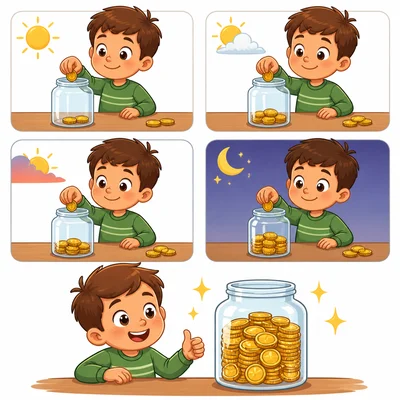
Marcus saves $1 on Monday, $1 on Tuesday, $2 on Wednesday, and $2 on Thursday. How much did he save in all?
- 15

Tara has $9. She needs socks for $4 and wants a comic book for $6. Can she buy both? What is a smart choice?