Practice using the magnetic force equation and the right-hand rule to analyze moving charges in magnetic fields.
Read each problem carefully. Show your work, include units, and state directions when asked.
Calculating force magnitude, direction, and charged particle motion in magnetic fields
Physics - Grade 9-12
- 1
A proton moves at 2.0 x 10^6 m/s through a magnetic field of 0.30 T. The velocity is perpendicular to the field. Calculate the magnitude of the magnetic force on the proton.
- 2
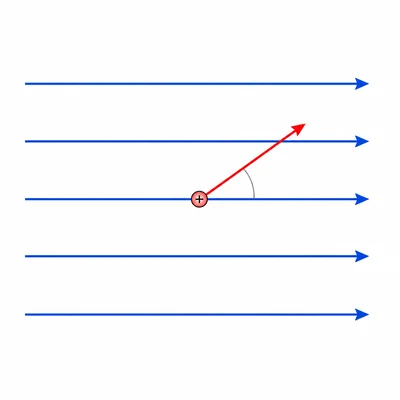
An electron moves at 5.0 x 10^5 m/s through a 0.80 T magnetic field. The electron's velocity makes a 30° angle with the field. Calculate the magnitude of the magnetic force.
- 3
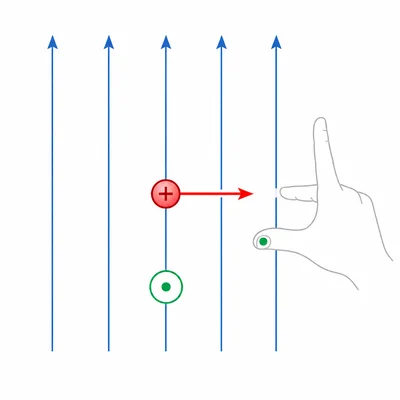
A positive charge moves east through a magnetic field directed north. Use the right-hand rule to determine the direction of the magnetic force.
- 4
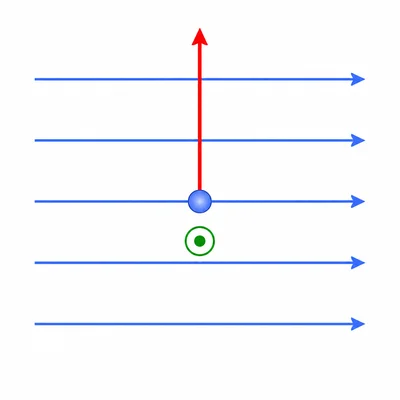
An electron moves north through a magnetic field directed east. Determine the direction of the magnetic force on the electron.
- 5
A particle with charge +2.0 μC moves at 3.0 x 10^4 m/s perpendicular to a 0.50 T magnetic field. Calculate the force magnitude.
- 6
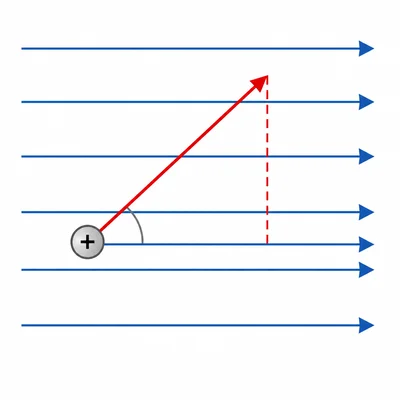
A charge of +1.6 x 10^-19 C moves at 2.0 x 10^6 m/s through a 0.25 T magnetic field at an angle of 30° to the field. Calculate the magnetic force magnitude.
- 7
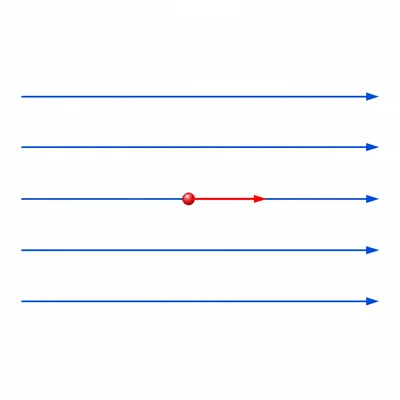
A charged particle moves exactly parallel to a uniform magnetic field. State the magnetic force on the particle and explain why.
- 8
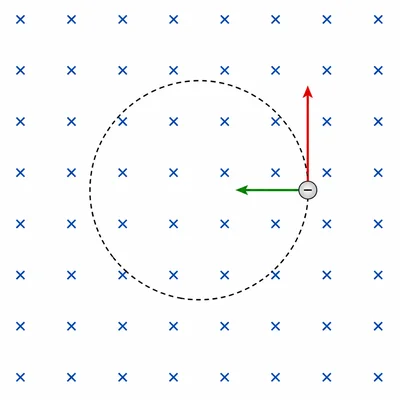
An electron enters a uniform 0.020 T magnetic field with a speed of 4.0 x 10^6 m/s perpendicular to the field. Calculate the radius of its circular path.
- 9
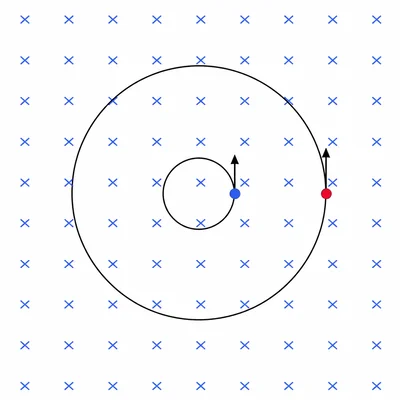
A proton and an electron move at the same speed perpendicular to the same magnetic field. Compare the radii of their circular paths.
- 10
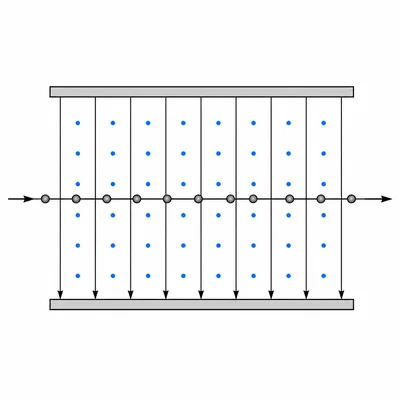
In a velocity selector, an electric field of 2.4 x 10^4 N/C balances a magnetic field of 0.080 T so that charged particles pass through undeflected. Calculate the speed of the particles that pass through.
- 11
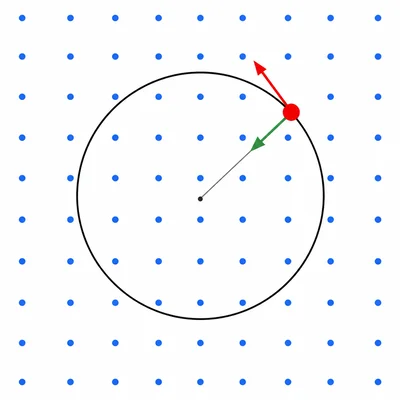
A singly charged positive ion moves at 2.0 x 10^5 m/s in a 0.40 T magnetic field and follows a circular path with radius 0.12 m. Calculate the mass of the ion.
- 12
An alpha particle has charge +3.2 x 10^-19 C and mass 6.64 x 10^-27 kg. It moves at 1.0 x 10^6 m/s perpendicular to a 0.50 T magnetic field. Calculate the force magnitude and acceleration magnitude.
- 13
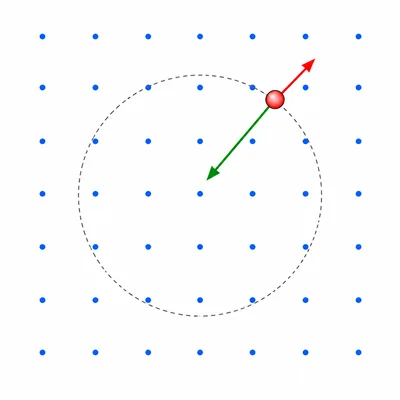
A charged particle moves through a uniform magnetic field. Explain why the magnetic force can change the particle's direction but not its speed.
- 14
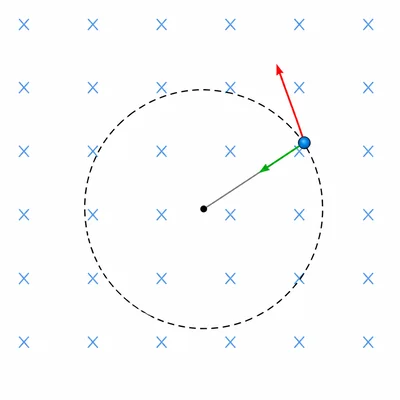
An electron moves perpendicular to a magnetic field with speed 3.0 x 10^6 m/s. The radius of its circular path is 0.050 m. Calculate the magnetic field strength.
- 15
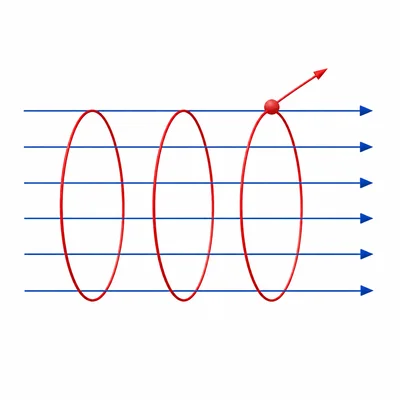
A proton moves in a uniform 0.20 T magnetic field. Its perpendicular velocity component is 4.0 x 10^5 m/s and its parallel velocity component is 3.0 x 10^5 m/s. Calculate the radius of the helical path and the distance advanced along the field in one cycle.