Practice using simple harmonic motion models to solve problems involving springs and pendulums.
Read each problem carefully. Show your work in the space provided. Use g = 9.8 m/s^2 unless a problem states otherwise.
Analyzing springs, pendulums, period, frequency, and energy
Physics - Grade 9-12
- 1
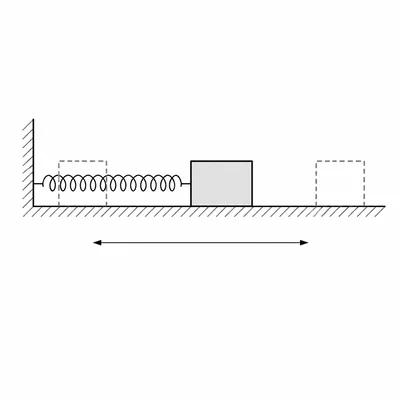
A 0.50 kg mass is attached to a spring with spring constant 200 N/m. Calculate the period of the mass-spring oscillator.
- 2
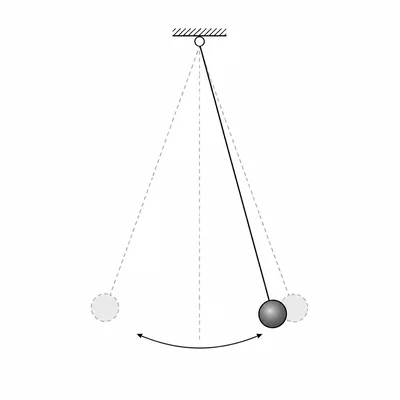
A simple pendulum has a length of 1.00 m. Calculate its period and frequency for small oscillations.
- 3
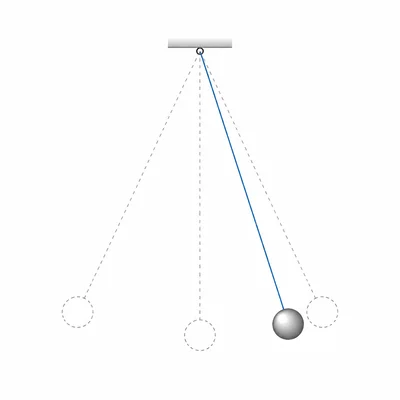
A pendulum has a period of 3.0 s. Calculate the length of the pendulum.
- 4
A 0.25 kg mass on a spring completes one full cycle every 0.50 s. Calculate the spring constant.
- 5
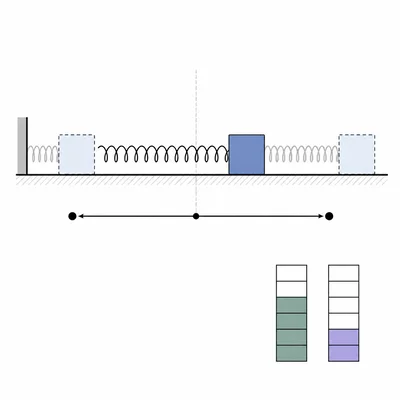
A spring with spring constant 80 N/m oscillates with an amplitude of 0.10 m. Find the total mechanical energy of the oscillator. Then find the spring potential energy and kinetic energy when the displacement is 0.06 m.
- 6
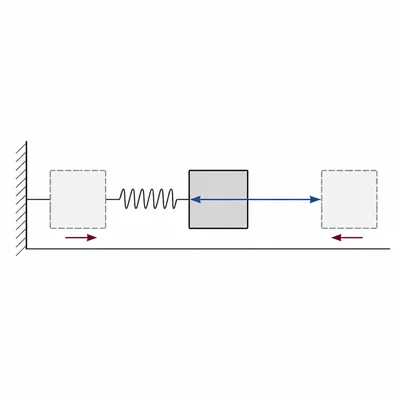
A mass-spring oscillator has an amplitude of 0.15 m and a period of 1.20 s. Calculate the maximum speed and maximum acceleration of the mass.
- 7
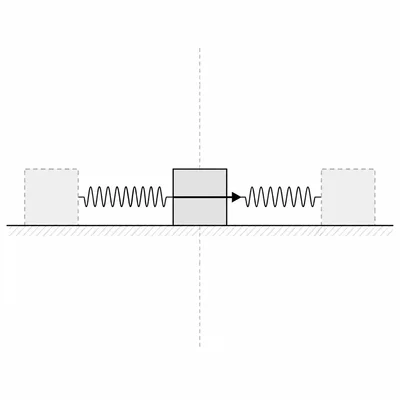
For a mass on a spring moving in simple harmonic motion, describe the speed, acceleration, and force when the mass is at the equilibrium position.
- 8
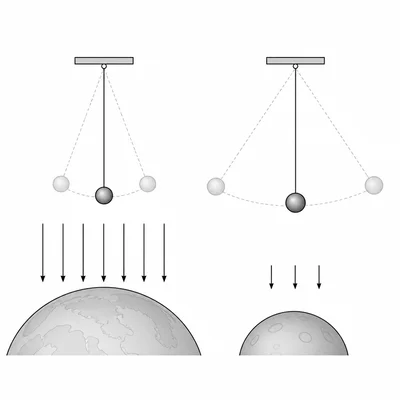
A pendulum is moved from Earth to a planet where the acceleration due to gravity is smaller. Explain what happens to the pendulum's period if its length stays the same.
- 9
A student counts 15 complete oscillations of a mass-spring system in 30.0 s. Calculate the period and frequency.
- 10
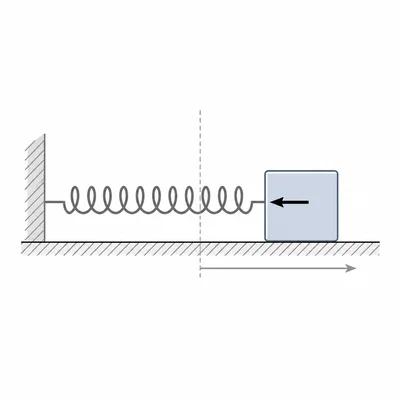
A 0.20 kg mass attached to a spring with spring constant 50 N/m is displaced 0.040 m to the right of equilibrium. Taking right as positive, calculate the acceleration at that instant.
- 11
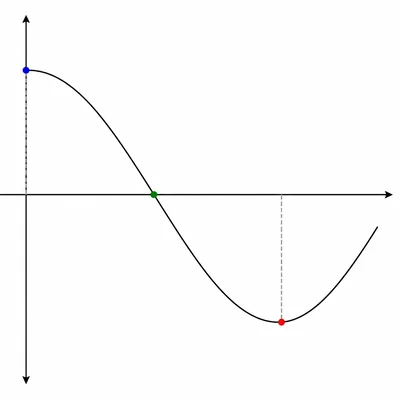
The position of an oscillator is modeled by x(t) = A cos(ωt). Its amplitude is 0.050 m and its period is 0.80 s. If the object starts at maximum positive displacement, find its position at t = 0.20 s and at t = 0.40 s.
- 12
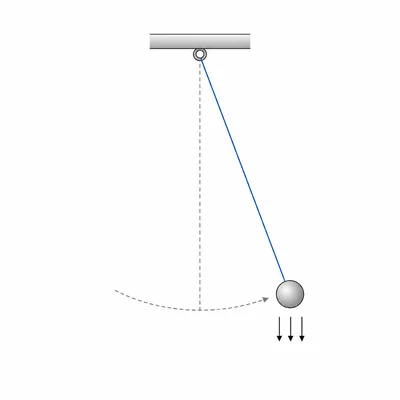
A pendulum of length 0.75 m has a measured period of 1.74 s. Use the data to calculate the experimental value of g.