Understanding Energy Conservation Explorer
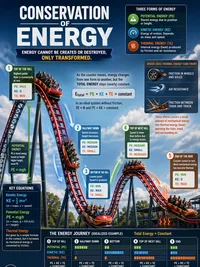
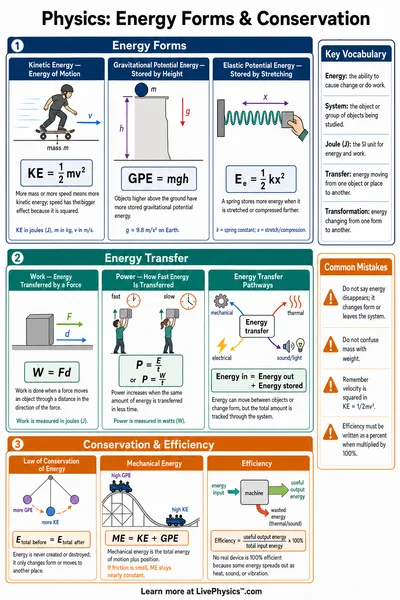
Energy is best understood as a way of keeping track of what an object can do. A moving cart can push, collide, or climb because it has kinetic energy. A raised cart can move downward because gravity can pull it through a distance.
The amount transferred depends on mass, speed, height, and the strength of the gravitational field. Speed matters especially strongly because kinetic energy depends on speed squared. Doubling speed gives four times as much kinetic energy, so fast motion can be far more energetic than it first appears.
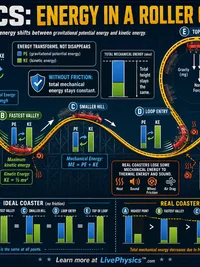
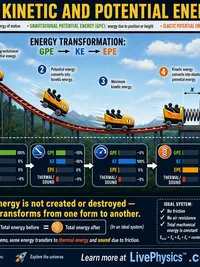
On a smooth ramp, gravity changes the direction of motion and transfers energy between motion and height. As an object rises, it slows because its kinetic energy becomes gravitational potential energy. At the highest point, its speed may briefly become zero, but its energy has not vanished.
It is stored in the object's position above a chosen reference level. The choice of zero height is arbitrary, yet changes in height are what determine the energy transfer. This is why only differences in potential energy matter in most calculations.
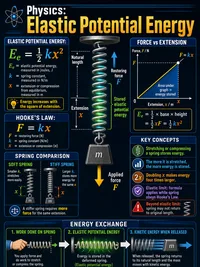
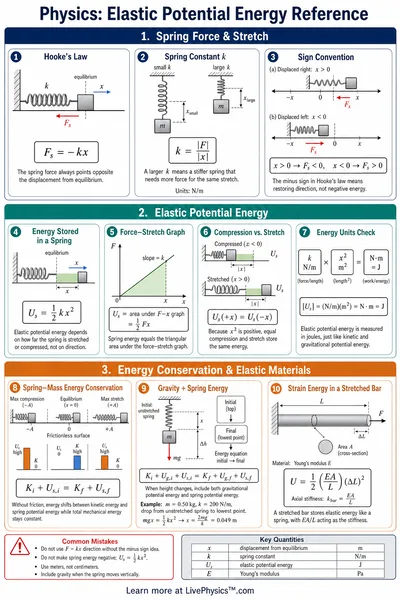
A spring stores energy when it is compressed or stretched. The spring pushes back because its material resists being changed from its natural length. A small stretch stores some elastic energy, while a larger stretch stores much more.
In an ideal spring, doubling the stretch gives four times the stored energy. When released, that stored energy can accelerate an object, launch it upward, or keep it oscillating back and forth. Real springs eventually lose some energy through internal friction and sound.
Friction does not destroy energy, even though it can make useful motion disappear. It transfers organized mechanical energy into tiny random motions of atoms, which we notice as warming. Air resistance works similarly by stirring and warming the surrounding air.
This transfer explains why a roller coaster cannot return to its starting height without extra energy from a lift or motor. It also explains why brakes become hot. When studying energy, identify the system carefully and include thermal energy when friction is present.
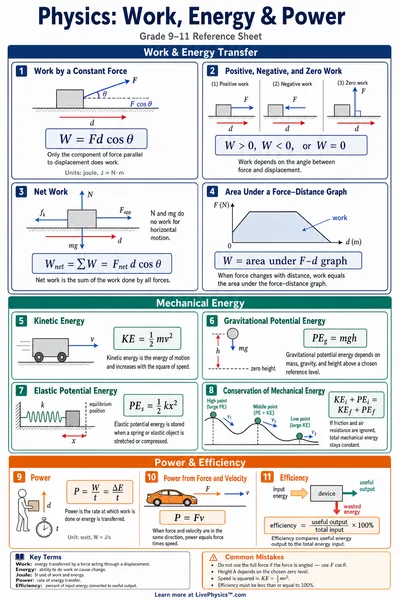
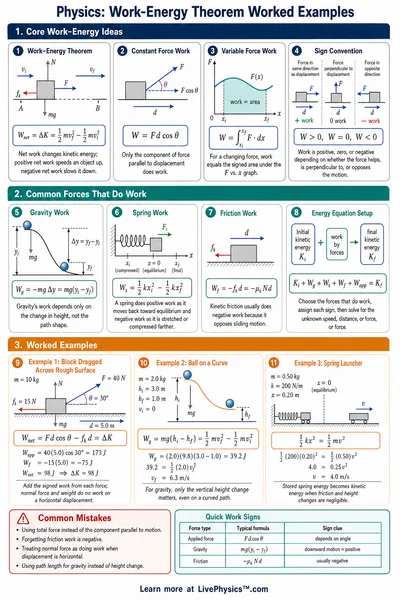
The work energy idea connects forces to changes in motion. Work is done when a force acts through a distance in its direction. A push in the direction of travel adds kinetic energy, while a force opposite the motion removes it.
Gravity does positive work during a descent and negative work during a climb. The normal force from a track usually does no work because it acts sideways to the motion. This detail helps students avoid assuming that every force must change an object's energy.
Energy accounting is useful beyond ramps and springs. A cyclist converts chemical energy from food into motion, heat, and sound. A phone battery transfers stored chemical energy into electrical energy, light, and unwanted heat.
In homes, insulation slows energy transfer to keep indoor temperatures steadier. In every case, the total energy is accounted for when all relevant forms and surroundings are included.
The difficult part is not memorising a list of energy types. It is following where energy enters, leaves, and changes form.