Practice using density, mass, volume, and buoyant force to explain why objects sink, float, or stay suspended in fluids.
Read each problem carefully. Show your work when calculations are needed, and explain your reasoning in complete sentences.
Exploring why objects sink, float, and balance in fluids
Science - Grade 6-8
- 1
A block has a mass of 120 grams and a volume of 60 cubic centimeters. What is its density?
- 2
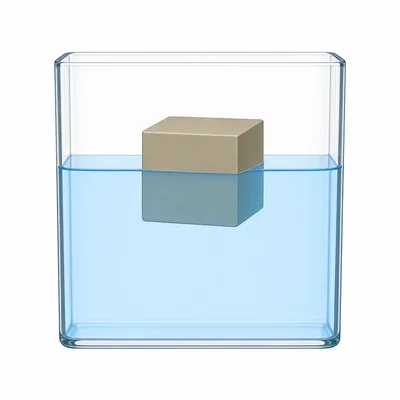
Water has a density of about 1 g/cm³. If a solid object has a density of 0.7 g/cm³, will it sink or float in water? Explain.
- 3
A metal cube has a mass of 270 grams and a volume of 30 cubic centimeters. A plastic cube has a mass of 40 grams and a volume of 50 cubic centimeters. Which cube is denser?
- 4
Explain the difference between mass and volume in your own words.
- 5
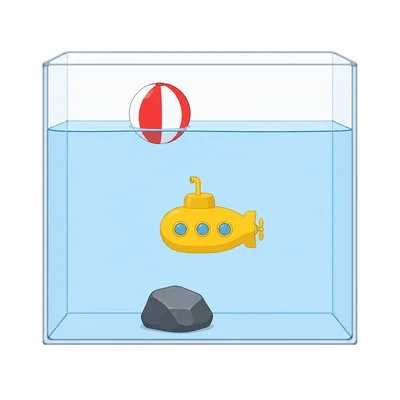
A student places three objects in water. Object A floats high on the surface, Object B floats with most of it underwater, and Object C sinks to the bottom. Rank the objects from lowest density to highest density.
- 6
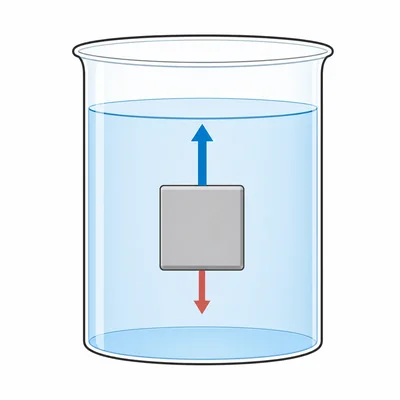
What is buoyant force, and what direction does it act on an object in a fluid?
- 7
A rock weighs 15 newtons in air. When it is completely submerged in water, it appears to weigh 9 newtons. What is the buoyant force on the rock?
- 8
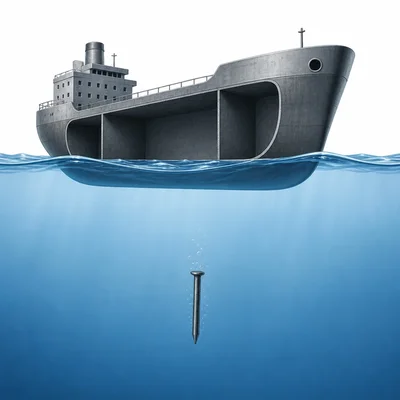
A large ship made of steel can float, even though a small steel nail sinks. Explain how this is possible.
- 9
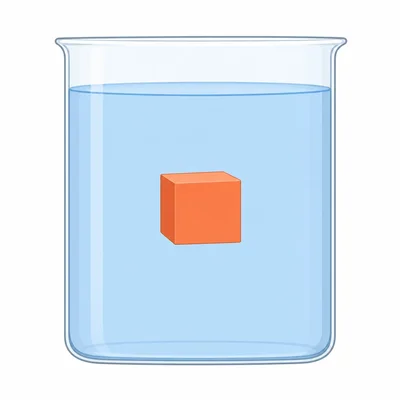
An object is placed in a liquid and stays suspended in the middle without rising or sinking. What can you conclude about the object's density compared with the liquid's density?
- 10
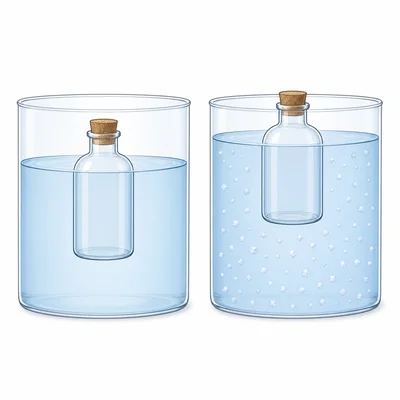
A sealed bottle floats in fresh water but sinks in salt water, according to a student's claim. Is this claim likely correct? Explain why or why not.
- 11
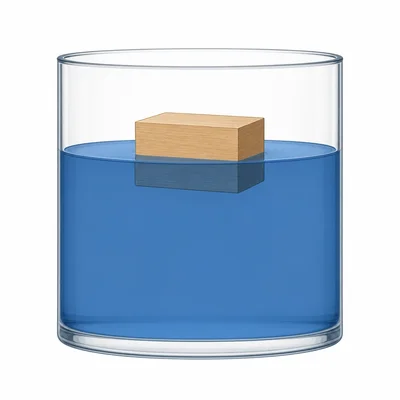
A liquid has a density of 1.2 g/cm³. An object with a density of 1.0 g/cm³ is placed in the liquid. Will the object sink or float? Explain.
- 12
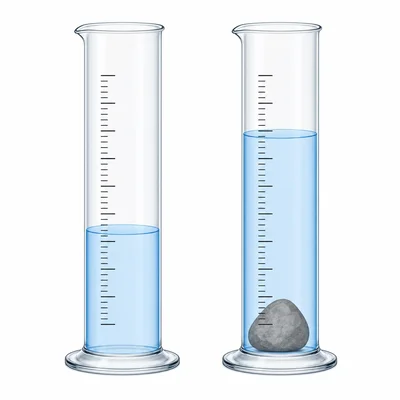
A graduated cylinder contains 50 mL of water. A small stone is placed in the cylinder, and the water level rises to 68 mL. The stone has a mass of 45 grams. What is the stone's density?