Center of Mass and Balance Lab
Drag colored weights along a ruler and watch it tip in real time. Adjust masses, move the fulcrum, and learn how center of mass and torque determine whether an object balances or falls.
Guided ExperimentBalancing Act
Where must the center of mass be relative to the support point for the ruler to balance? What happens when it moves to one side?
Write your hypothesis in the Lab Report panel, then click Next.
Balance Ruler
Drag weights to reposition themControls
Presets
Weights (2)
Results
Center of Mass
2.500 m
at center
Total Mass
2.00 kg
19.6 N weight
Net Torque
0.00 N·m
no rotation
Stability Margin
0.050 m
stable
Support Position
2.50 m from left
CoM is 0.000 m right of support
Formulas
Center of Mass
Substituted values
Net Torque
Substituted values
Data Collection
Data Table
(0 rows)| # | Trial | # Weights | Total Mass(kg) | CoM Position(m) | Support Position(m) | Net Torque(N·m) | Balanced? |
|---|
Reference Guide
Center of Mass
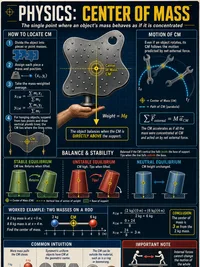
The center of mass is the average position of all the mass in a system. It is the single point where the system balances perfectly.
Each weight contributes to the CoM in proportion to its mass. A heavier weight pulls the CoM closer to it than a lighter weight at the same distance.
Torque
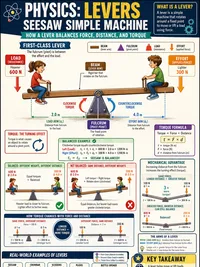
Torque is the turning effect of a force about a pivot point. A weight farther from the support creates more torque than a closer weight of equal mass.
Here d is the distance from the support. Net torque sums all contributions. When net torque equals zero, the ruler is in rotational equilibrium.
Stability and Balance
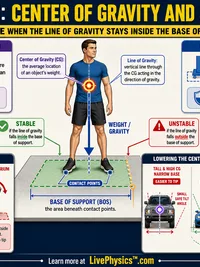
A system is balanced when its center of mass is directly above the support point. Moving the CoM off-center creates net torque that rotates the object.
The stability margin tells you how much you can shift the CoM before tipping. A larger margin means a more stable configuration.
Real-World Examples
Seesaws (teeter-totters)
A lighter child can balance a heavier child by sitting farther from the pivot. Their torques must be equal and opposite.
Balancing beams in construction
Cranes and bridges are designed so their centers of mass remain above support structures, even under varying loads.
The human body
You shift your CoM continuously when walking. Losing balance means your CoM moved outside your base of support.