Practice using dimensional analysis to convert units and solve problems from physics, chemistry, biology, Earth science, astronomy, and environmental science.
Read each problem carefully. Set up each conversion so that unwanted units cancel. Show your work in the space provided.
Using units to solve problems in science
Science - Grade 9-12
- 1
A car is traveling at 72 kilometers per hour. Use dimensional analysis to convert this speed to meters per second.
- 2
A medicine dosage is 12 milligrams per kilogram of body mass. A patient has a mass of 58 kilograms. How many milligrams are needed for one dose, and how many 250 milligram tablets is that?
- 3
In a chemistry lab, you need 0.500 moles of sodium chloride. The molar mass of sodium chloride is 58.44 grams per mole. What mass of sodium chloride should you measure?
- 4
A sample of aluminum has a mass of 135 grams. Aluminum has a density of 2.70 grams per cubic centimeter. What is the volume of the sample?
- 5
A stream has a flow rate of 3.2 cubic meters per second. Convert this flow rate to liters per minute. Use 1 cubic meter = 1000 liters.
- 6
Light travels at about 3.00 × 10^8 meters per second. How far does light travel in one 365 day year, expressed in kilometers?
- 7
A gas tank is pressurized to 2.45 atmospheres. Convert this pressure to kilopascals using 1 atmosphere = 101.3 kilopascals.
- 8
A snack contains 230 food Calories. One food Calorie equals 4184 joules. How much energy is in the snack in joules?
- 9
A car uses 6.5 liters of gasoline per 100 kilometers. How many liters of gasoline are needed for a 450 kilometer trip?
- 10
An electric power source produces 820 grams of CO2 for each kilowatt-hour of electricity. A household uses 650 kilowatt-hours in a month. How many kilograms of CO2 are produced?
- 11
A bacterium is 2.5 micrometers long. Convert this length to millimeters and meters. Use 1 millimeter = 1000 micrometers and 1 micrometer = 10^-6 meters.
- 12
Ocean water has a salinity of 35 parts per thousand by mass, which means 35 grams of salt per 1000 grams of seawater. How many grams of salt are in 2.5 kilograms of seawater?
- 13
Newton's second law is F = ma. If mass is measured in kilograms and acceleration is measured in meters per second squared, what base units make up one newton of force?
- 14
At standard temperature and pressure, 1 mole of a gas occupies 22.4 liters. A container holds 5.60 liters of oxygen gas. How many oxygen molecules are in the container? Use Avogadro's number, 6.022 × 10^23 molecules per mole.
- 15
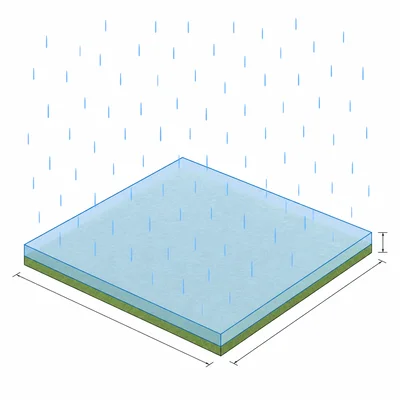
A storm drops 2.4 centimeters of rain evenly over a rectangular field that is 80 meters long and 50 meters wide. What volume of water falls on the field in cubic meters and in liters?