Mole Converter & Gas Stoichiometry
Enter a chemical formula and a quantity in grams, moles, molecules, or liters at STP. The tool converts to all other units and shows the step-by-step dimensional analysis.
Input
Results
Molar Mass
18.015 g/mol
Grams
18 g
Moles
0.999167 mol
Molecules
6.0171 x 10^23
Liters at STP
22.3953 L
Mole Map
Step-by-Step Dimensional Analysis
1. Determine molar mass
2. Convert grams to moles
3. Calculate molecules
4. Calculate volume at STP
Reference Guide
Molar Mass
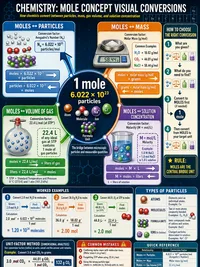
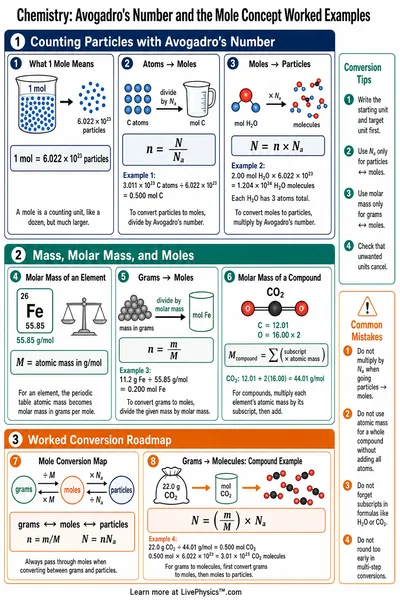
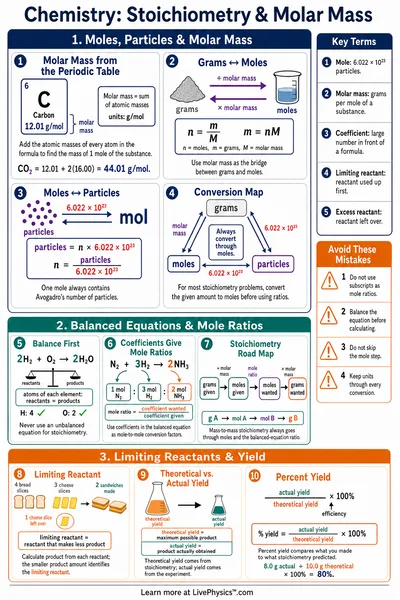
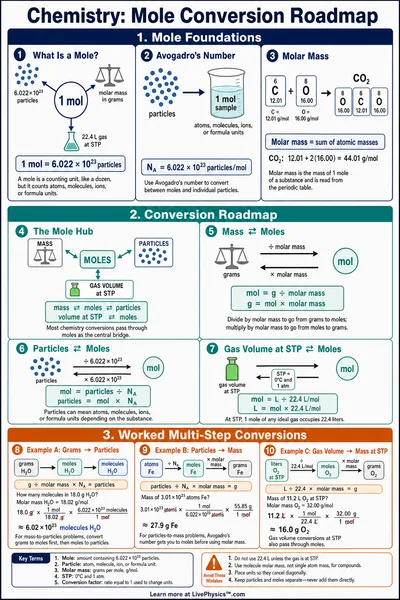
The molar mass (M) is the mass of one mole of a substance, equal to the sum of atomic masses of all atoms in the formula.
Avogadro's Number
One mole contains exactly 6.022 x 10^23 particles (atoms, molecules, or formula units).
Molar Volume at STP
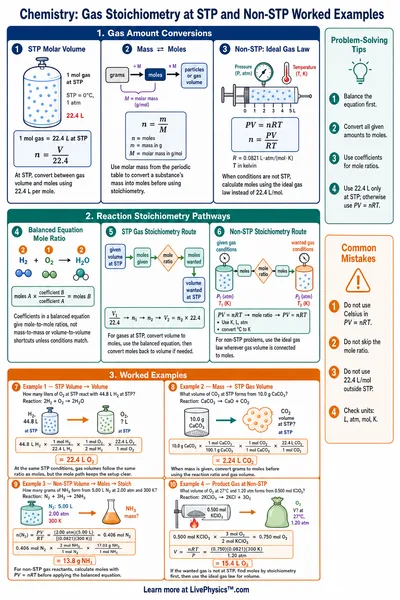
At standard temperature and pressure (0 C, 1 atm), one mole of any ideal gas occupies 22.4 liters.
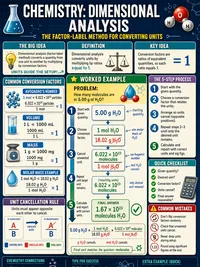
Dimensional Analysis
Convert between units by multiplying by conversion factors so that unwanted units cancel. The mole sits at the center of all conversions.
Related Content
Visual Explainers
Related Tools
Periodic Table Explorer
Interactive periodic table with all 118 elements. Search by name or symbol, compare elements side-by-side, and view by category, electronegativity, phase, or orbital block.
Molar Mass & Stoichiometry Calculator
Enter any chemical formula to compute molar mass, element breakdown with mass percentages, and step-by-step calculations. Supports parenthesized groups.
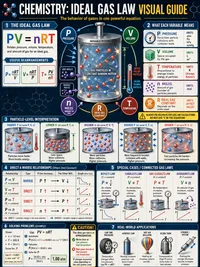
Ideal Gas Law (PV=nRT) Calculator
Solve PV=nRT for any variable with unit support for pressure, volume, and temperature. Gas particle visualization and step-by-step math.
pH, pOH & Acid-Base Calculator
Enter pH, pOH, [H+], or [OH-] to compute all four. Color-coded pH scale bar, acid/base classification, and step-by-step KaTeX.
Related Labs
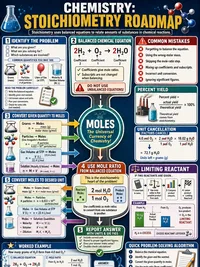
Stoichiometry Lab
Identify limiting reagents, calculate theoretical and percent yield, and trace dimensional analysis step by step with visual mole bar charts
Limiting Reactant & Percent Yield Lab
Pick a balanced reaction, set the amount of each reactant, and find the limiting reactant, the excess left over, the theoretical yield, and the percent yield from your actual yield. Record trials and write a full lab report.
Gas Laws Lab
Explore Boyle's, Charles's, and Gay-Lussac's gas laws with animated particles. Adjust pressure, volume, temperature, and moles to discover relationships experimentally
Gas Collection over Water & Partial Pressure Lab
Collect a gas over water in a eudiometer and apply Dalton's law to subtract the water vapor pressure, finding the dry gas partial pressure and the moles of gas via the ideal gas law