Understanding Kinematics Solver
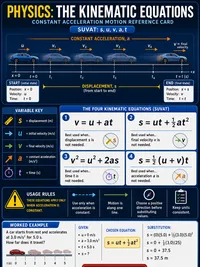
Constant acceleration is a model, not a promise that every moving object behaves this way. It works when acceleration stays nearly the same over the time being studied, such as a ball falling near Earth or a car speeding up steadily.
Air resistance, changing engine force, and curved paths can make the model less accurate. In these cases, a short time interval may still be close enough to constant acceleration for a useful estimate.
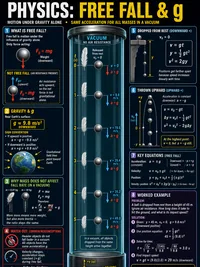
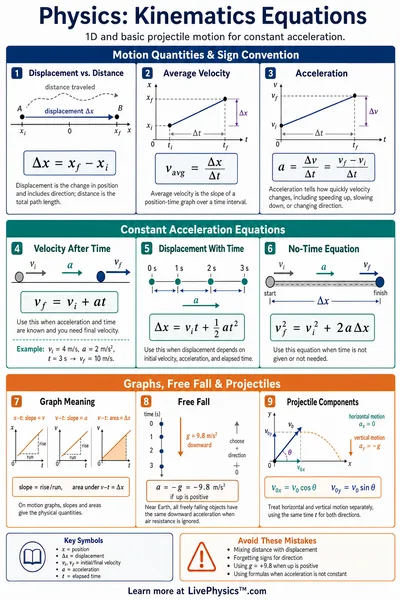
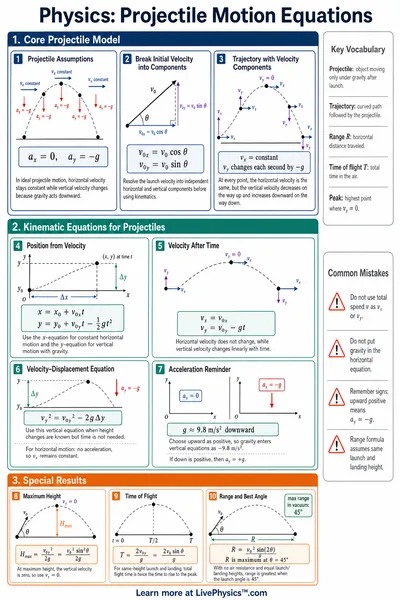
Direction matters because position, velocity, and acceleration have signs. Choose one direction as positive before using any values, then keep that choice throughout the problem. For vertical motion, many students choose upward as positive, which makes gravitational acceleration negative.
A thrown ball has positive velocity while rising, zero velocity at its highest point, then negative velocity while falling. Its acceleration remains negative during the whole trip if air resistance is ignored.
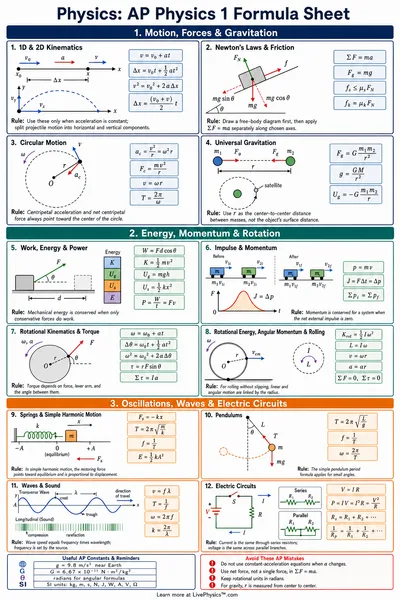
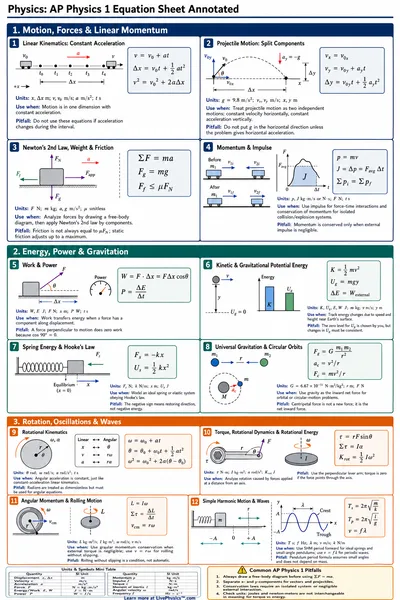
Units provide an important error check. Position is measured in meters, time in seconds, velocity in meters per second, and acceleration in meters per second per second. When acceleration is multiplied by time, the seconds cancel in a way that produces velocity.
When acceleration is multiplied by time squared, the result has units of distance. A final answer with the wrong kind of unit usually means that a value was entered incorrectly or an equation was used in the wrong way.
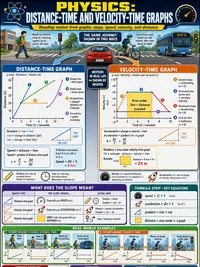
Motion graphs show the same event from different viewpoints. The slope of a position versus time graph gives velocity, so a steeper line means faster motion. The slope of a velocity versus time graph gives acceleration.
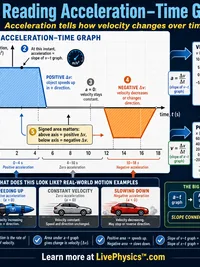
The area between a velocity versus time graph and the time axis gives displacement, including its direction. A graph below the time axis represents negative position or negative velocity, depending on which quantity is plotted. It does not automatically mean that the object is slowing down.
Slowing down occurs when velocity and acceleration point in opposite directions. An object moving right with positive velocity slows if its acceleration is negative. An object moving left with negative velocity slows if its acceleration is positive.
This distinction prevents a common mistake in which negative acceleration is treated as slowing down in every situation. Negative only identifies the chosen direction.
Real situations often involve stages of motion. A cyclist may wait at rest, accelerate away from a light, travel at constant speed, then brake. One constant acceleration calculation cannot describe the entire trip, but each stage can be handled separately.
The ending position and velocity from one stage become the starting values for the next stage. This is how simple kinematics connects to journey planning, sports timing, vehicle stopping distances, and safety analysis.
A reliable solution includes a physical check after the arithmetic. A longer time with positive acceleration should produce a larger change in velocity. A stopped object released above the ground should move downward and gain speed.
If a result predicts a negative travel time, it often describes an earlier moment or signals that the chosen information does not match the situation. Checking signs, units, and the shape of the motion is often more valuable than repeating calculations.