Practice calculating and interpreting GDP, real GDP, GDP deflators, national income, and related macroeconomic measures.
Read each problem carefully. Show your work in the space provided and include units when needed.
Measuring output, income, and economic performance
Social Studies - Grade 9-12
- 1
An economy has consumption spending of 900 billion dollars, investment spending of 250 billion dollars, government purchases of 300 billion dollars, exports of 120 billion dollars, and imports of 180 billion dollars. Calculate GDP using the expenditure approach.
- 2
For each transaction, state whether it is included in current U.S. GDP and explain why: a used car sold from one household to another, a new car produced in Tennessee and sold to a household, tires sold to an auto factory, and a haircut purchased at a local salon.
- 3
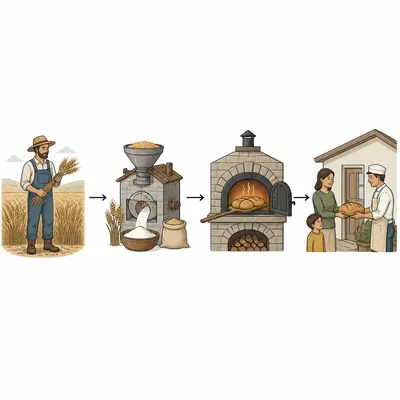
A farmer sells wheat to a mill for 1 dollar, the mill sells flour to a bakery for 2 dollars, and the bakery sells bread to a household for 5 dollars. Calculate the total contribution to GDP using the final goods method and the value-added method.
- 4
A small economy produces only burgers and fries. In 2023, it produces 100 burgers at 5 dollars each and 200 fries at 2 dollars each. In 2024, it produces 110 burgers at 6 dollars each and 220 fries at 3 dollars each. Using 2023 as the base year, calculate nominal GDP in 2024, real GDP in 2024, and the GDP deflator for 2024.
- 5
If nominal GDP is 22 trillion dollars and real GDP is 20 trillion dollars, calculate the GDP deflator and interpret what it means relative to the base year.
- 6
An economy has GDP of 5,000 billion dollars and depreciation of 600 billion dollars. Calculate net domestic product.
- 7
Assume no statistical discrepancy. An economy has GDP of 2,000 billion dollars, depreciation of 200 billion dollars, net foreign factor income of 50 billion dollars, and indirect business taxes of 150 billion dollars. Calculate national income.
- 8
A country has national income of 8,000 billion dollars, retained corporate profits of 400 billion dollars, corporate income taxes of 300 billion dollars, social insurance contributions of 500 billion dollars, transfer payments of 900 billion dollars, interest on government debt of 100 billion dollars, and personal taxes of 1,200 billion dollars. Calculate personal income and disposable income.
- 9
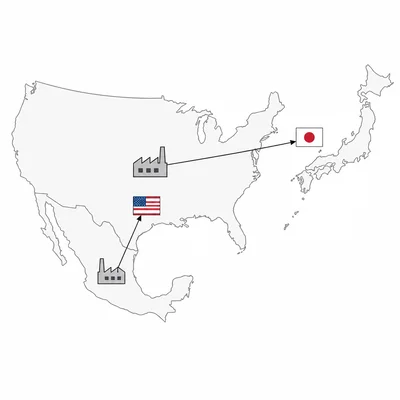
A U.S.-owned company produces 50 billion dollars of output in Mexico, and a Japanese-owned company produces 30 billion dollars of output in the United States. Explain how these transactions affect U.S. GDP and U.S. GNP.
- 10
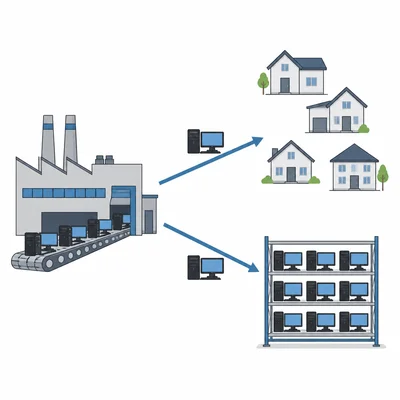
A computer factory produces 100 computers this year. It sells 80 computers to households for 1,000 dollars each and keeps 20 computers in inventory at the same market value. How much does this production add to GDP, and which expenditure categories are affected?
- 11
Identify two types of economic activity that GDP does not fully measure. Explain why this makes GDP an imperfect measure of well-being.
- 12
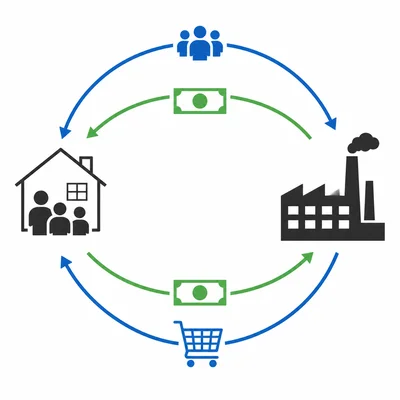
In a simple circular flow model, households provide labor to firms and receive wages. Firms sell goods and services to households and receive consumer spending. Identify the income flow and the output flow in this model.
- 13
Country A has GDP of 1.2 trillion dollars and a population of 300 million people. Country B has GDP of 800 billion dollars and a population of 100 million people. Calculate GDP per capita for each country and state which country has the higher GDP per capita.
- 14
A country's real GDP rises from 2,500 billion dollars to 2,650 billion dollars. Its population rises from 100 million to 104 million. Calculate the growth rate of real GDP and describe what happened to real GDP per capita.
- 15
A state government pays 500 million dollars in unemployment benefits and buys 700 million dollars of new computers for public schools. Explain how each action affects GDP directly.