World Geography Regions Lab
Explore the six major geographic regions of the world. Compare area, population, physical features, climate, and cultural highlights, then test your knowledge with a region quiz.
Controls
Click any region card to expand its full profile including geography, climate, economy, and culture.
Data Table
(0 rows)| # | Region | Area | Population | Countries | Largest Country | Climate Type | Major Physical Feature |
|---|
Reference Guide
Reading Physical Maps
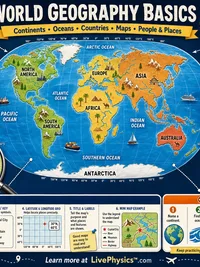
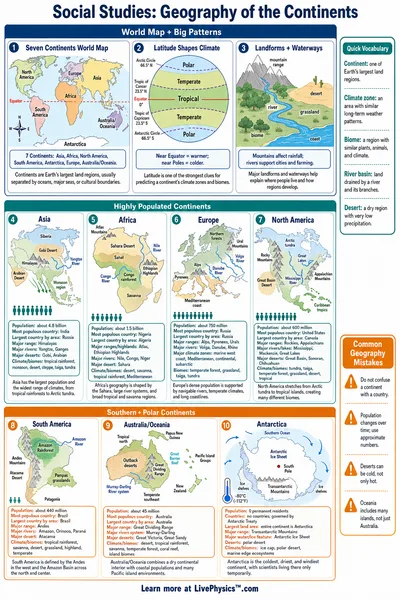
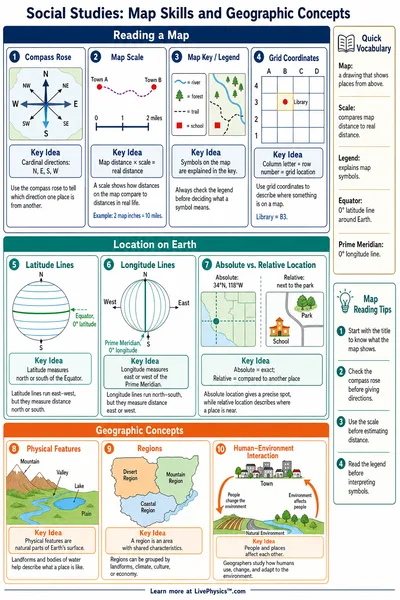
Physical maps show landforms, elevation, and water bodies using color and shading. Brown and gray tones indicate mountains and highlands. Green represents lowland plains and valleys. Blue shades show water depth in oceans and lakes.
Contour lines connect points of equal elevation. Closely spaced lines mean steep terrain; widely spaced lines mean gentle slopes. Understanding contour patterns helps you identify mountain ranges, river valleys, and plateaus from a map.
Major physical features like the Himalayas, the Amazon basin, and the Sahara Desert appear on every world map and act as natural boundaries that have shaped human settlement for thousands of years.
World Climates
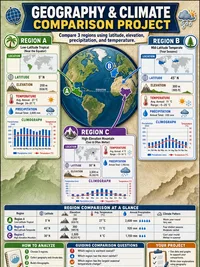
The Koppen climate classification divides the world into five major climate zones, tropical (hot and wet year-round near the equator), dry (deserts and semi-arid regions), temperate (mild seasons in mid-latitudes), continental (hot summers and cold winters inland), and polar (cold year-round near the poles).
Mountain ranges act as climate barriers. The Himalayas block cold Siberian air from reaching South Asia and force moisture-laden monsoon winds to rise and drop heavy rainfall on the southern slopes. The Andes create a rain shadow desert (the Atacama) on their leeward side.
Ocean currents moderate coastal climates. The Gulf Stream keeps Western Europe warmer than its latitude would otherwise suggest. Cold currents bring fog and dryness to coasts like Peru and Namibia.
Population Distribution
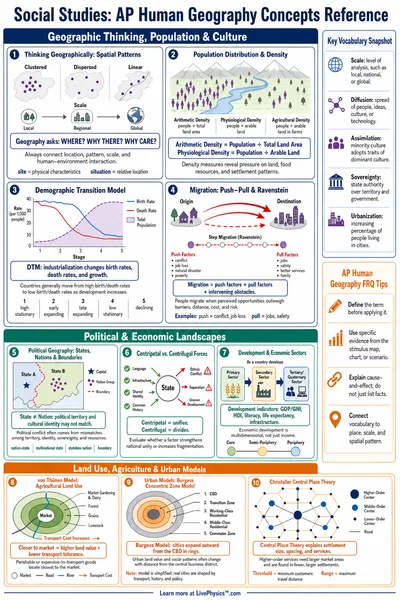
Population density is measured in people per square kilometer. The world average is about 60 people per km², but distribution is extremely uneven. Fertile river valleys, coastal plains, and temperate zones attract dense settlement. Deserts, tundra, and high mountain regions remain sparsely populated.
The most densely populated areas include the North China Plain, the Ganges Plain in India and Bangladesh, the Nile Delta in Egypt, and the Rhine-Ruhr industrial zone in Europe. Together, Asia holds about 60% of the world's population on roughly 30% of the world's land area.
Urbanization rates vary widely by region. Europe and North America are 75-80% urban. Africa is still predominantly rural at around 45% urban, though its cities are among the fastest-growing in the world.
Geographic Regions vs Political Borders
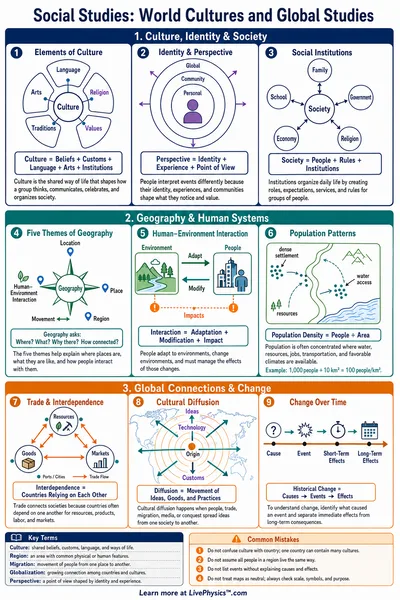
Geographic regions are defined by physical and environmental characteristics, shared landmasses, climate zones, or ecological systems. Political borders divide the same physical space into countries, states, and provinces based on history, culture, and treaty agreements.
These two systems often conflict. The Amazon rainforest spans nine countries. The Sahara Desert covers parts of eleven nations. The Himalayas are divided among five countries. Understanding this difference helps explain why environmental problems like deforestation and pollution require international cooperation.
Some political boundaries do follow physical features, using rivers (the Rio Grande between the US and Mexico), mountain ridges (the Alps between France and Italy), or coastlines as natural dividers. Others were drawn by colonial powers with little regard for ethnic, linguistic, or geographic boundaries, which has contributed to conflicts in Africa and the Middle East.