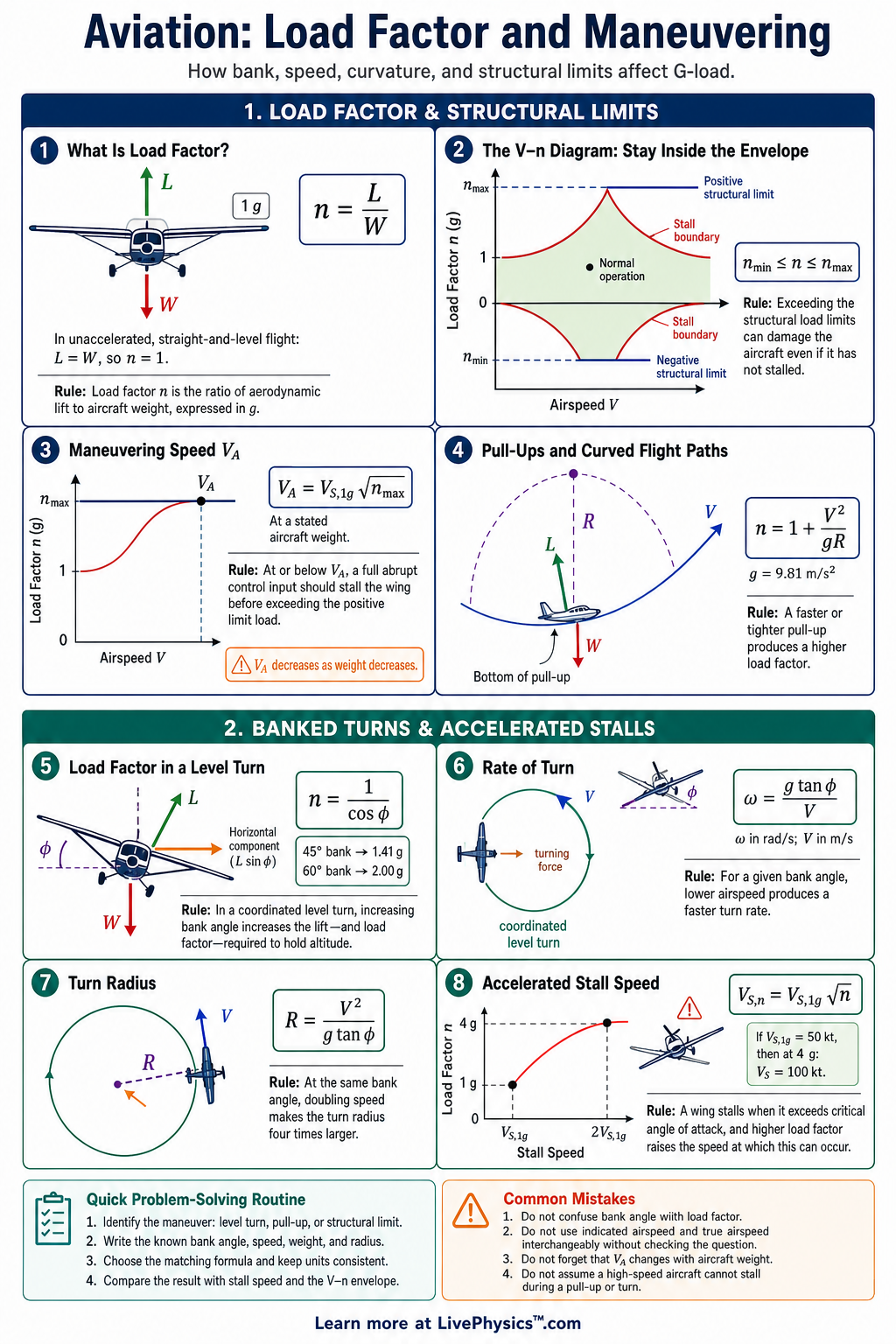
This cheat sheet explains how aircraft load factor changes during turns, pull-ups, turbulence, and other maneuvers. Pilots need to understand load factor because it affects both stall speed and structural stress. A maneuver that feels normal can create large forces when bank angle or control input increases.
These ideas support safe aircraft operation and sound aeronautical decision making.
Load factor compares the lift carried by an aircraft to its actual weight, and it is measured in Gs. In a coordinated level turn, greater bank angle requires greater lift, so load factor rises quickly. Higher load factor also raises stall speed, which can lead to an accelerated stall.
Maneuvering speed and published aircraft limits help pilots avoid structural damage during abrupt control movements or rough air.
Key Facts
- Load factor equals lift divided by weight, and it is measured in Gs.
- In straight and level unaccelerated flight, load factor equals 1 G.
- For a coordinated level turn, load factor equals one divided by the cosine of the bank angle.
- A 60 degree coordinated level turn produces a load factor of 2 G.
- Maneuvering stall speed equals normal stall speed times the square root of load factor.
- At 4 G, maneuvering stall speed is twice the normal one G stall speed.
- Maneuvering speed decreases when aircraft weight decreases, so Va is lower in a lighter aircraft.
Vocabulary
- Load factor
- Load factor is the ratio of aerodynamic lift to aircraft weight, expressed in Gs.
- G force
- A G is a unit that compares an acceleration or load to the force of normal gravity.
- Accelerated stall
- An accelerated stall occurs when an aircraft exceeds its critical angle of attack at a load factor greater than 1 G.
- Maneuvering speed
- Maneuvering speed is the recommended maximum speed for full abrupt control movement under specified aircraft weight conditions.
- Limit load
- Limit load is the greatest load factor an aircraft structure is designed to withstand without permanent deformation.
- Coordinated turn
- A coordinated turn is a balanced turn with no significant slipping or skidding force.
Common Mistakes to Avoid
- Assuming every turn creates the same load factor is wrong because load factor increases sharply as bank angle becomes steeper in a level turn.
- Using the published one G stall speed during a steep turn is wrong because higher load factor raises the actual stall speed.
- Treating Va as one fixed airspeed is wrong because maneuvering speed changes with aircraft weight and is lower when the aircraft is lighter.
- Believing that maneuvering speed protects the aircraft from all turbulence is wrong because severe gusts, repeated inputs, and improper control use can still exceed structural limits.
- Pulling harder to hold altitude in a steep turn without monitoring airspeed is wrong because the added angle of attack can cause an accelerated stall.
Practice Questions
- 1 An aircraft makes a coordinated level turn at 60 degrees of bank. What is its load factor in Gs?
- 2 An aircraft has a normal stall speed of 50 knots. What is its maneuvering stall speed at 4 G?
- 3 An aircraft has a normal stall speed of 48 knots and enters a maneuver producing 2.25 G. Calculate its maneuvering stall speed.
- 4 Explain why a steep, low-altitude turn can create a greater stall risk even when the aircraft is flying above its published straight and level stall speed.
Understanding Load Factor and Maneuvering
Load factor describes the total aerodynamic force acting on an aircraft compared with its weight. One G means the wings produce lift equal to the aircraft weight in normal straight and level flight. Two G means the wings and structure support twice the aircraft weight.
Positive load factor pushes occupants into their seats. Negative load factor pushes occupants against their restraints and can be especially uncomfortable and structurally demanding.
A level coordinated turn is one of the most important uses of load factor calculations. As an aircraft banks, some lift points sideways to make the aircraft turn. The remaining vertical lift becomes smaller.
The pilot must increase total lift to maintain altitude, usually by increasing angle of attack with elevator back pressure. Load factor equals one divided by the cosine of the bank angle.
At 60 degrees of bank, the load factor is 2 G. At steeper banks, load factor rises very rapidly.
Stall speed changes with load factor because the wings must create more lift to support the aircraft. Maneuvering stall speed equals normal stall speed times the square root of load factor. If load factor reaches 4 G, stall speed doubles.
This is called an accelerated stall because it can happen well above the published straight and level stall speed. It can occur at any attitude or airspeed when the critical angle of attack is exceeded. A steep turn near the ground is particularly hazardous because altitude and time for recovery are limited.
Every aircraft has published structural load limits. Normal category aircraft commonly have positive limits near 3.8 G, though pilots must always use the approved flight manual for the specific aircraft. Exceeding a limit load may permanently bend or weaken the structure.
A larger ultimate load is used during certification testing, but it is not an operating target. Smooth and coordinated control inputs reduce unnecessary stress and help keep loads within safe limits.
Maneuvering speed, often marked Va, is the speed at which a full abrupt control input should cause a stall before the aircraft exceeds its limit load. It does not make rough-air flight automatically safe. Va decreases as aircraft weight decreases, so a lighter aircraft has a lower maneuvering speed.
Pilots should slow to the recommended turbulence penetration speed in rough air and avoid abrupt, repeated, or opposing control inputs. When studying this topic, connect bank angle, G load, stall speed, airspeed, and aircraft weight rather than treating each value as a separate fact.