Analyze how base isolation and structural bracing help buildings resist earthquake forces, then compare their advantages, limits, and design tradeoffs.
Read each problem carefully. Show calculations, sketches, and reasoning in the space provided. Use complete sentences when explaining design choices.
Comparing two ways to reduce earthquake damage
Engineering - Grade 9-12
- 1
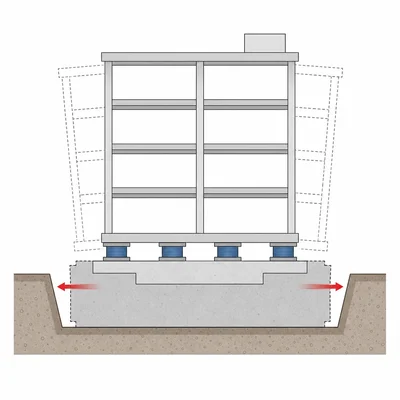
Define base isolation in the context of earthquake engineering. Explain how it changes the way earthquake motion reaches a building.
- 2
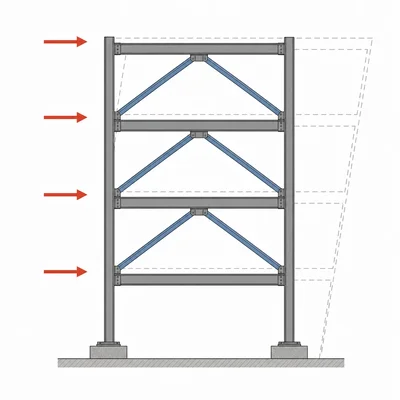
Define bracing in the context of earthquake-resistant design. Explain how braces help a building during side-to-side shaking.
- 3
A building without special earthquake protection has a peak floor acceleration of 0.80g during a quake. A base isolation system reduces that acceleration by 55 percent. What is the new peak floor acceleration?
- 4
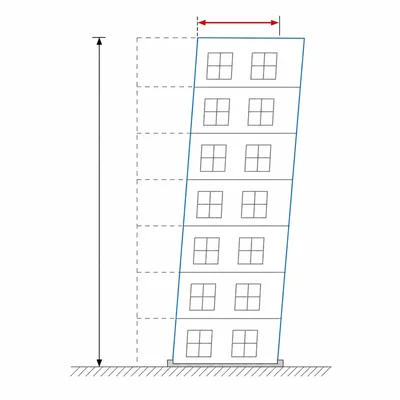
A braced frame is designed to limit roof drift. A 30 m tall building has a roof displacement of 0.18 m during an earthquake. Calculate the drift ratio as a percent.
- 5
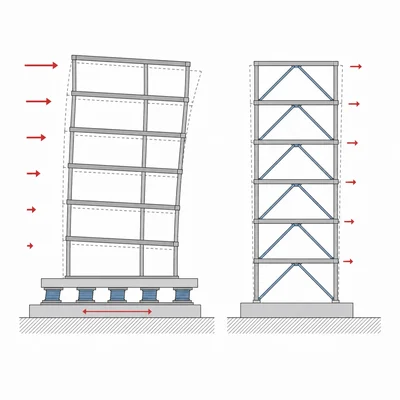
Compare base isolation and bracing in terms of stiffness. Which approach usually makes the building system more flexible, and which approach usually makes the structural frame stiffer?
- 6
A hospital contains sensitive equipment that could be damaged by high floor accelerations. Would base isolation or bracing usually be the better first design strategy for protecting this equipment? Explain your choice.
- 7
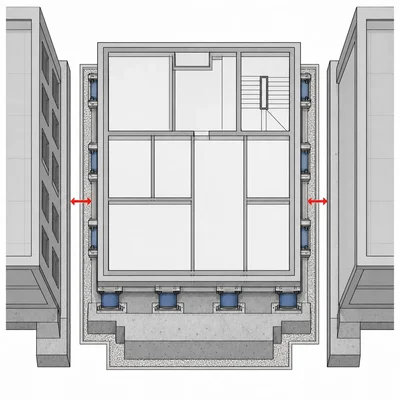
A tall office tower is located on a tight urban lot with very little space around its foundation. Explain one practical challenge this creates for using base isolation.
- 8
A one-story emergency operations center must remain usable after a major earthquake. List two reasons base isolation might be appropriate for this building.
- 9
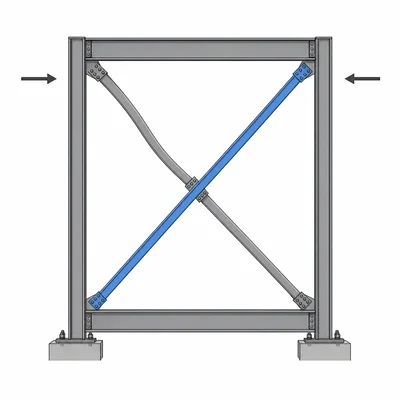
A school gym uses X-bracing in its steel frame. During a quake, one diagonal brace is in tension while the opposite diagonal may be in compression. Explain why using two crossing braces can be helpful.
- 10
A building owner is choosing between adding steel bracing and installing base isolation during a retrofit. Name one construction advantage of adding bracing to an existing frame and one possible disadvantage.
- 11
A base isolation bearing has a horizontal stiffness of 800 kN/m. During an earthquake, it displaces 0.12 m. Using F = kx, estimate the horizontal force in the bearing.
- 12
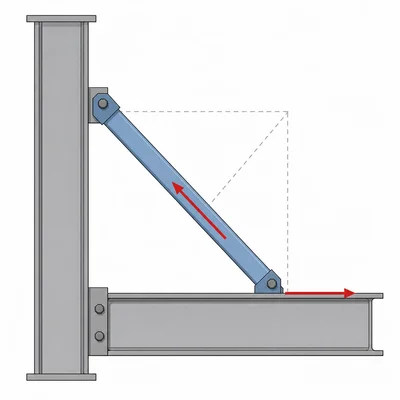
A diagonal brace carries an axial force of 180 kN. If the brace makes a 45 degree angle with the floor, estimate the horizontal component of the force using cos 45 degrees = 0.707.
- 13
Explain why earthquake engineers must consider both strength and ductility when designing braced frames.
- 14
A simplified comparison gives these results for two designs: Design A has low floor acceleration but large base displacement. Design B has low drift but higher floor acceleration. Identify which design is more likely base isolation and which is more likely bracing. Explain.
- 15
You are designing a museum to protect fragile artifacts during earthquakes. Write a short recommendation explaining whether you would prioritize base isolation, bracing, or a combination of both. Include at least two engineering reasons.