Understanding Fluid Flow Streamline Simulator
Potential flow is a simplified model of moving water or air. It treats the fluid as having no viscosity, so layers can slide past one another without friction. This makes the equations easier to solve, though it leaves out some important real effects.
In this model, the velocity at every point has both a size and a direction. The simulator calculates that local velocity, then uses it to move tracer particles step by step. A visible path forms because each particle continually follows the changing direction of the flow.
A streamline is not the path of one particular particle over a long time in every situation. It is a map line that is tangent to the fluid velocity at one instant. For steady flow, where the pattern does not change with time, streamlines match the paths traced by particles.
Obstacle shape changes the way the flow must bend. Fluid cannot pass through a solid boundary, so its velocity near the surface points along that surface. Sharp corners create especially strong changes in direction in an ideal calculation.
Around a circular cylinder, the fluid speeds up along parts of the curved surface and slows near special points called stagnation points. At a stagnation point, the local velocity is zero. Their locations shift when circulation is added to the flow.
Circulation describes a net tendency for fluid to move around an object. It can be produced in the model without making the whole object visibly spin. Combining circulation with a background stream makes one side of an object carry faster flow than the other.
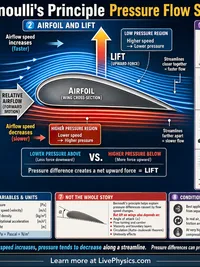
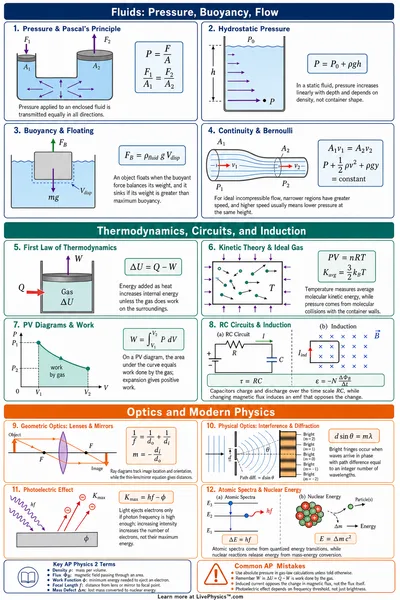
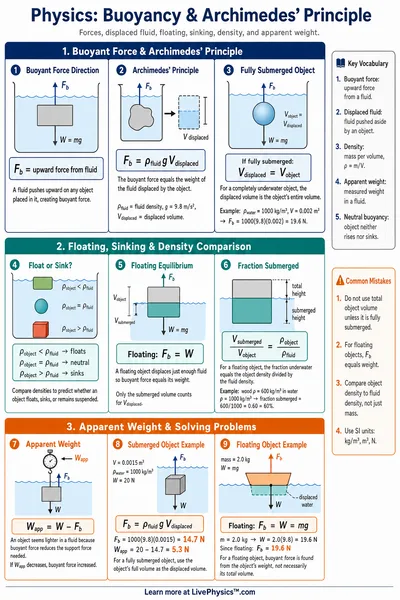
Pressure differences are linked to changes in speed in this ideal model. Along the same streamline, faster flow is associated with lower pressure when height is unchanged. That connection helps explain why a flow pattern with circulation can produce a sideways force.
The lift predicted for an airfoil depends on fluid density, free stream speed, circulation, and the effective span of the wing. This result is useful because it connects an overall force to a property of the flow around the shape. Real wings need viscosity and boundary-layer effects to create and maintain the required circulation.
The colored speed map needs careful reading. Bright regions may show high speed, but high speed does not automatically mean high force on an object. Force depends on pressure over the entire surface, not on one small region alone.
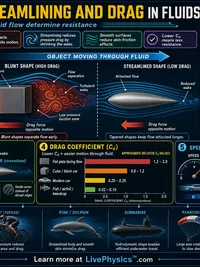
Potential flow cannot predict drag on a smooth cylinder correctly. The ideal model gives no net drag in a steady uniform flow, which conflicts with everyday experience. Real drag comes largely from viscosity, surface friction, flow separation, and turbulent wakes.
Flow separation occurs when fluid near a surface loses enough momentum that it cannot follow the shape. A broad wake then forms behind the object, often increasing drag. This is why a real flat plate or rectangle behaves much less smoothly than an ideal streamline picture suggests.
Use the controls to change one feature at a time, then compare the resulting pattern. Watch where particles crowd together, where they spread apart, and where they slow nearly to rest. These observations build a stronger link between the picture, velocity, pressure, and forces on objects.