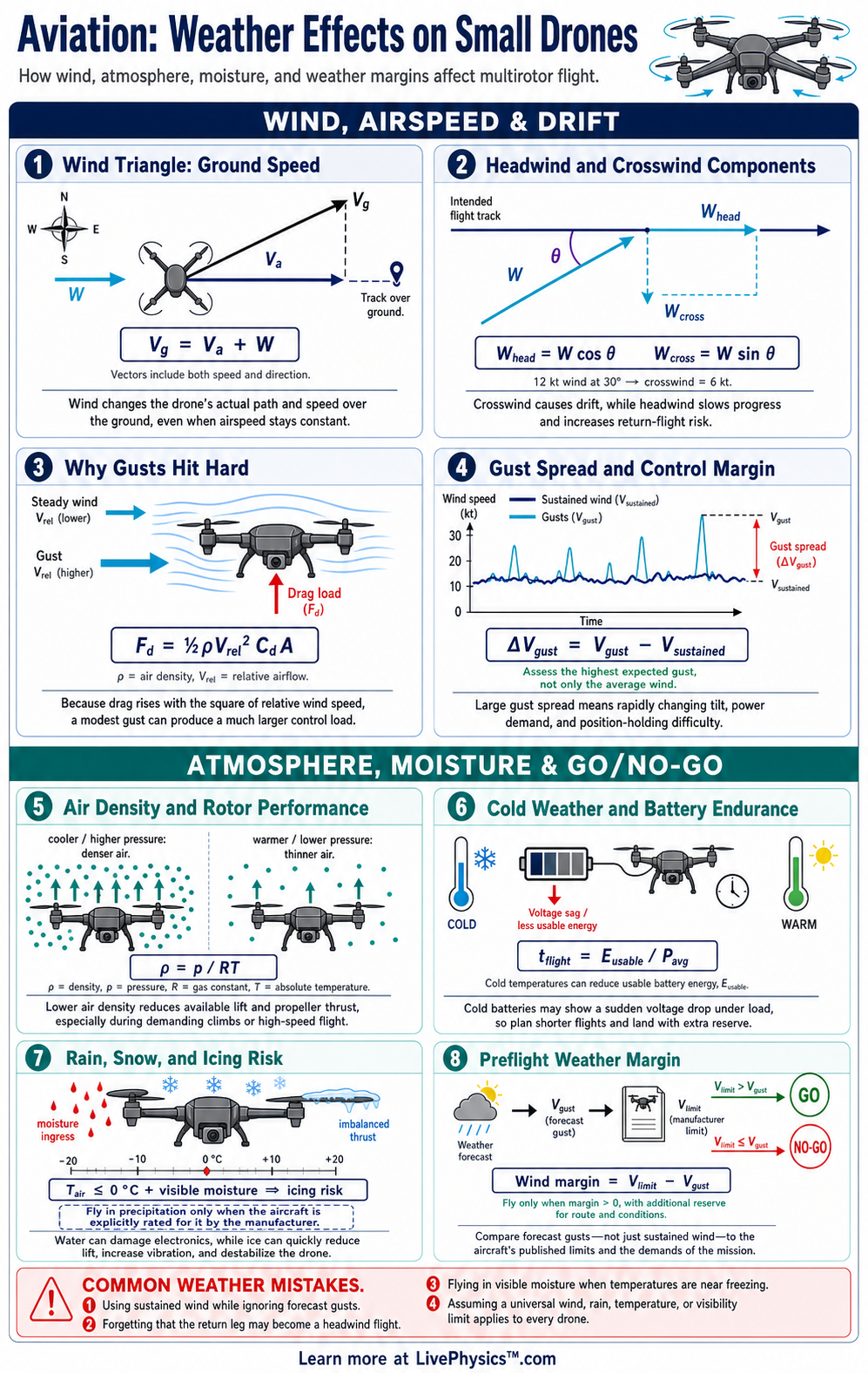
Small drones are strongly affected by weather because they are light, have limited battery capacity, and rely on steady airflow for control. Pilots need to understand weather before launch because conditions can change quickly during a short flight. This cheat sheet helps learners connect weather observations to practical flight decisions.
It focuses on safe planning, accurate limits, and early warning signs.
Wind changes the drone's speed over the ground, power use, and ability to return home. Temperature, pressure, and humidity change air density, which affects lift, propeller performance, and battery behavior. Rain, fog, and low clouds can damage equipment or remove the visual references needed for safe flight.
Good pilots use published aircraft limits, local forecasts, and conservative safety margins before every mission.
Key Facts
- Ground speed equals airspeed plus or minus the wind component along the flight path.
- A headwind reduces ground speed and usually increases battery use during the return flight.
- A tailwind increases outbound ground speed but can create a difficult, high-power return against the wind.
- Air density decreases when temperature increases, pressure decreases, or elevation increases.
- Lower air density reduces propeller thrust, so a drone may climb more slowly and use more power to hover.
- Cold battery voltage can drop sharply when current demand rises, especially during climbing or flight in strong wind.
- Do not fly in rain, thunderstorms, or visibility conditions that prevent safe visual line of sight.
- A safe weather margin keeps wind, gusts, temperature, and moisture conditions well within the manufacturer’s published limits.
Vocabulary
- Wind component
- The part of the wind that acts in the same direction as, opposite to, or across the drone's flight path.
- Ground speed
- The speed of the drone relative to the ground after wind effects are included.
- Air density
- The amount of air mass in a given volume, which affects how much thrust propellers can produce.
- Gust
- A brief and sudden increase or change in wind speed that can disturb a drone's position.
- Visual line of sight
- A condition in which the pilot can directly see the drone well enough to control and monitor it safely.
- Weather margin
- Extra safety room between actual weather conditions and the maximum conditions approved for the drone.
Common Mistakes to Avoid
- Checking only the wind at ground level is wrong because wind can be much stronger or more turbulent at the drone's operating height.
- Flying far downwind is risky because the drone may need much more power and time to return against the wind.
- Treating sustained wind as the only limit is wrong because gusts can exceed the drone's control capability even when average wind appears acceptable.
- Launching with a cold battery is unsafe because voltage can sag under load and trigger an early critical battery landing.
- Flying when weather is close to the published limit is a mistake because local turbulence, gusts, and changing conditions can remove the remaining safety margin.
Practice Questions
- 1 A drone flies at an airspeed of 12 metres per second into a headwind of 5 metres per second. What is its ground speed?
- 2 A drone has an airspeed of 10 metres per second and a tailwind of 4 metres per second on its outbound flight. What ground speed does it have outbound, and what ground speed does it have when returning into the same wind?
- 3 A pilot plans to fly on a hot day at a high-elevation site. State two ways these conditions can affect multirotor performance.
- 4 Explain why a pilot should turn back early when a drone is flying downwind even if the battery indicator still shows a comfortable remaining charge.
Understanding Weather Effects on Small Drones
Wind is often the most important weather factor for a small multirotor. A drone must tilt into the wind to hold position, and that tilt reduces the thrust available for climbing or resisting gusts. Headwinds slow the drone over the ground and increase energy use.
Tailwinds can make an outbound flight seem easy, but the return trip may require far more battery power. Crosswinds can push the aircraft away from its intended route and make precise landings difficult.
Gusts are especially hazardous because their speed and direction change rapidly. Pilots should compare sustained wind, gust speed, and the drone manufacturer's maximum wind resistance before flight.
Wind aloft can differ from wind at the launch point. Trees, buildings, hills, and large structures create turbulence, rotor flow, and sudden changes in direction. A calm ground reading does not guarantee calm conditions at operating height.
Flights near cliffs, rooftops, or the downwind side of obstacles need extra care. The drone may lose altitude or drift when it enters disturbed air. Maintaining more distance from obstacles gives the pilot more time and space to recover.
Air density affects how effectively propellers produce thrust. Density decreases as temperature increases or pressure decreases, and it can also decrease with higher elevation. Less dense air means the motors may work harder to hover, climb, and carry payloads.
Hot days and high elevation locations can therefore shorten useful flight time. Humidity has a smaller effect on density than temperature and pressure, but it still contributes to overall performance. Pilots should expect reduced margins when several unfavorable factors occur together.
Temperature also affects the battery. Cold batteries deliver less available power and can show a sudden voltage drop under heavy load. A drone that appears to have enough charge while hovering may reach a low battery warning during a climb, fast flight, or windy return.
Batteries should be stored and prepared within the manufacturer’s recommended temperature range. Hot conditions create a different problem because batteries, motors, and electronics can overheat. Avoid leaving equipment in direct sun and allow warm components to cool between flights.
Moisture presents both equipment and operational risks. Rain can enter non-waterproof electronics, reduce propeller efficiency, and cause unstable flight behavior. Fog, mist, haze, and low cloud reduce visibility and make it harder to maintain visual line of sight.
Water droplets on the lens can also make camera footage unusable. Thunderstorms must be avoided because they can produce strong gust fronts, heavy rain, lightning, and rapidly changing pressure. A weather margin means choosing not to fly when conditions are near a published limit, since real conditions can worsen after takeoff.