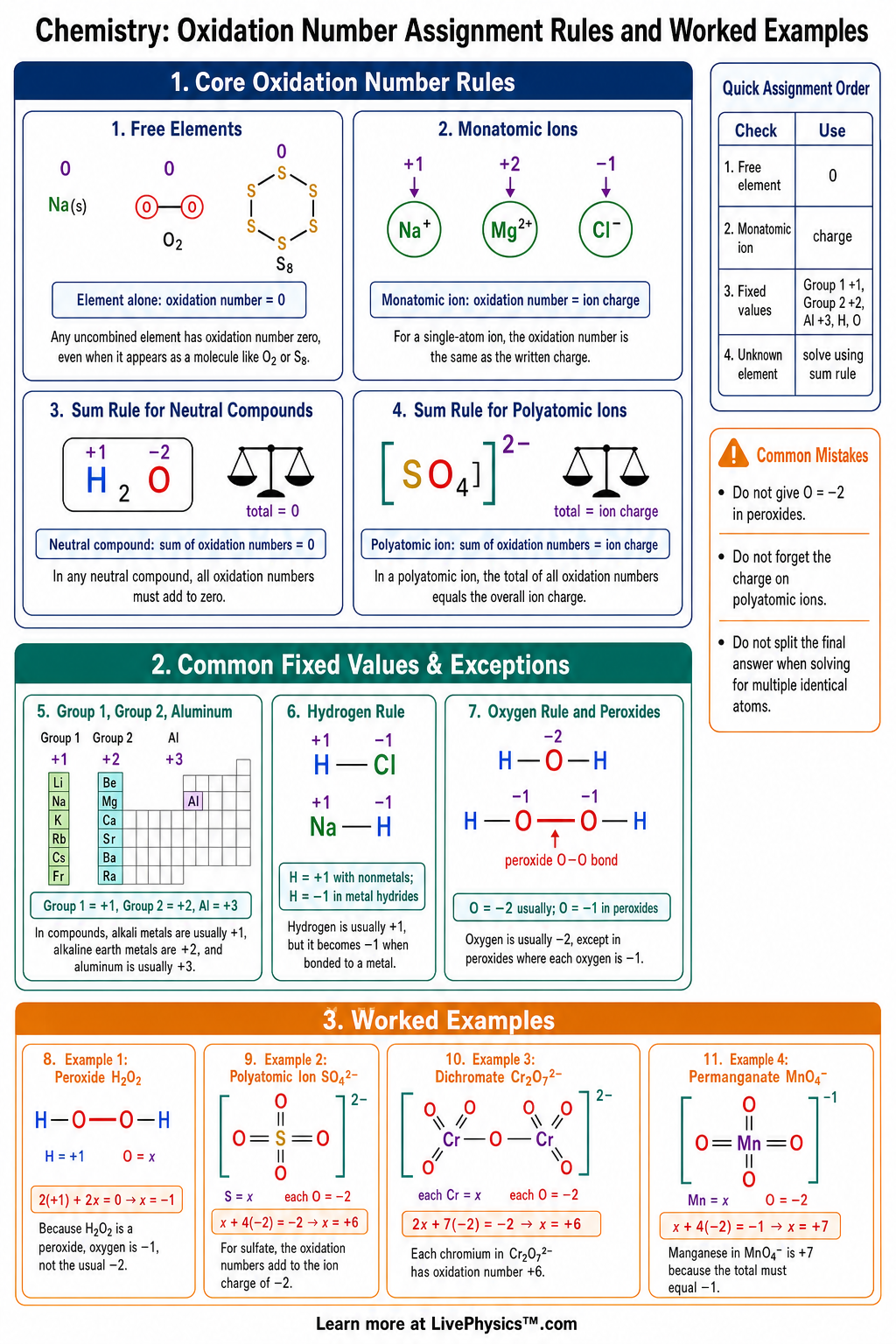
Oxidation numbers help students track electron movement in chemical reactions and identify oxidation and reduction. This cheat sheet covers the main rules for assigning oxidation numbers to atoms in elements, ions, compounds, and polyatomic ions. Students need these rules to balance redox reactions, name compounds, and understand electron transfer in chemistry.
It is designed as a quick reference for homework, labs, and test review.
The most important idea is that the sum of oxidation numbers must match the overall charge of the substance. Free elements have oxidation number , monatomic ions use their ion charge, and common elements such as oxygen, hydrogen, and halogens follow predictable patterns. Unknown oxidation numbers can be found by writing an equation using the known values.
Worked examples usually start with the most reliable rules, then solve for the atom that is not known.
Key Facts
- The oxidation number of any free element in its standard or uncombined form is , such as , , , and .
- The oxidation number of a monatomic ion equals its charge, so is , is , and is .
- The sum of all oxidation numbers in a neutral compound is , so in the total is .
- The sum of all oxidation numbers in a polyatomic ion equals the ion charge, so in the total is .
- Oxygen is usually , but it is in peroxides such as and positive when bonded to fluorine.
- Hydrogen is usually when bonded to nonmetals, but it is in metal hydrides such as .
- Fluorine is always in compounds, and other halogens are usually unless bonded to oxygen or a more electronegative halogen.
- Oxidation means an oxidation number increases, and reduction means an oxidation number decreases.
Vocabulary
- Oxidation number
- A number assigned to an atom that represents its apparent charge if electrons in bonds are assigned by electronegativity.
- Redox reaction
- A chemical reaction in which oxidation numbers change because electrons are transferred between substances.
- Oxidation
- The process in which an atom or ion loses electrons and its oxidation number increases.
- Reduction
- The process in which an atom or ion gains electrons and its oxidation number decreases.
- Polyatomic ion
- A charged group of covalently bonded atoms that acts as a single ion, such as or .
- Monatomic ion
- A single atom with a charge, such as or .
Common Mistakes to Avoid
- Using the subscript as the oxidation number is wrong because subscripts show how many atoms are present, not the charge or oxidation state of one atom.
- Forgetting to multiply by the number of atoms is wrong because the total contribution is the oxidation number times the subscript, such as for oxygen in .
- Making every compound add to is wrong for polyatomic ions because their oxidation numbers must add to the ion charge, such as for .
- Assuming oxygen is always is wrong because oxygen is in peroxides like and can be positive with fluorine.
- Confusing oxidation number changes with coefficient changes is wrong because redox depends on each atom's assigned oxidation number, not the balanced equation coefficients alone.
Practice Questions
- 1 Find the oxidation number of sulfur in .
- 2 Find the oxidation number of manganese in .
- 3 Assign oxidation numbers to each element in and explain which special rule applies.
- 4 In the reaction , explain which substance is oxidized and which substance is reduced.
Understanding Oxidation Number Assignment Rules and Worked Examples
An oxidation number is a bookkeeping value, not always a real electric charge on an atom. It imagines that bonding electrons belong completely to the more electronegative atom. This model works especially well for ionic compounds, where electron transfer is close to complete.
In covalent molecules, electrons are shared, so the assigned values can differ from the actual distribution of charge. The values are still useful because they give every atom a consistent electron accounting record. This is why chemists can track changes through a complicated reaction without needing to know the exact electron cloud around every bond.
A reliable method prevents most mistakes. First, write the formula clearly and identify whether it is neutral or charged. Next, assign values to atoms with rules that are hard to break, such as metals from Groups 1 and 2, fluorine, and usually oxygen.
Multiply each assigned value by the number of those atoms present. Then use the total charge to find the unknown value. In aluminum sulfate, treat sulfate as a charged group first.
Four oxygens contribute negative eight. Since the whole sulfate group has charge negative two, sulfur must contribute positive six. Working with a polyatomic ion as a unit makes longer formulas much less confusing.
The exceptions matter because they show that bonding partners control oxidation number. Oxygen is normally assigned negative two because it attracts electrons strongly. In a peroxide, the two oxygen atoms are bonded to each other.
Neither oxygen can claim the shared electrons more strongly, so each oxygen receives negative one instead. In a compound containing fluorine and oxygen, fluorine attracts electrons even more strongly than oxygen. Oxygen can therefore have a positive oxidation number.
Hydrogen changes in metal hydrides for a similar reason. A reactive metal gives electron density toward hydrogen, so hydrogen is assigned negative one.
Do not memorize exceptions as random facts. Connect each exception to which atom attracts bonding electrons more strongly.
Redox reactions become clearer when oxidation numbers are written above the atoms that change. For example, when iron metal forms an iron three ion, iron changes from zero to positive three. It has lost three electrons, so it is oxidized.
If copper two ions become copper metal, copper changes from positive two to zero. Each copper ion gains two electrons, so it is reduced. In a balanced reaction, the total number of electrons lost equals the total number gained.
Students often identify a substance as oxidized just because it contains oxygen. That shortcut fails in many reactions. Check the number on the specific atom before and after the reaction.
Pay close attention to coefficients, subscripts, ion charges, and unusual oxygen or hydrogen compounds. A correct rule used with the wrong atom count still gives the wrong answer.