Electrochemistry Cell Builder
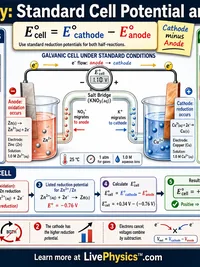
Pick anode and cathode half-reactions from the standard reduction potential table. Get E°cell, ΔG°, the equilibrium constant, and a fully balanced overall reaction. Switch between galvanic and electrolytic mode to see how the spontaneity flips.
Cell Configuration
Spontaneous reaction generates voltage. E°cell must be positive.
Standard temperature is 298.15 K (25 °C). Affects K_eq only.
Cell Schematic
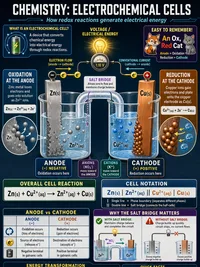
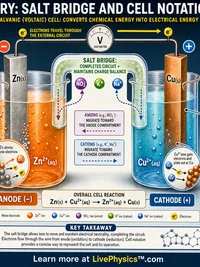
Electrons flow through the external wire from the anode to the cathode. The salt bridge keeps each solution electrically neutral.
Computed Values
Balanced Reaction
Reference Guide
Core Formulas
Nernst Equation
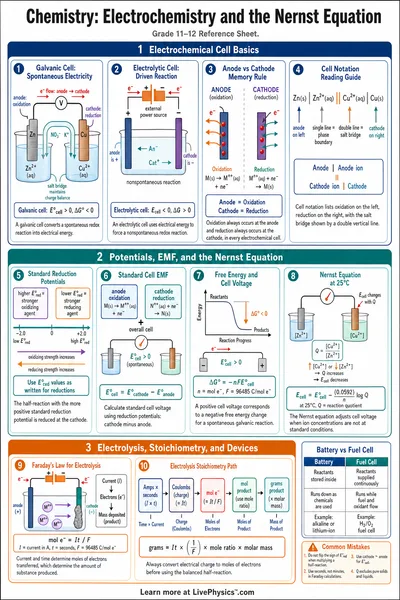
Real cells rarely run at standard concentrations. The Nernst equation corrects E°cell for the actual reaction quotient Q.
At 298 K, RT/F is about 0.0257 V. Using log base 10, the form most students see is
If Q is greater than 1 (more product than reactant), E_cell drops below E°cell. As the reaction proceeds toward equilibrium, E_cell falls to zero and the cell is dead.
Why a Salt Bridge
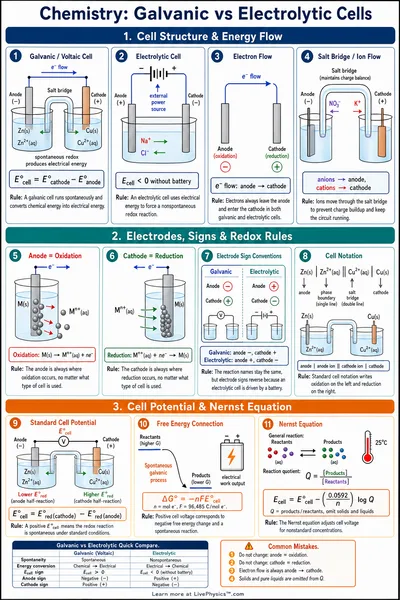
When the anode oxidizes, positive ions build up in the anode solution. When the cathode reduces, positive ions are consumed in the cathode solution. Both half-cells become electrically imbalanced and the reaction stops.
The salt bridge contains a neutral electrolyte such as KNO₃ or KCl. Its anions migrate toward the anode (canceling the excess positive charge there) and its cations migrate toward the cathode (replacing the consumed cations).
Without a salt bridge, current cannot flow for more than a fraction of a second. The bridge does not carry electrons. It only carries ions.
Galvanic vs Electrolytic
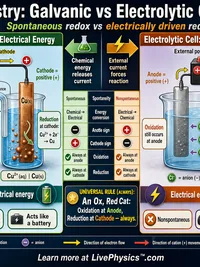
| Property | Galvanic | Electrolytic |
|---|---|---|
| E°cell | positive | negative |
| ΔG° | negative | positive |
| Energy | released | supplied |
| Anode sign | − | + |
| Cathode sign | + | − |
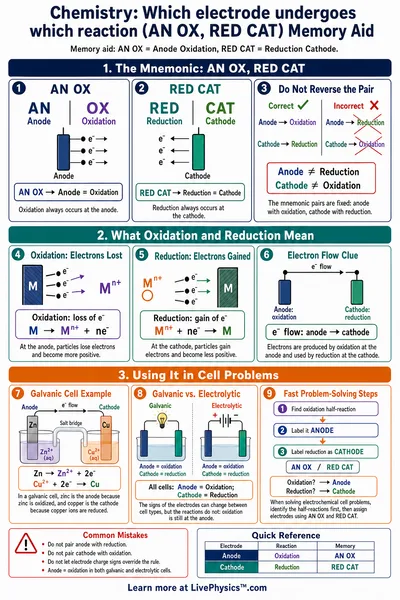
Both cells have oxidation at the anode and reduction at the cathode. The difference is whether the reaction runs on its own (galvanic) or needs an external power source (electrolytic).
Reading the Reduction Table
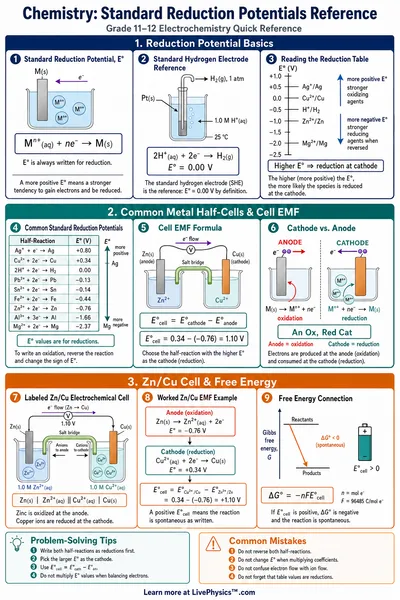
The table lists half-reactions written as reductions, ranked by E°. Species at the top (large positive E°) are strong oxidizing agents. Species at the bottom (large negative E°) are strong reducing agents.
- Spontaneous pairing. Pick a strong oxidizer for the cathode and a strong reducer for the anode. The bigger the gap in E°, the more voltage you get.
- F₂ at +2.87 V is one of the strongest oxidizers known.
- Li at −3.04 V is the strongest common reducing agent, which is why Li-ion batteries pack so much energy per gram.
- SHE (2H⁺/H₂) sits at exactly 0 V by definition.
Real-World Applications
- Batteries. Alkaline cells use Zn anode and MnO₂ cathode. Lead-acid cells use Pb and PbO₂ in sulfuric acid. Lithium-ion cells use a graphite anode and a lithium metal oxide cathode.
- Electroplating. Drive a non-spontaneous reaction with an external power source to deposit a thin layer of metal on a surface. Decorative gold plating, chrome bumpers, and zinc galvanizing all work this way.
- Corrosion. Iron rusting is a galvanic process. Sacrificial anodes made of zinc or magnesium are bolted to ship hulls so they corrode instead of the iron.
- Electrolysis. Industrial chlorine and sodium hydroxide come from the electrolysis of brine. Aluminum is produced from molten Al₂O₃ by the Hall-Héroult process.
- Fuel cells. A hydrogen-oxygen fuel cell uses 2H₂ + O₂ → 2H₂O and produces about 1.23 V at standard conditions.