Electrolysis & Metal Plating Lab
Choose a metal to plate, set the current and the plating time, and predict how much metal deposits on the cathode using Faraday's law. Watch the charge passed, the moles of electrons and metal, the mass plated, and the layer thickness building up on the electrode. Compare silver, copper, gold, and other metals to see why the electrons per ion control how many grams plate per coulomb.
Guided ExperimentHow current and time control the mass plated
The mass of metal plated depends on the total charge passed, and charge is current times time. What happens to the mass when you double the current or double the time?
Write your hypothesis in the Lab Report panel, then click Next.
Controls
The charge passed is the current times the time. Each metal ion needs n electrons to plate out, so a higher n means fewer grams per coulomb. The electrode area sets how that mass spreads into a layer thickness. Current efficiency below 100 percent means some charge drives side reactions instead of plating.
Electrolytic cell
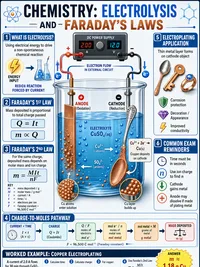
The power source pushes electrons onto the cathode, where positive metal ions gain electrons and plate out as solid metal. The amber band shows the plated layer, scaled to the computed thickness.
Results
Charge passed
3600C
Moles of electrons
0.0373mol
Moles of metal
0.01866mol
Mass deposited
1.1856g
Plating thickness
66.16µm
Atoms deposited
1.123 × 10^22
Grams per coulomb
3.293e-4g/C
Faraday's law
m = (I · t · M) / (n · F)
m = (2.0 A · 1800 s · 63.55 g/mol) / (2 · 96485 C/mol) = 1.1856 g
Takeaways
- •Doubling the current or the time doubles the charge passed, which doubles the mass plated, because the mass tracks the total charge.
- •Each Cu²⁺ ion needs 2 electrons, so it takes 2 times as much charge to plate the same number of atoms as a metal with a single-electron ion.
- •At 100 percent current efficiency, every coulomb goes into plating metal, so the deposited mass is the full Faraday-law value.
The charge is the current times the time in seconds, 2.0 A times 1800 s. Dividing by the Faraday constant gives moles of electrons, and dividing by n gives moles of Copper. Multiplying by the molar mass gives the mass plated.
Data Table
(0 rows)| # | Metal | Current(A) | Time(min) | Charge(C) | Mass(g) | Thickness(um) |
|---|
Reference Guide
Electrolysis and Electroplating
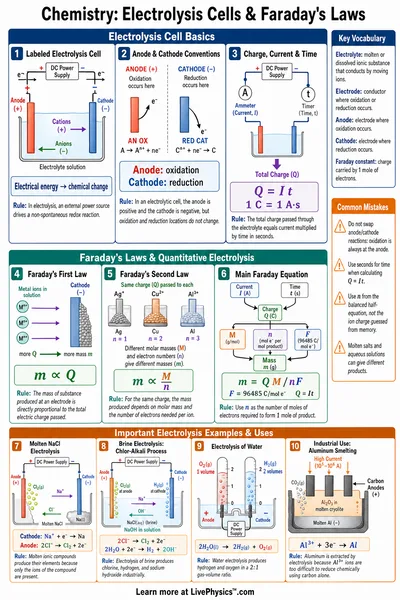
In electrolysis, an outside power source drives a chemical change that would not happen on its own. Electroplating uses this to coat one metal onto an object.
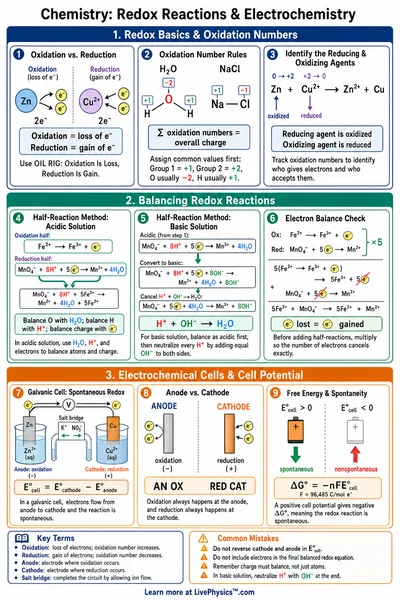
- The anode is the positive electrode where oxidation happens.
- The cathode is the negative electrode where metal ions gain electrons and plate out.
- The electrolyte is a solution of the metal salt that carries the ions.
- Electrons flow from the power source onto the cathode to reduce the ions.
The object to be plated is the cathode. Positive metal ions move toward it and deposit as a solid layer.
Faraday's First Law
Faraday's first law says the mass of metal deposited is proportional to the total electric charge passed through the cell.
- The charge in coulombs is the current in amperes times the time in seconds.
- Doubling the current doubles the mass plated.
- Doubling the time doubles the mass plated.
- The Faraday constant is about 96485 coulombs per mole of electrons.
Dividing the charge by the Faraday constant gives the moles of electrons that flowed through the circuit.
Faraday's Second Law
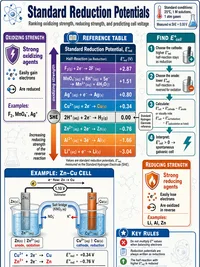
Faraday's second law says that for the same charge, the mass deposited depends on the metal. Each ion needs a set number of electrons to become a neutral atom.
- A silver ion needs one electron, so silver plates many grams per coulomb.
- A copper or nickel ion needs two electrons.
- A gold or chromium ion needs three electrons, so fewer atoms plate per coulomb.
- Mass is the molar mass divided by the electrons per ion, all times the moles of electrons.
A large molar mass does not always mean more mass plated, because a higher charge per ion lowers the grams plated per coulomb.
Current Efficiency and Thickness
Real cells are not perfectly efficient. Some of the charge drives side reactions, such as releasing hydrogen gas, instead of plating metal.
- Current efficiency is the fraction of charge that actually plates metal.
- At 50 percent efficiency, only half of the ideal mass deposits.
- The plating thickness is the mass divided by the metal density and the electrode area.
- Spreading the same mass over a larger area gives a thinner layer.
Engineers use Faraday's law and current efficiency to control how thick a plated coating turns out.