Qualitative Analysis, Unknown Ion Identification Lab
You are handed a solution containing one unknown metal cation. Add group reagents in any order, observe whether a precipitate forms and what color it is, and watch the list of still-possible ions narrow with each test. When one cation remains, submit your identification and record the result in the data table.
Guided Experiment Identifying an Unknown Cation by Wet Chemical Tests
You are given a solution containing one unknown metal cation. Which group reagents would you add first to start narrowing down the possibilities, and what observations would you expect for silver, lead, barium, copper(II), iron(III), and zinc?
Write your hypothesis in the Lab Report panel, then click Next.
Add a reagent to observe the result.
Controls
Add a reagent
Still possible (6)
Submit your identification
Data Table
(0 rows)| # | Trial | Sample | Reagent | Observation | Identified Cation | Correct? |
|---|
Reference Guide
What Qualitative Analysis Is
Qualitative analysis answers the question of which ions are present in a sample, without measuring how much. For metal cations the classic approach is a sequence of wet chemical tests. Each reagent reacts with some cations and not others, so the pattern of results points to a single ion.
The key observations are whether a precipitate forms, what color it is, and whether that precipitate redissolves when more reagent is added. Reading these clues in order lets you eliminate possibilities one at a time.
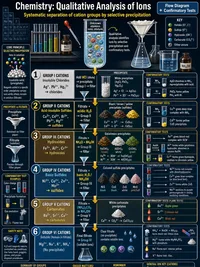
The Systematic Scheme of Group Reagents
Dilute HCl. Precipitates the insoluble chlorides of silver (AgCl) and lead (PbCl₂) as white solids. Other cations stay in solution.
Dilute H₂SO₄. Precipitates the insoluble sulfates of barium (BaSO₄) and lead (PbSO₄) as white solids.
NaOH, then excess. Forms metal hydroxides whose color and solubility separate the remaining cations.
Ammonia in excess. A confirmatory test through complex-ion formation.
Reading Precipitate Colors
Copper(II) (Cu²⁺). Blue gelatinous Cu(OH)₂ with NaOH.
Iron(III) (Fe³⁺). Red-brown Fe(OH)₃ with NaOH.
Zinc (Zn²⁺). White Zn(OH)₂ with NaOH.
Lead (Pb²⁺). White hydroxide, white chloride, white sulfate.
Silver (Ag⁺). White AgCl with HCl, brown Ag₂O with NaOH.
A white precipitate alone is not enough. You must combine it with the reagent used and with the redissolving tests below to reach one cation.
Amphoteric Hydroxides and Confirmatory Tests
Zinc and lead hydroxides are amphoteric. They dissolve in excess strong base because they react with the extra hydroxide to form soluble complexes such as the zincate ion, so a white precipitate that redissolves in excess NaOH points to zinc or lead. Iron(III) and copper(II) hydroxides do not redissolve.
Adding excess ammonia gives confirmatory tests through complex-ion formation. Copper forms a deep-blue solution, silver chloride and zinc hydroxide redissolve as ammine complexes, while barium and iron(III) are unaffected. Combining the precipitation, color, and redissolving results leaves exactly one cation.