Sign in to save

Bookmark this page so you can find it later.

Sign in to save

Bookmark this page so you can find it later.

Earth Science middle-school May 21, 2026

Why Do Eclipses Happen?

Shadows reveal the Sun Earth Moon system
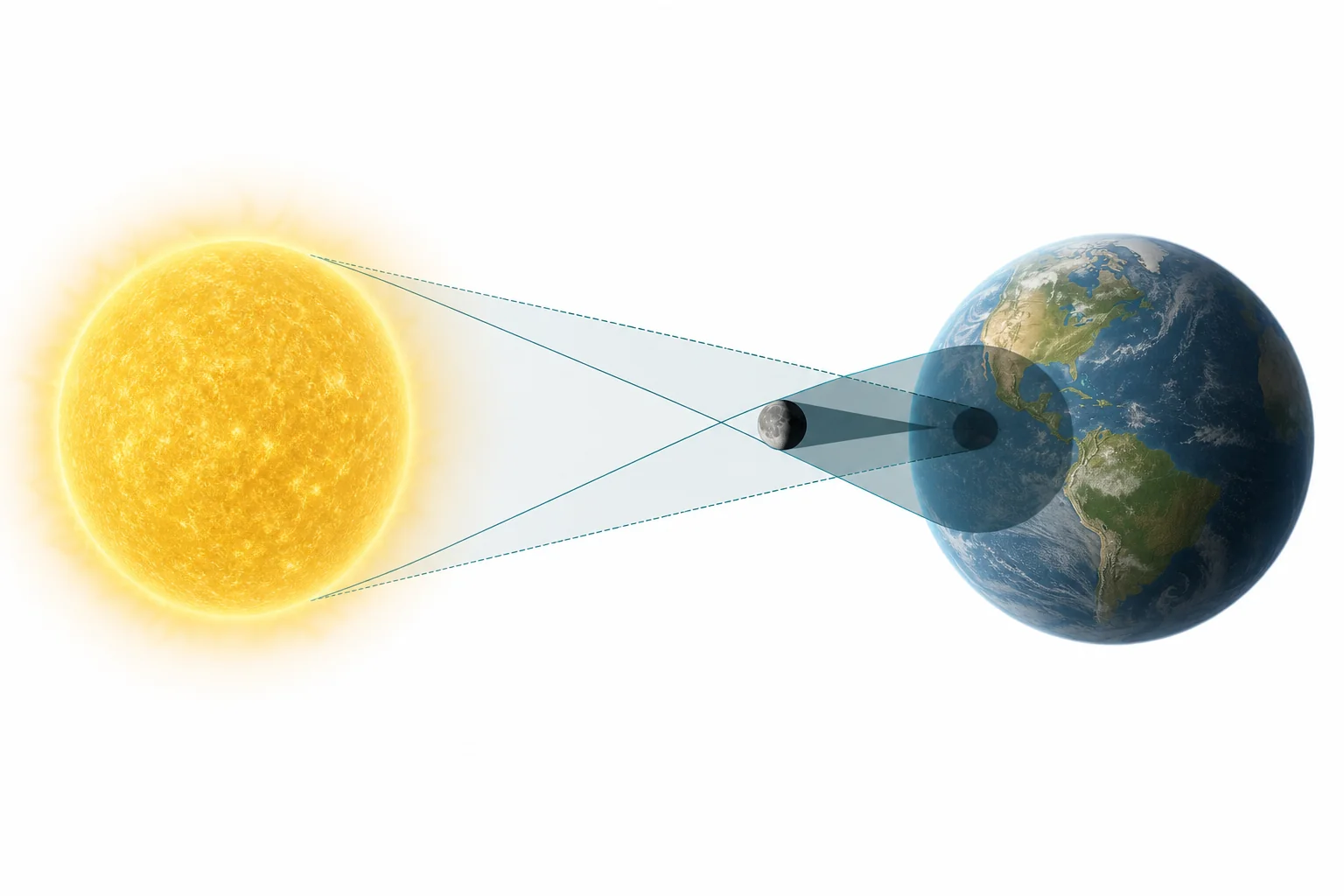
Diagram of the Sun, Earth, and Moon aligned so that one object casts a shadow on another during an eclipse.

Eclipses happen when the Sun, Earth, and Moon line up so one object blocks sunlight from reaching another. In a solar eclipse, the Moon moves between Earth and the Sun and its shadow falls on Earth. In a lunar eclipse, Earth moves between the Sun and Moon and Earth's shadow falls on the Moon.

Big Idea. NGSS MS-ESS1-1 uses models of the Sun, Earth, and Moon system to explain patterns such as eclipses.

An eclipse is not a mystery event in the sky. It is a shadow problem. The Sun gives off light in many directions. Earth and the Moon are round objects that can block that light. When the three bodies line up in the right order, a shadow lands where we can see it. That is an eclipse. The kind of eclipse depends on which object is in the middle. If the Moon is between Earth and the Sun, people in a narrow path on Earth may see a solar eclipse. If Earth is between the Sun and the Moon, people on the night side of Earth may see a lunar eclipse. Eclipses do not happen every month because the Moon's orbit is tilted. Most months, the shadows miss. When the timing and alignment match, the sky gives a clear lesson in geometry.

Three bodies must line up
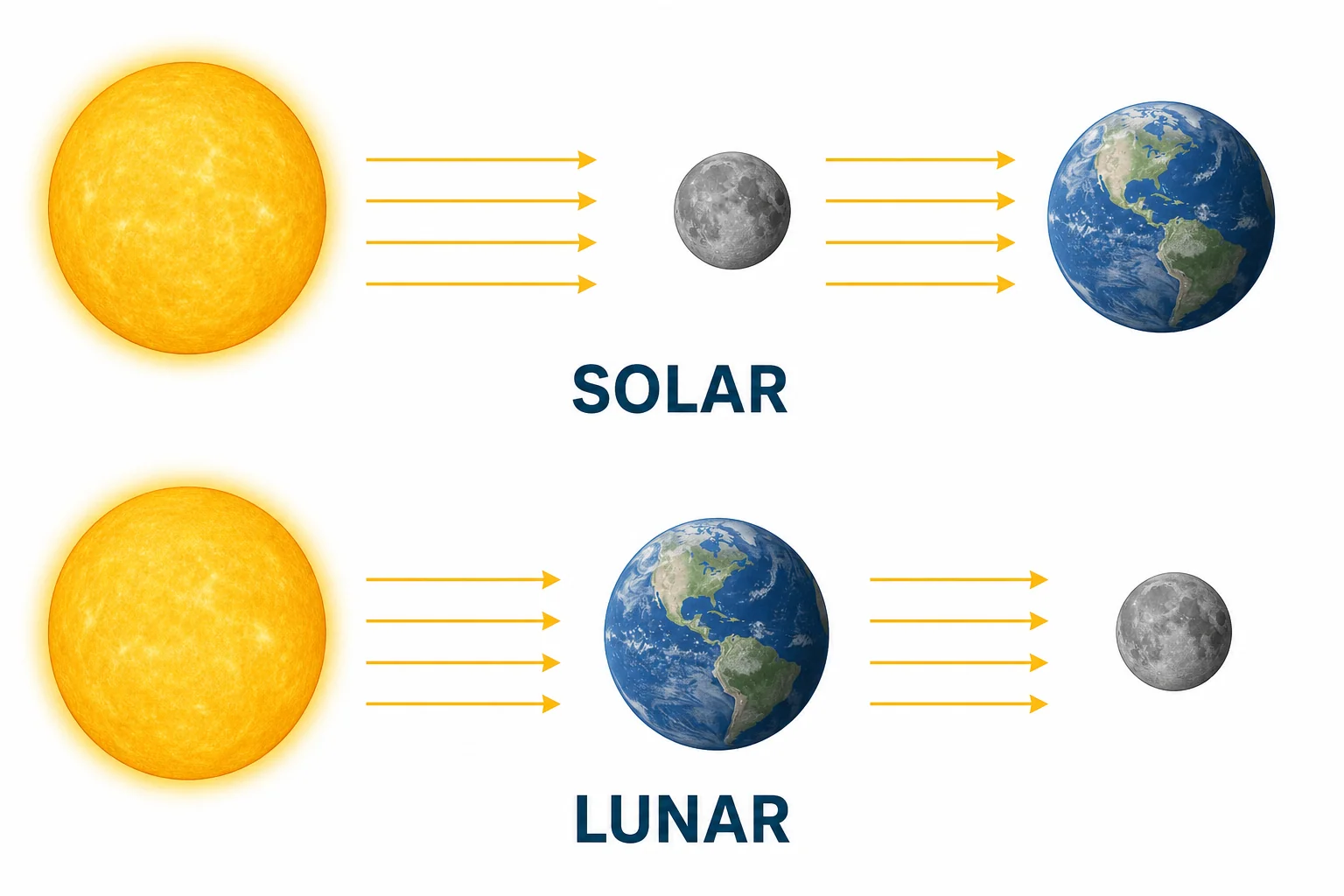
Side-by-side diagrams showing the Sun, Moon, and Earth aligned for a solar eclipse and the Sun, Earth, and Moon aligned for a lunar eclipse.
The object in the middle decides the eclipse type.
The Sun, Earth, and Moon are always moving. Earth orbits the Sun, and the Moon orbits Earth. An eclipse needs more than motion. It needs alignment. The three bodies must be lined up so sunlight is blocked. The order decides the eclipse type. For a solar eclipse, the order is Sun, Moon, Earth. The Moon is smaller than Earth, but it is much closer to us. From Earth, it can appear large enough to cover the Sun. For a lunar eclipse, the order is Sun, Earth, Moon. Earth blocks sunlight that would have reached the Moon. The Moon then moves through Earth's shadow. A simple line model helps show why this is a predictable event. The same model also shows why eclipses are not random. They happen when position and timing match.

An eclipse is an alignment of light, objects, and shadows.

A solar eclipse casts a small shadow
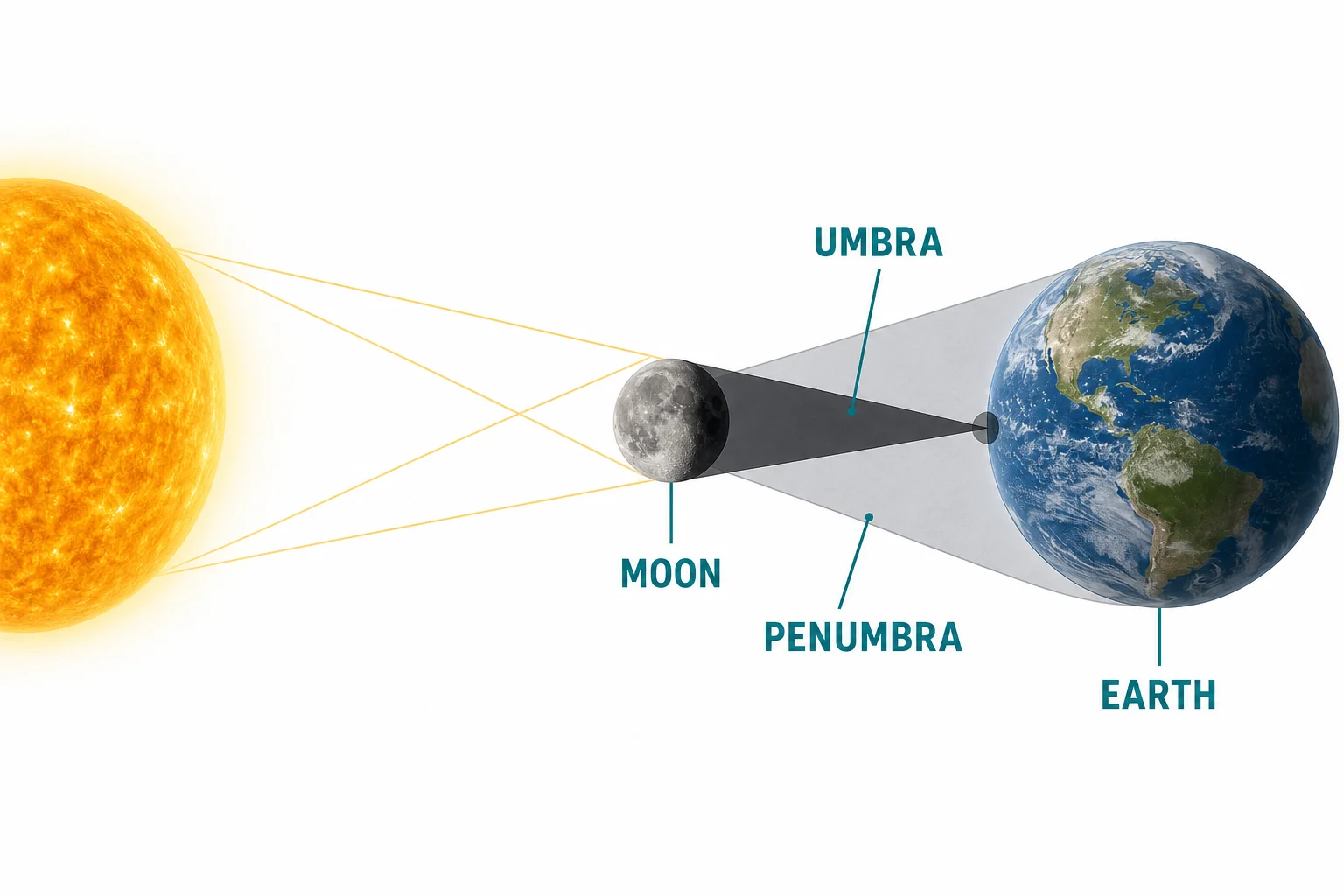
Solar eclipse shadow geometry showing the Moon between the Sun and Earth, with dark umbra and lighter penumbra reaching Earth.
The Moon's shadow has a dark center and a lighter outer region.
A solar eclipse happens during a new moon. At that time, the Moon is between Earth and the Sun. If the Moon lines up closely with the Sun, its shadow reaches Earth. The darkest part of the shadow is the umbra. A person inside that small area may see the Sun fully covered. Around it is a lighter shadow called the penumbra. A person there sees only part of the Sun covered. This is why a total solar eclipse is visible only along a narrow path. People outside that path may see a partial eclipse, or no eclipse at all. The Moon's shadow is shaped like a cone because the Sun is wider than the Moon. As Earth rotates and the Moon moves, the shadow path sweeps across Earth.

The total solar eclipse path is small because the Moon's darkest shadow is small.

A lunar eclipse uses Earth's shadow
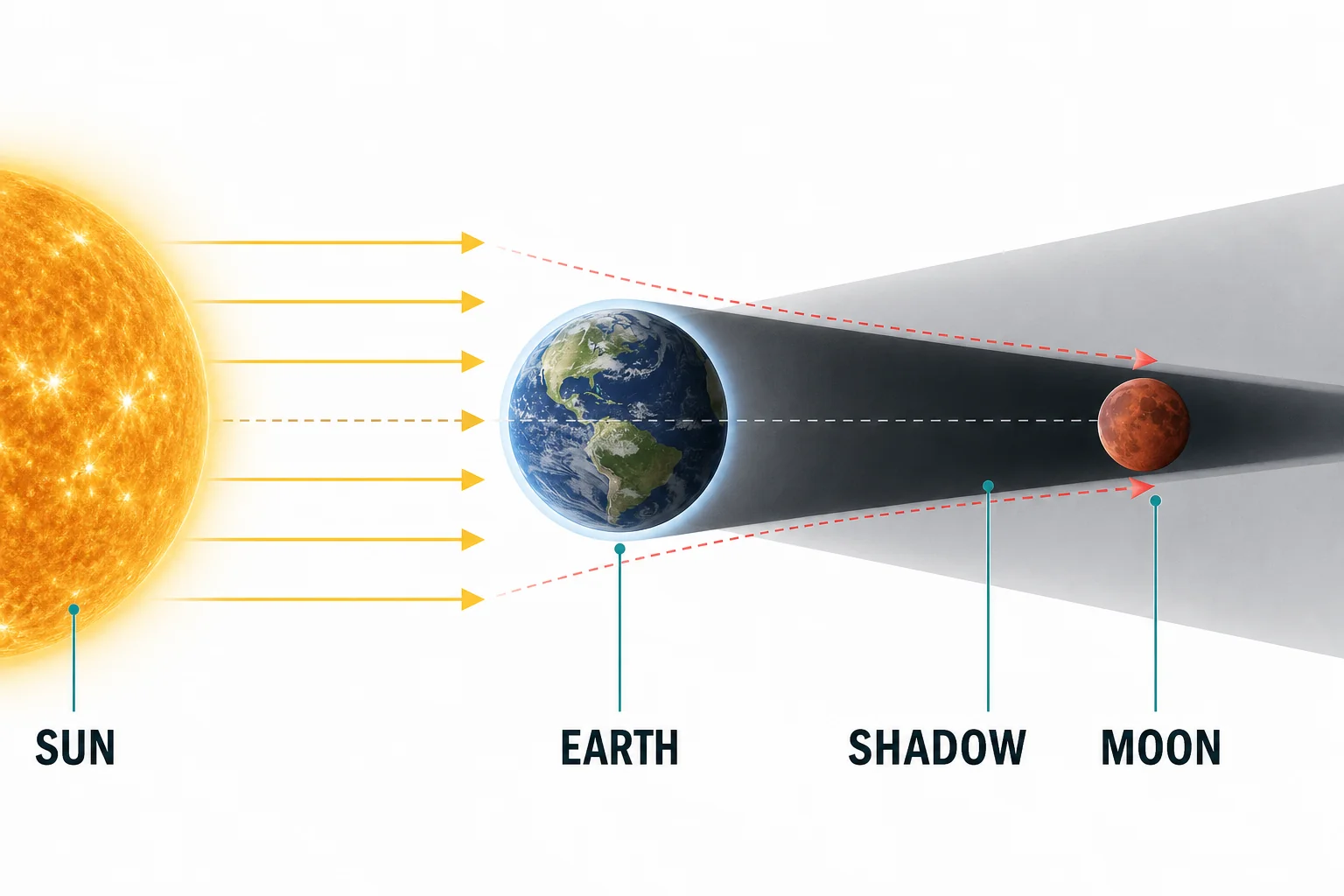
Lunar eclipse diagram showing Earth between the Sun and Moon, with the Moon passing through Earth's shadow.
During a lunar eclipse, the Moon moves through Earth's shadow.
A lunar eclipse happens during a full moon. At that time, Earth is between the Sun and the Moon. If the alignment is close enough, the Moon moves into Earth's shadow. Earth's shadow is much larger than the Moon's shadow because Earth is larger than the Moon. This is why a lunar eclipse can be seen by many people on Earth's night side. The Moon does not disappear completely during many lunar eclipses. It can look dim red or orange. That color comes from sunlight bending through Earth's atmosphere before reaching the Moon. Blue light is scattered more strongly, while redder light can continue around Earth. The Moon is still receiving some sunlight, but the light has taken a longer path through air first.

A lunar eclipse is visible from anywhere on Earth's night side with a clear sky.

The Moon's orbit is tilted
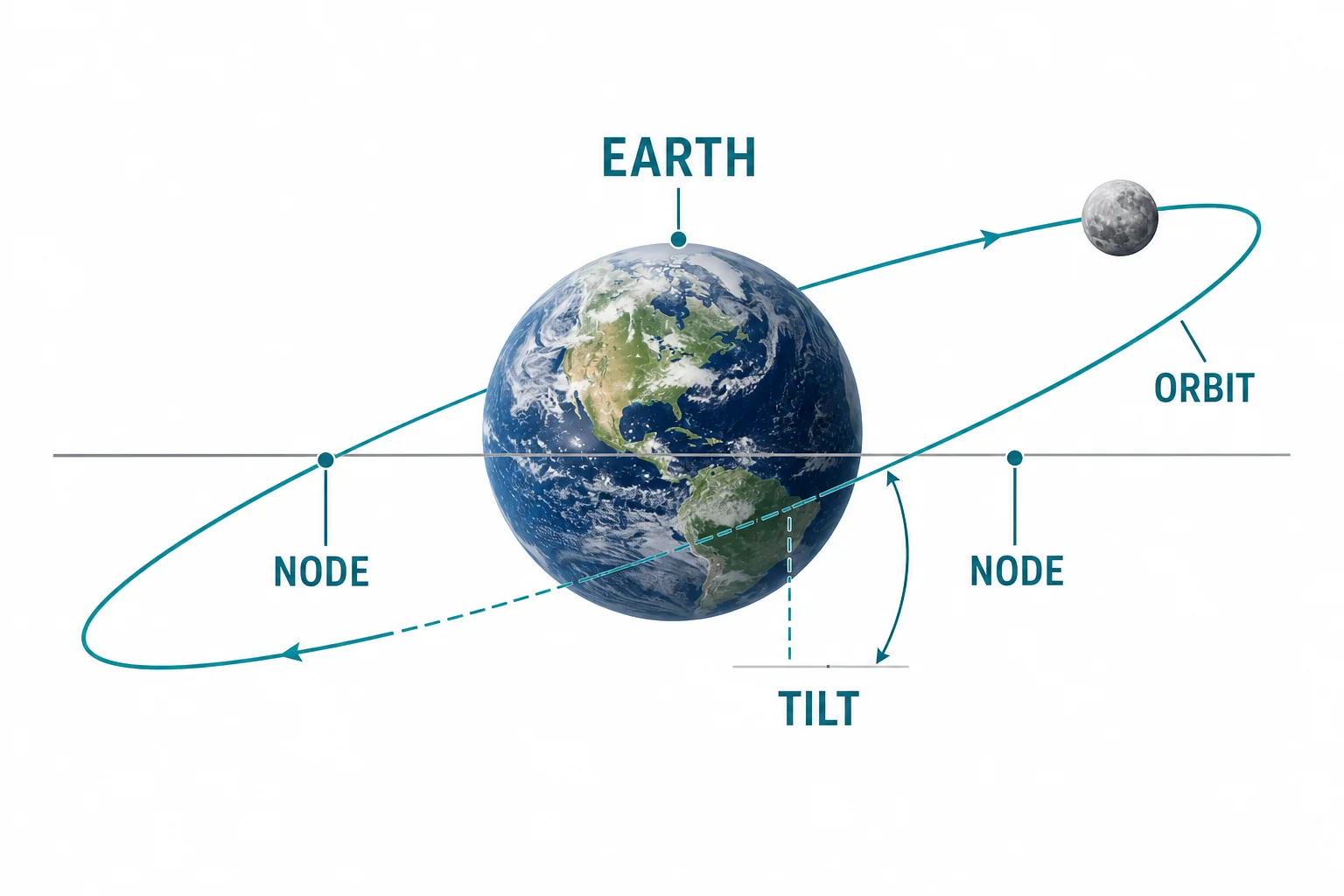
Diagram showing the Moon's tilted orbit around Earth crossing Earth's orbital plane at two nodes.
The Moon usually misses the shadow because its orbit is tilted.
If the Moon orbited Earth in the exact same flat plane as Earth orbits the Sun, eclipses would happen every month. Solar eclipses would happen at every new moon, and lunar eclipses would happen at every full moon. That is not what we see. The Moon's orbit is tilted about 5 degrees compared with Earth's path around the Sun. Most of the time, the Moon passes a little above or below the Sun from our point of view. At full moon, it usually passes above or below Earth's shadow. Eclipses happen only when the Moon is near one of the two places where its tilted orbit crosses Earth's orbital plane. These crossing places are called nodes. The Moon must be near a node at the same time it is new or full.

Eclipse seasons happen when new or full moons occur near the Moon's orbital nodes.

Observers see different events
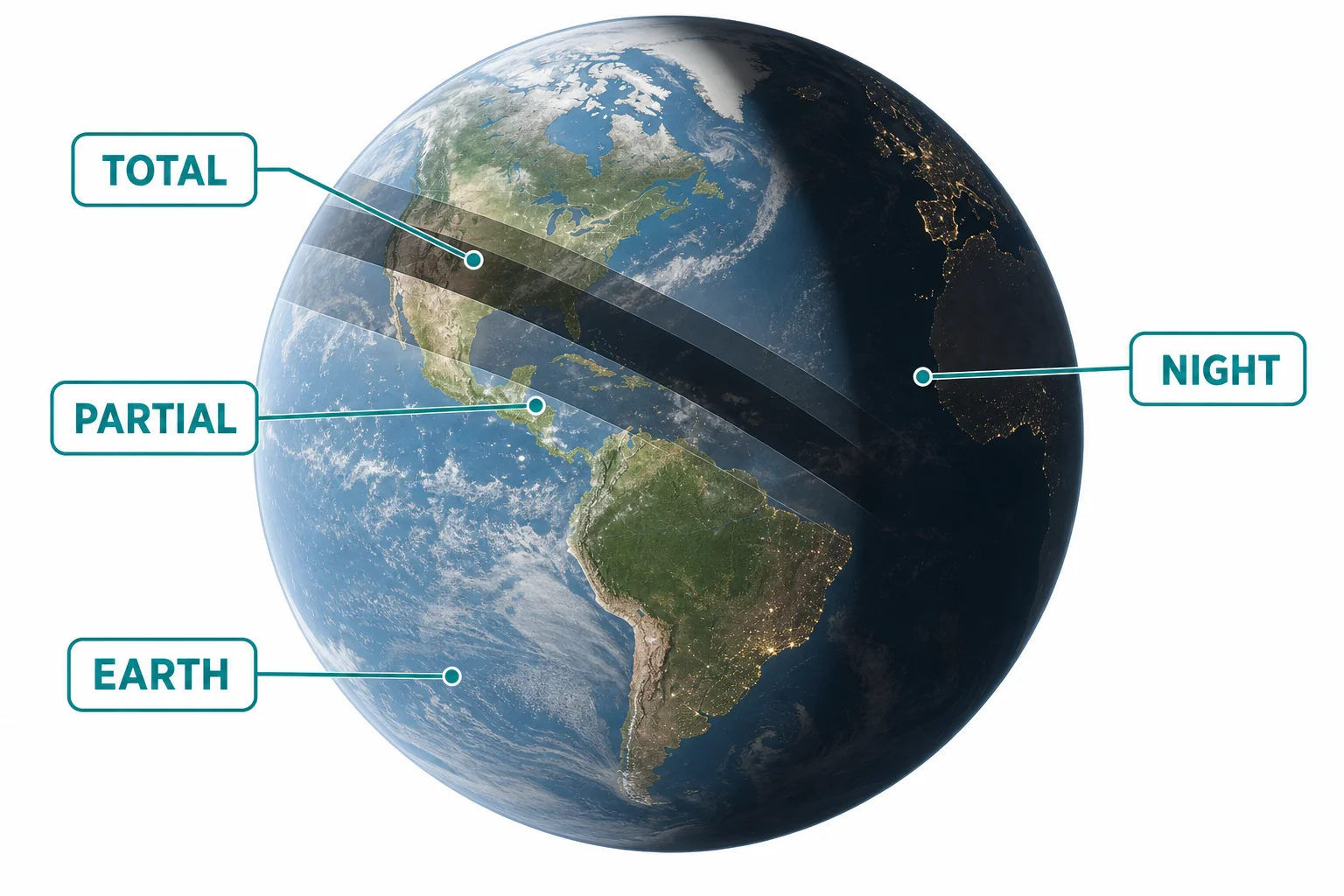
Map-style view of Earth showing a narrow solar eclipse path and a wider night side view for a lunar eclipse.
Where you stand affects what kind of eclipse you see.
The same eclipse can look different from different places. During a solar eclipse, location matters a lot. Someone in the umbra may see a total solar eclipse. Someone in the penumbra may see a partial solar eclipse. Someone far away sees no eclipse. This is because the Moon's shadow covers only part of Earth at one time. During a lunar eclipse, everyone on the night side of Earth sees the same Moon pass through the shadow, though weather and time zone can change the view. Solar eclipses also need special safety care. Looking at the Sun without proper eclipse glasses can damage eyes. Lunar eclipses are safe to watch with the unaided eye. Both events can be predicted because they follow orbital patterns.

Solar eclipses are local, while lunar eclipses are visible over a much wider area.

Vocabulary

Eclipse
An event when one object in space blocks light from reaching another object.
Solar eclipse
An eclipse that happens when the Moon moves between Earth and the Sun and casts a shadow on Earth.
Lunar eclipse
An eclipse that happens when Earth moves between the Sun and the Moon and casts a shadow on the Moon.
Umbra
The darkest part of a shadow, where the light source is fully blocked.
Penumbra
The lighter outer part of a shadow, where the light source is only partly blocked.
Node
A point where the Moon's tilted orbit crosses Earth's orbital plane.

In the Classroom

Lamp, ball, and shadow model

25 minutes | Grades 6-8

Use a lamp for the Sun, a large ball for Earth, and a small ball for the Moon. Students move the Moon into different positions and record when a shadow reaches Earth or the Moon.

Umbra and penumbra tracing

20 minutes | Grades 6-8

Students shine a flashlight past a small sphere onto paper and trace the dark and light shadow regions. They compare the traced shadow to solar eclipse diagrams.

Why not every month diagram

30 minutes | Grades 6-8

Students draw Earth, the Moon's tilted orbit, and the two nodes. They use the diagram to explain why new moon and full moon do not always make eclipses.

Key Takeaways

  • Eclipses happen when the Sun, Earth, and Moon line up so one object blocks sunlight.
  • A solar eclipse happens when the Moon's shadow falls on Earth.
  • A lunar eclipse happens when Earth's shadow falls on the Moon.
  • The umbra is the darkest part of a shadow, and the penumbra is the lighter outer part.
  • Eclipses do not happen every month because the Moon's orbit is tilted.