Sign in to save

Bookmark this page so you can find it later.

Sign in to save

Bookmark this page so you can find it later.

Earth Science middle-school May 21, 2026

Why Do We Have Seasons?

How tilt changes sunlight through the year
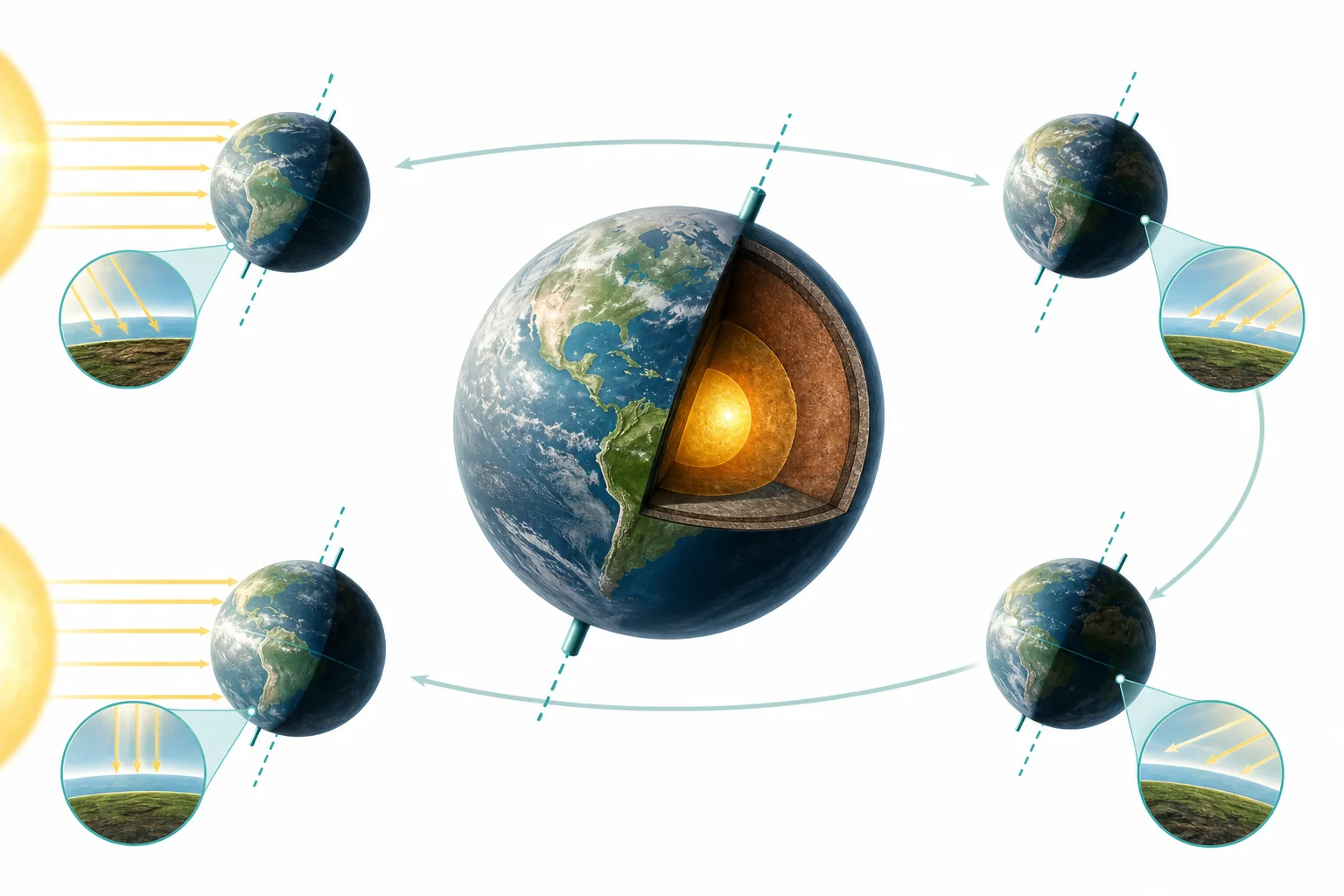
Earth orbiting the Sun with its axis tilted, showing different sunlight patterns in the Northern and Southern Hemispheres.

We have seasons because Earth is tilted as it travels around the Sun. The tilt changes how high the Sun appears in the sky and how long daylight lasts. When one half of Earth tilts toward the Sun, it has summer while the other half has winter.

Big Idea. NGSS MS-ESS1-1 connects seasons to the pattern of Earth’s motion around the Sun and the steady tilt of Earth’s axis.

Seasons feel like a change in weather, but the cause starts with geometry. Earth spins once each day on an imaginary line through the North and South Poles. That line is tilted about $23.5^\circ$ compared with Earth’s path around the Sun. As Earth moves through its year, that tilt keeps pointing in nearly the same direction in space. This changes how sunlight reaches each hemisphere. Sometimes sunlight hits more directly and stays longer each day. That brings warmer months. At other times, sunlight arrives at a lower angle and the days are shorter. That brings cooler months. Seasons are not caused by Earth moving much closer to or farther from the Sun. In fact, Earth is closest to the Sun during January. The key idea is the tilt, plus the way sunlight spreads over Earth’s curved surface.

Earth is tilted
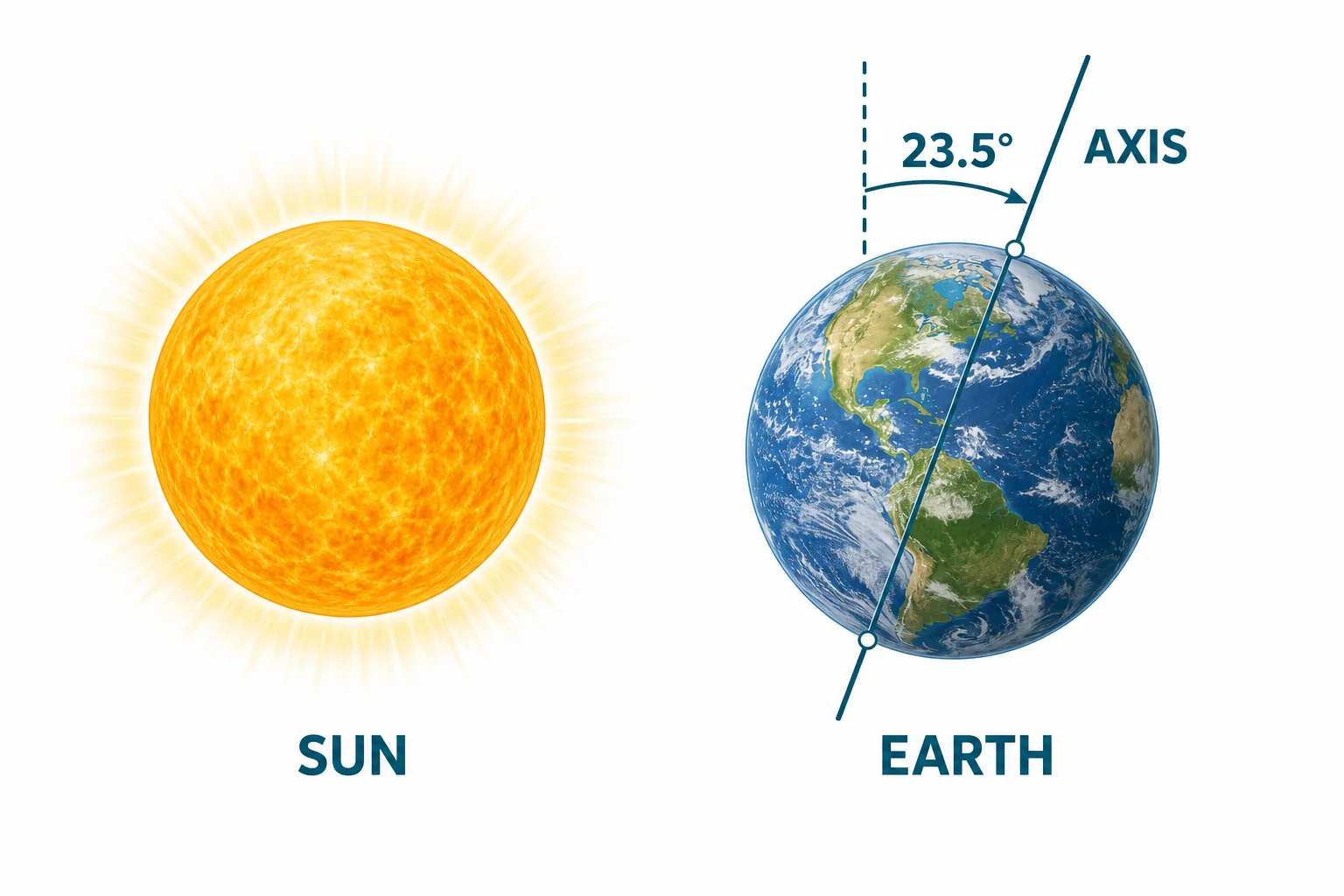
Diagram of Earth with a tilted axis next to the Sun, showing the axis leaning about 23.5 degrees.
Earth’s axis leans about $23.5^\circ$.
Earth does not spin straight up and down compared with its path around the Sun. Its spin axis leans by about $23.5^\circ$. This lean is called axial tilt. The axis points nearly toward the same place in space all year. That steady direction matters. As Earth orbits the Sun, different hemispheres lean toward the Sun at different times. When the Northern Hemisphere leans toward the Sun, the Sun takes a higher path through the sky there. The days also last longer. Six months later, the Northern Hemisphere leans away from the Sun. The Sun’s path is lower, and the days are shorter. The Southern Hemisphere does the opposite. A small tilt creates a large yearly pattern because it affects every sunrise, noon shadow, and sunset over many weeks.

The tilt stays nearly fixed as Earth moves around the Sun.

Sun angle matters
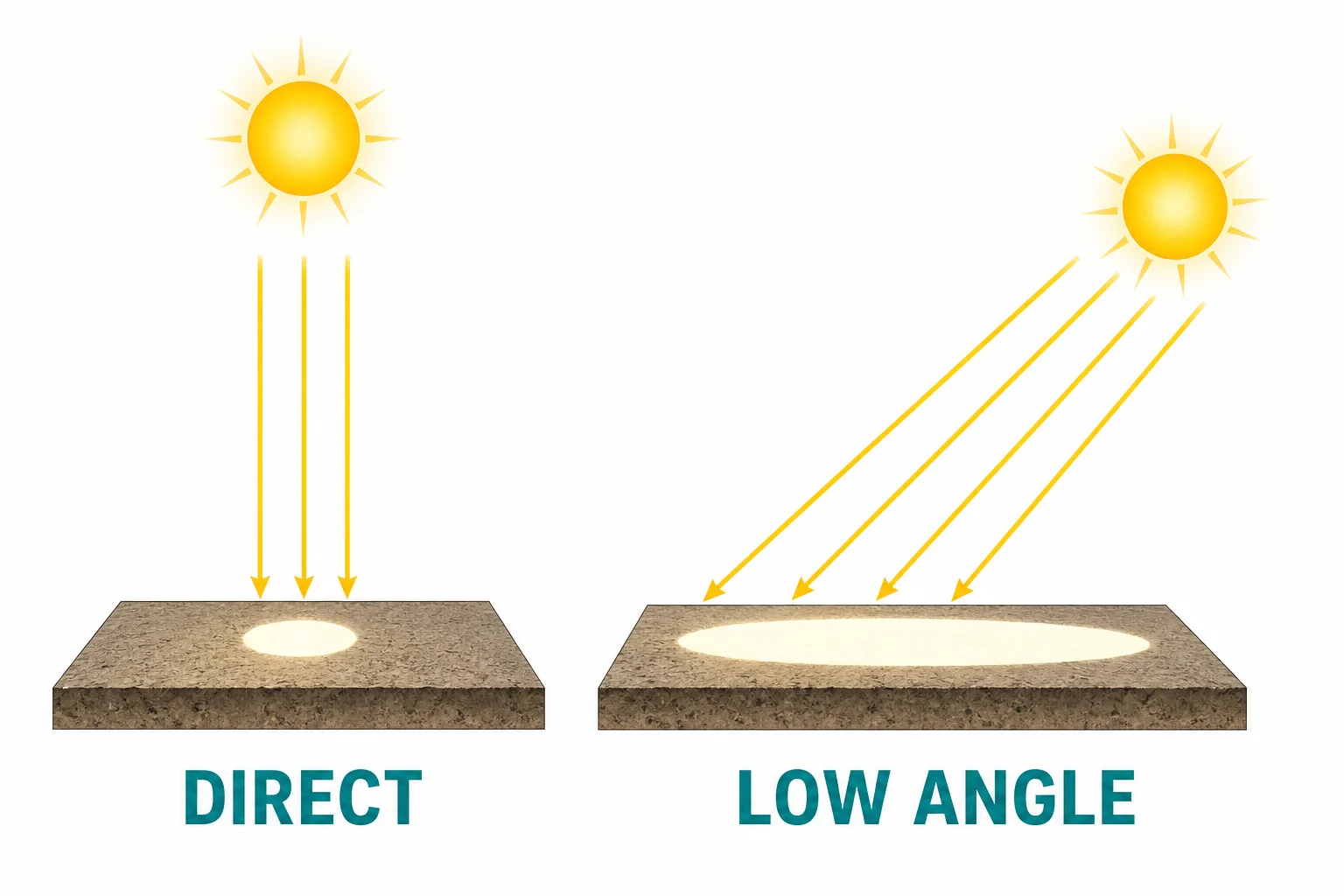
Comparison of direct sunlight covering a small area and low-angle sunlight covering a larger area on Earth’s surface.
Direct sunlight is more concentrated.
Sunlight warms the ground more when it arrives from high overhead. The same beam of sunlight covers a smaller patch of ground, so the energy is more concentrated. When sunlight arrives at a low angle, the same beam spreads across a larger patch. Each square meter gets less energy. This is one reason noon feels warmer than early morning, even on the same day. Seasons work in a similar way over months. In summer, the Sun’s path is higher in the sky for that hemisphere. Sunlight strikes the ground more directly. In winter, the Sun stays lower in the sky. Sunlight spreads out more before it warms the surface. The change is not about the Sun producing more or less energy. It is about how Earth’s tilt changes the angle of incoming light.

Higher Sun angle means more sunlight energy per area.

Daylight hours change
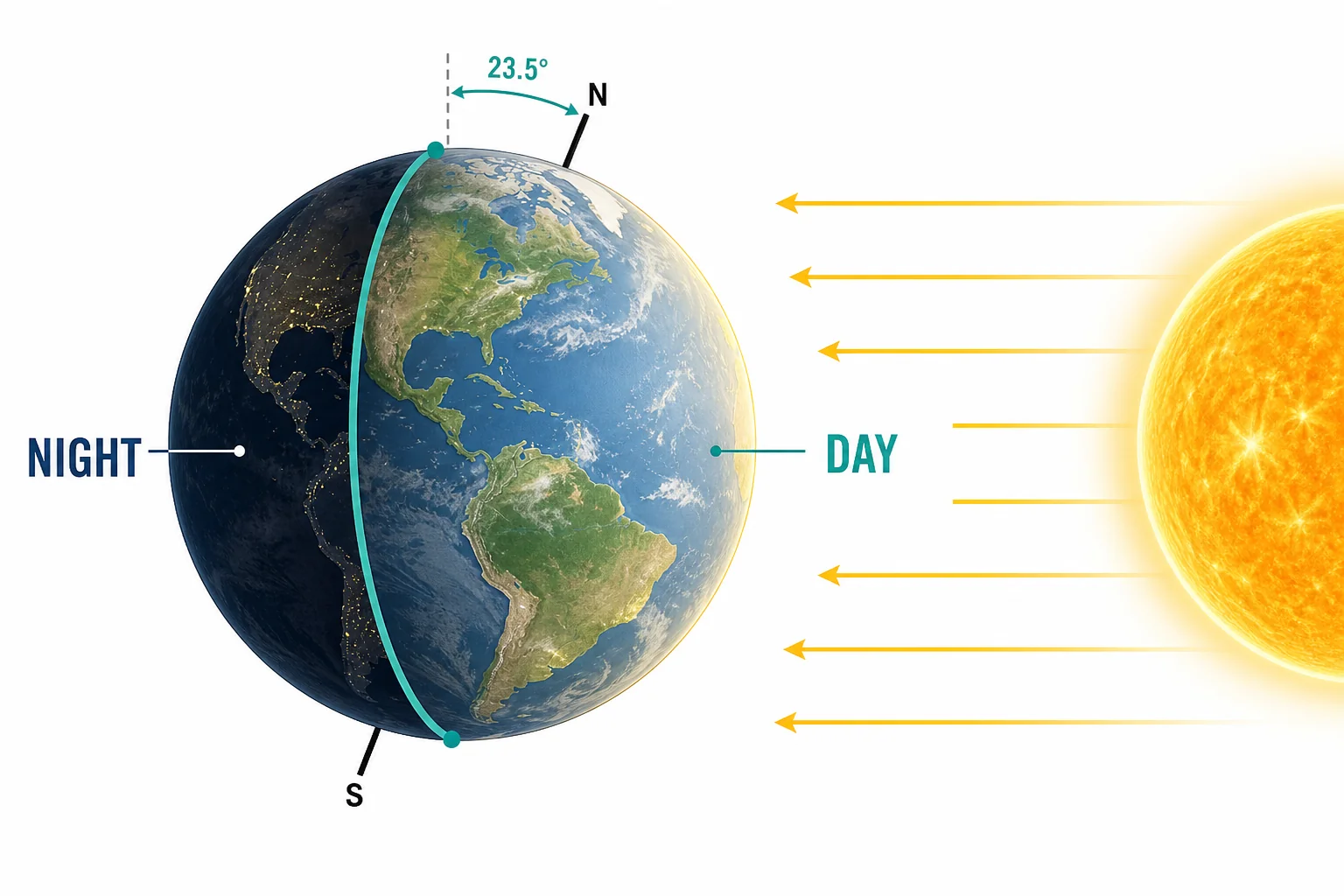
Earth shown with the Northern Hemisphere tilted toward the Sun, with a longer daylight arc and shorter night arc.
Summer has longer daylight in the tilted-toward hemisphere.
Seasonal warming also depends on how long the Sun is above the horizon. Longer daylight gives the ground and air more time to absorb energy. Shorter daylight gives them less time. In summer, a hemisphere tilted toward the Sun has long days and short nights. In winter, that same hemisphere has short days and long nights. The change is strongest near the poles and weaker near the equator. Near the Arctic Circle, summer days can last almost all day. In winter, daylight can be very brief. Near the equator, day length stays close to 12 hours through the year. This is why seasons are stronger in middle and high latitudes than in tropical regions. Sun angle and daylight hours work together to produce the temperature pattern we notice.

Longer days add more heating time.

Hemispheres trade seasons
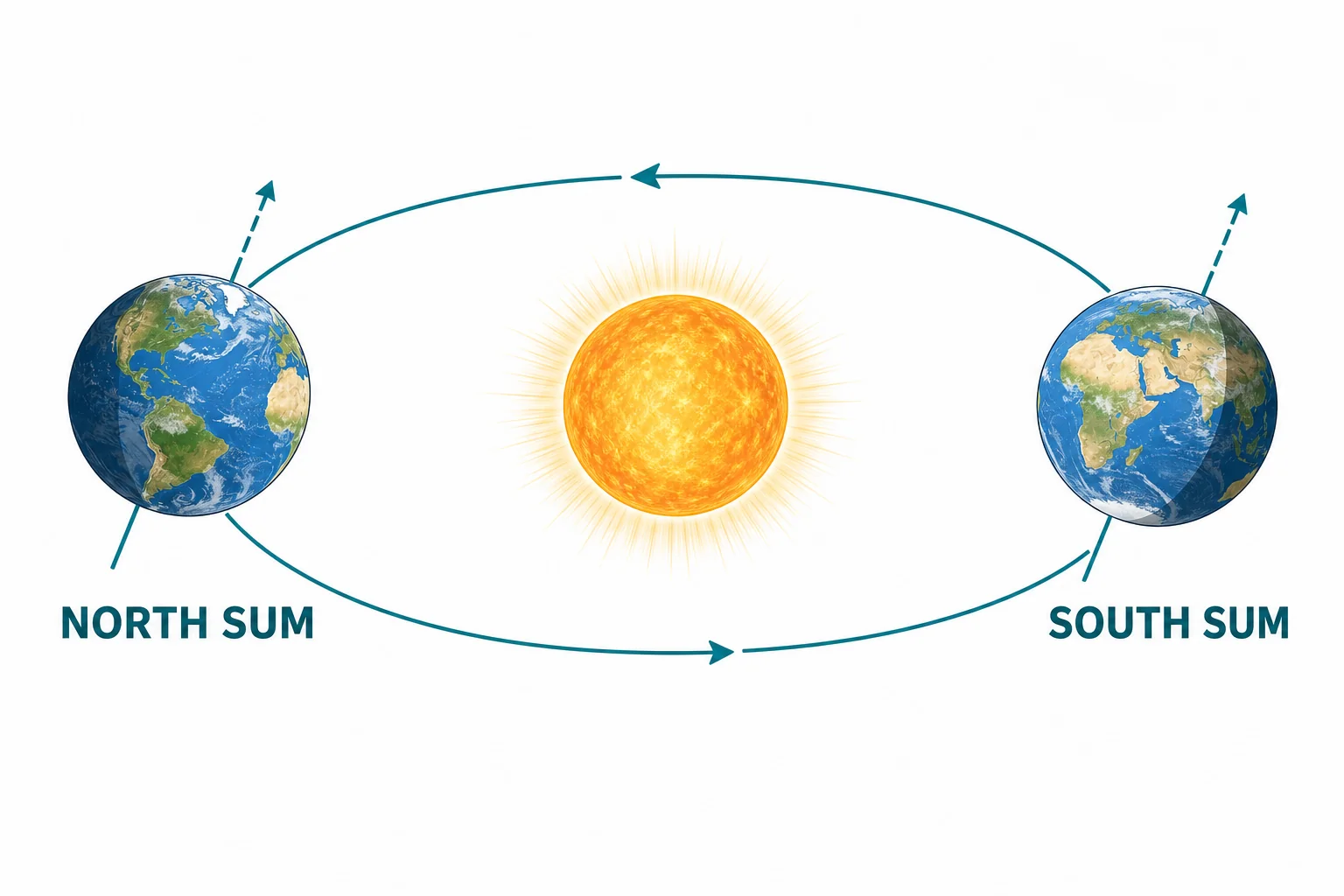
Earth at two opposite points in its orbit showing Northern Hemisphere summer on one side and Southern Hemisphere summer on the other.
Opposite hemispheres have opposite seasons.
The Northern and Southern Hemispheres have opposite seasons. When the North Pole leans toward the Sun, the Northern Hemisphere has summer. At the same time, the South Pole leans away from the Sun, so the Southern Hemisphere has winter. About six months later, the pattern reverses. The Southern Hemisphere gets more direct sunlight and longer days. The Northern Hemisphere gets less direct sunlight and shorter days. This explains why July is a warm month in places like Canada and Japan, but a cool month in places like Argentina and South Africa. It also shows why a season is not a global event. Earth as a whole is still receiving sunlight, but the tilt divides that sunlight unevenly between the two halves of the planet during different parts of the year.

One hemisphere’s summer is the other hemisphere’s winter.

Distance is not the cause
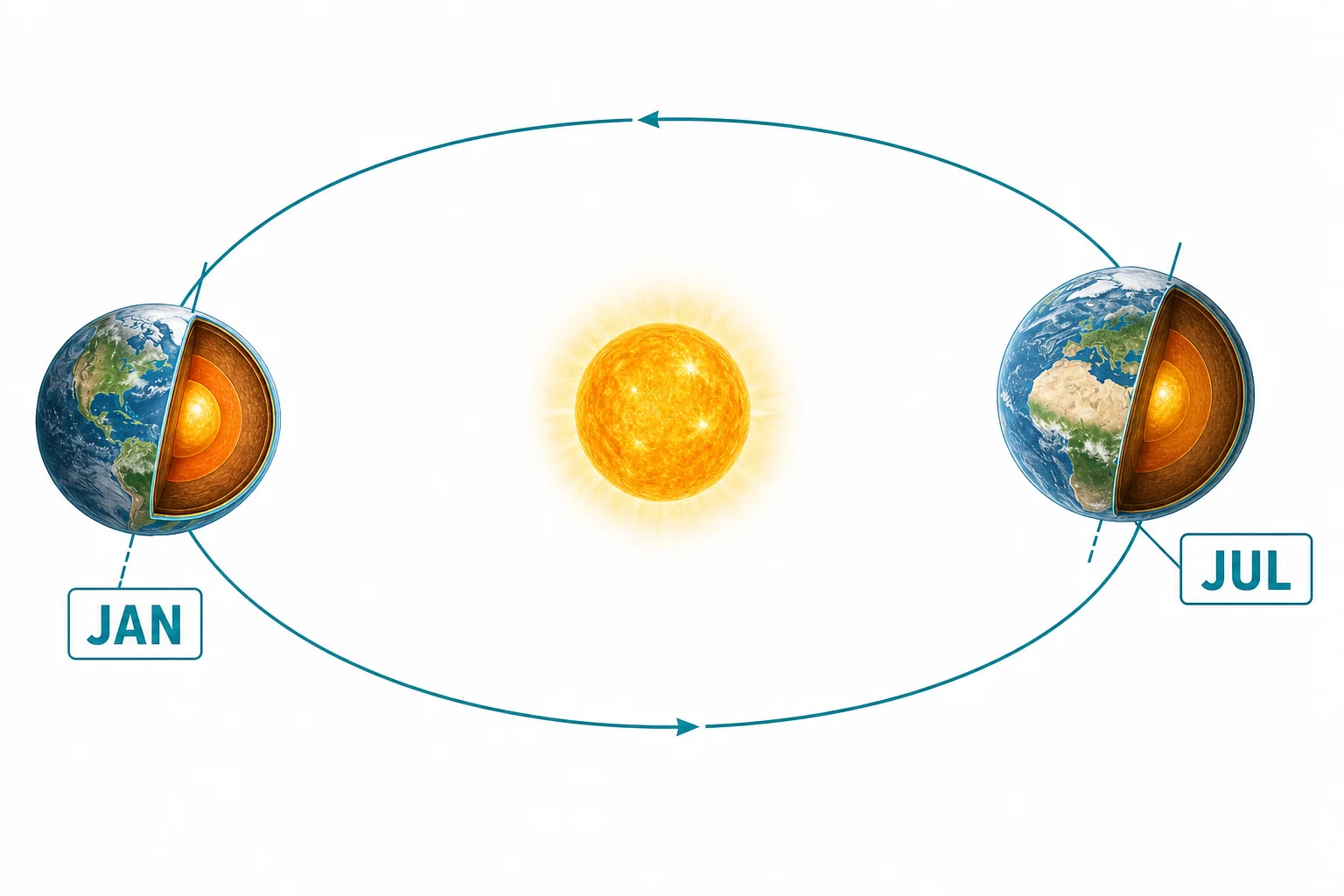
Nearly circular Earth orbit around the Sun with labels showing closest point in January and farthest point in July.
Earth is closest to the Sun during Northern Hemisphere winter.
Earth’s orbit is not a perfect circle, but it is close to one. The distance from Earth to the Sun changes a little during the year. That small change does not cause the seasons. A useful clue is timing. Earth is closest to the Sun in early January. If distance caused seasons, the whole planet would be warmest then. Instead, January is winter in the Northern Hemisphere and summer in the Southern Hemisphere. Another clue is that both hemispheres have opposite seasons at the same time. Distance from the Sun is nearly the same for both hemispheres, but their sunlight angles and daylight hours are different. The orbit still matters because it carries Earth through the yearly cycle. The tilt is what turns that motion into spring, summer, fall, and winter.

Earth’s tilt explains seasons better than distance does.

Vocabulary

Axis
An imaginary line that Earth spins around, running through the North and South Poles.
Axial tilt
The lean of Earth’s spin axis compared with its path around the Sun.
Hemisphere
One half of Earth, usually the Northern Hemisphere or Southern Hemisphere.
Sun angle
The angle at which sunlight reaches the ground.
Solstice
A day when one hemisphere has its longest daylight and the other has its shortest daylight.
Equinox
A time of year when day and night are nearly equal in length around the world.

In the Classroom

Flashlight Sun angle model

20 minutes | Grades 6-8

Shine a flashlight straight down on graph paper, then shine it from a low angle. Students compare the size of the light patch and connect the pattern to sunlight spreading over Earth’s surface.

Tilted globe seasons demo

30 minutes | Grades 6-8

Use a globe or foam ball tilted on a pencil as Earth and a lamp as the Sun. Move the model around the lamp while keeping the axis pointed in the same direction, then identify which hemisphere has summer at each position.

Day length data check

35 minutes | Grades 6-8

Students compare sunrise and sunset times for two cities, one in each hemisphere. They calculate daylight hours and look for opposite seasonal patterns.

Key Takeaways

  • Earth has seasons because its spin axis is tilted.
  • A hemisphere tilted toward the Sun gets more direct sunlight and longer days.
  • A hemisphere tilted away from the Sun gets lower Sun angles and shorter days.
  • The Northern and Southern Hemispheres have opposite seasons.
  • Earth’s changing distance from the Sun is not the main cause of seasons.
Content generated with AI assistance and reviewed by the LivePhysics editorial team. See sources below for original references.