Sign in to save

Bookmark this page so you can find it later.

Sign in to save

Bookmark this page so you can find it later.

Earth Science middle-school May 21, 2026

Why Does Lightning Strike?

How storm clouds turn charge into a flash
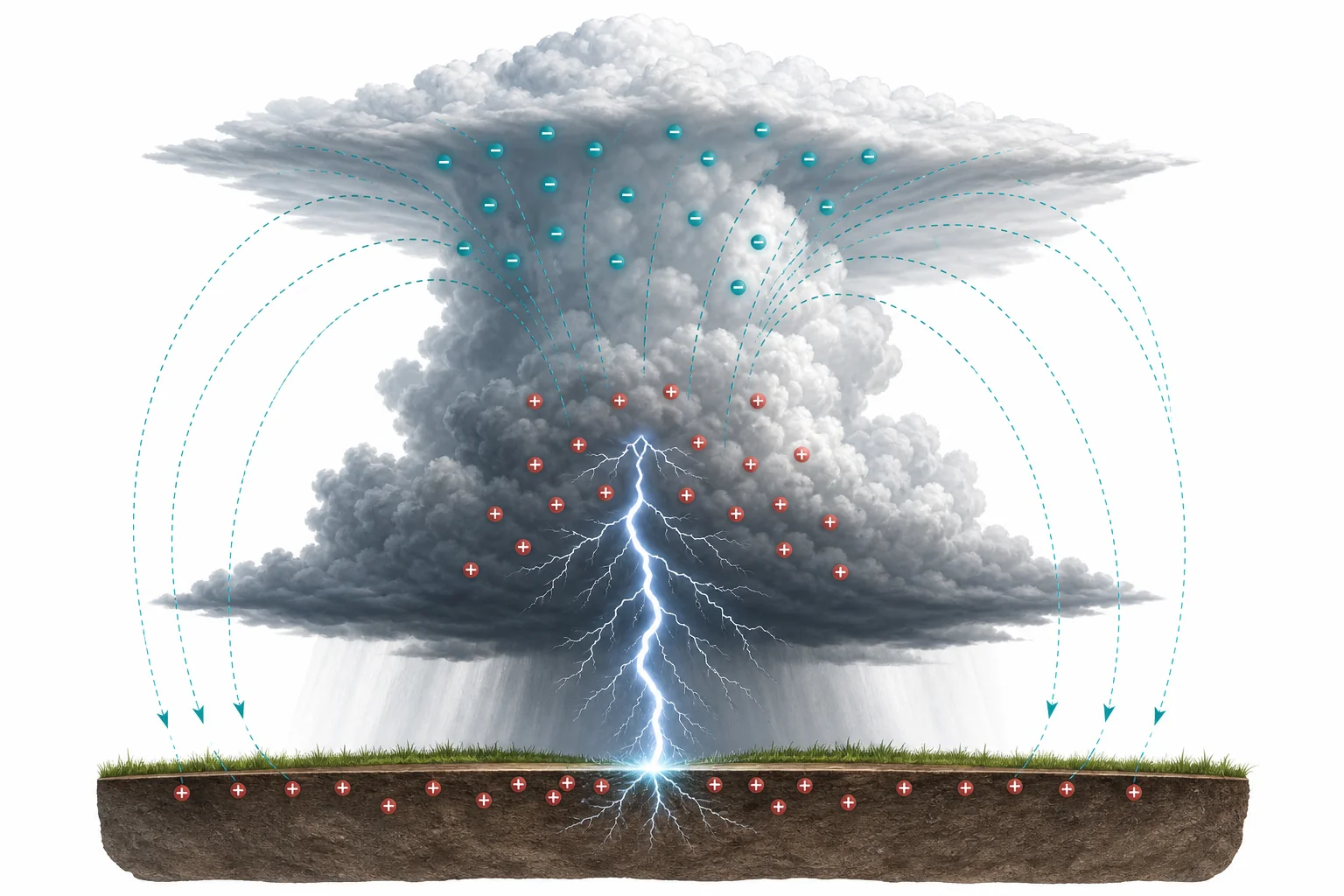
A thunderstorm cloud with separated electric charges and a lightning channel reaching toward the ground

Lightning strikes when a storm cloud and the ground build up opposite electric charges. The pull between them can become strong enough to tear a path through the air. A huge spark then jumps along that path, making a bright flash and heating the air into thunder.

Big Idea. NGSS MS-PS2-3 connects lightning to electric forces that act at a distance between charged objects.

A lightning strike is not random magic. It is a fast release of built-up electric charge inside a storm. In a thundercloud, strong winds push water drops, ice crystals, and hail-like pellets past one another. Collisions move tiny bits of charge from one particle to another. Over time, different parts of the cloud become more positive or more negative. The ground below the cloud can also shift in charge because opposite charges pull on each other across space. Air usually blocks electric current, which is why the charge can build up. When the electric pull gets strong enough, the air breaks down. A narrow path forms. Charge rushes through it, and we see lightning. This story connects weather, forces, and energy. It also shows how invisible electric forces can shape a very visible event in Earth’s atmosphere.

Charge separates in the cloud
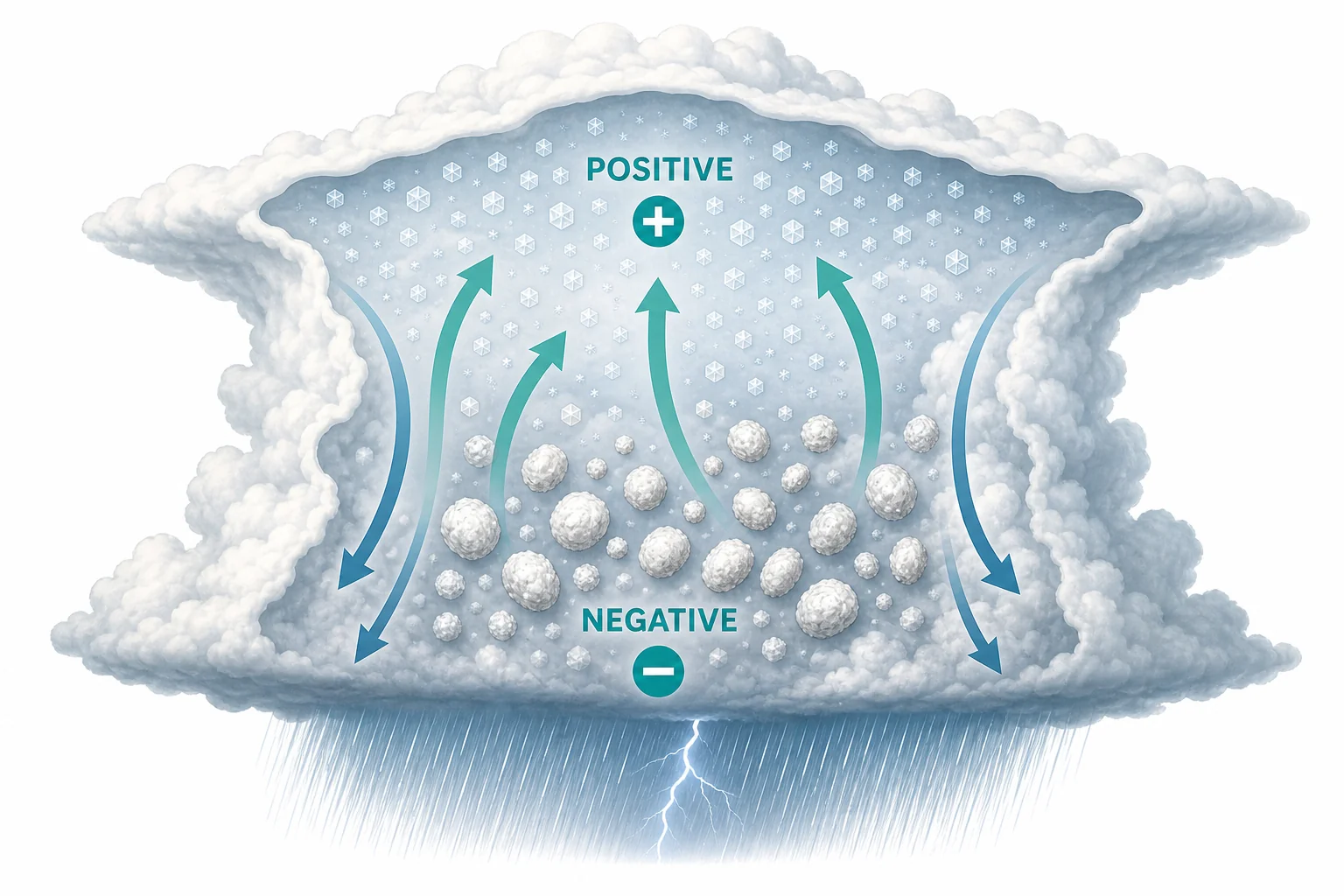
A cross section of a thunderstorm cloud showing positive charge near the top and negative charge lower in the cloud
Storm motion can separate charge inside the cloud.
Storm clouds are full of moving particles. Tiny ice crystals, water drops, and soft hail called graupel are carried up and down by strong air currents. When these particles collide, charge can move from one particle to another. Many smaller ice crystals tend to move upward and often become positively charged. Heavier graupel tends to fall lower in the cloud and often becomes negatively charged. This creates separated regions of charge. The cloud is now more than a pile of water and ice. It has an electric structure. The exact details depend on temperature, height, and particle type, but the key idea is simple. Collisions plus motion can sort charge into different places. That sorting stores electric energy in the storm.

Lightning starts with charge separation, not with the flash.

The ground responds
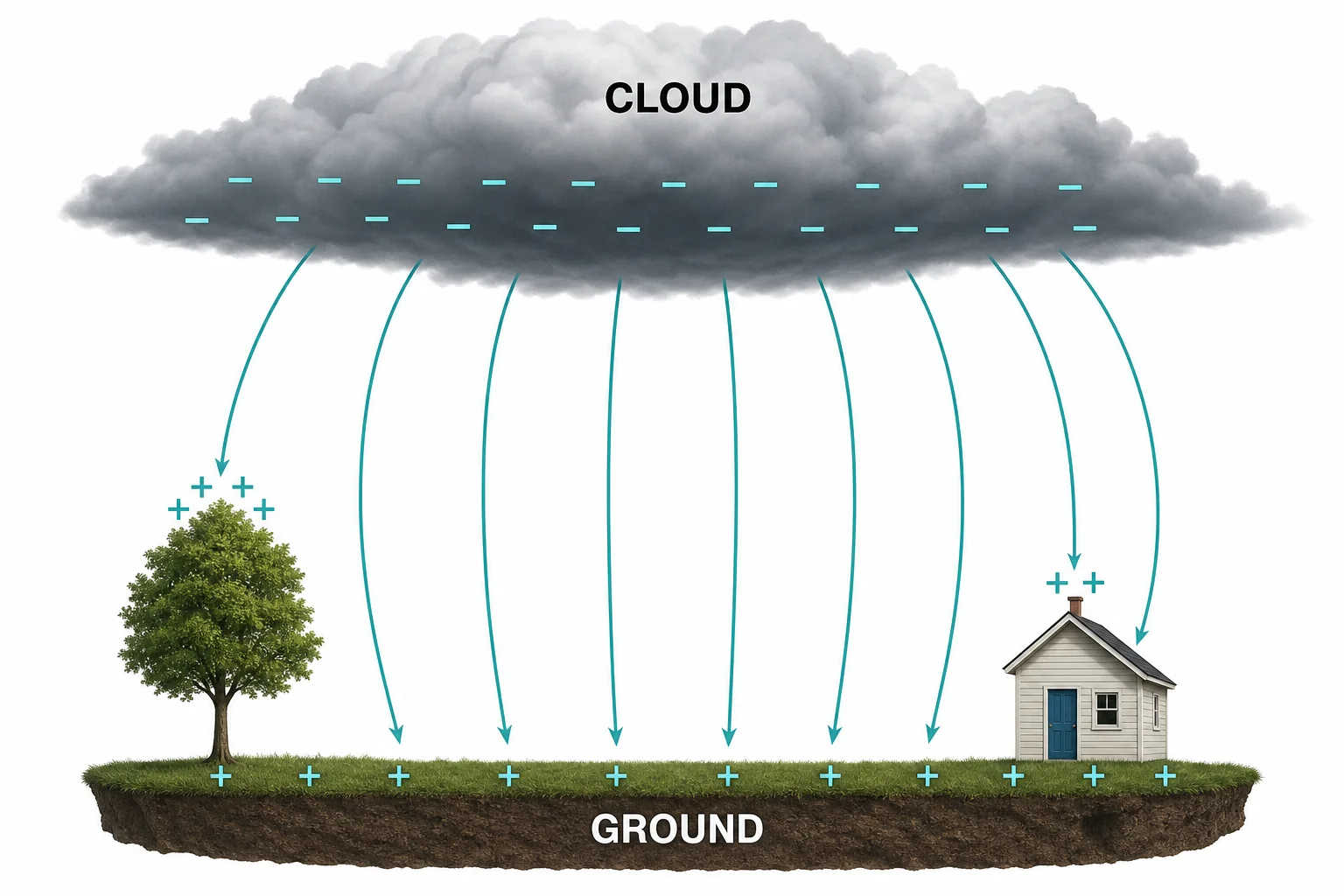
A negatively charged cloud base above the ground with positive charge gathered near trees and buildings
Opposite charge gathers below the cloud.
A charged cloud affects the ground even before lightning forms. If the lower part of the cloud is mostly negative, it pushes negative charges in the ground away. Positive charge is left closer to the surface. Tall objects, such as trees, towers, and buildings, can collect more of this positive charge near their tips. Nothing has touched yet. The force acts through the space between the cloud and the ground. This is an electric force at a distance, which is a main idea in middle school physical science. The stronger the charge separation becomes, the stronger the electric field becomes. The field is the region where charges feel a push or pull. Most of the time, air still blocks current. The storm keeps building tension.

The cloud can rearrange charge on the ground without touching it.

Air breaks down
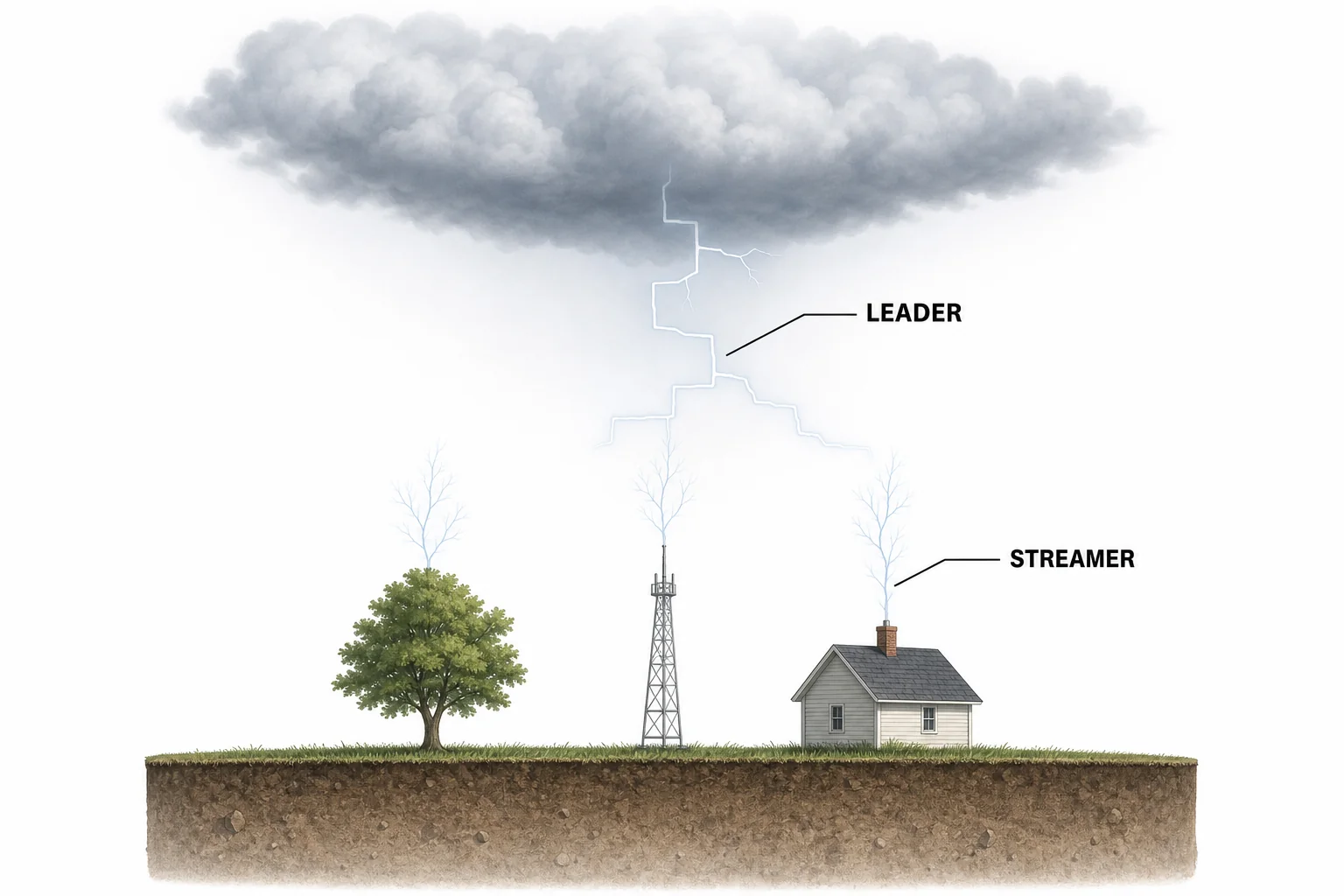
A faint branching lightning leader moving downward from a cloud and small streamers rising from tall objects
A channel forms when air becomes easier for charge to cross.
Air is usually a good insulator. That means it does not let electric charge flow easily. In a strong storm, the electric field can become large enough to change that. Some air molecules lose electrons and become charged particles. This process makes the air more able to carry current. A faint, branching path begins to grow downward from the cloud. Scientists call this a stepped leader because it moves in short jumps. It is not the bright flash most people notice. It is a dim path that prepares the way. At the same time, charged streamers may rise from the ground or from tall objects. When a downward path and an upward path connect, the circuit is complete for a tiny moment.

The bright strike needs a path through air first.

The return stroke flashes
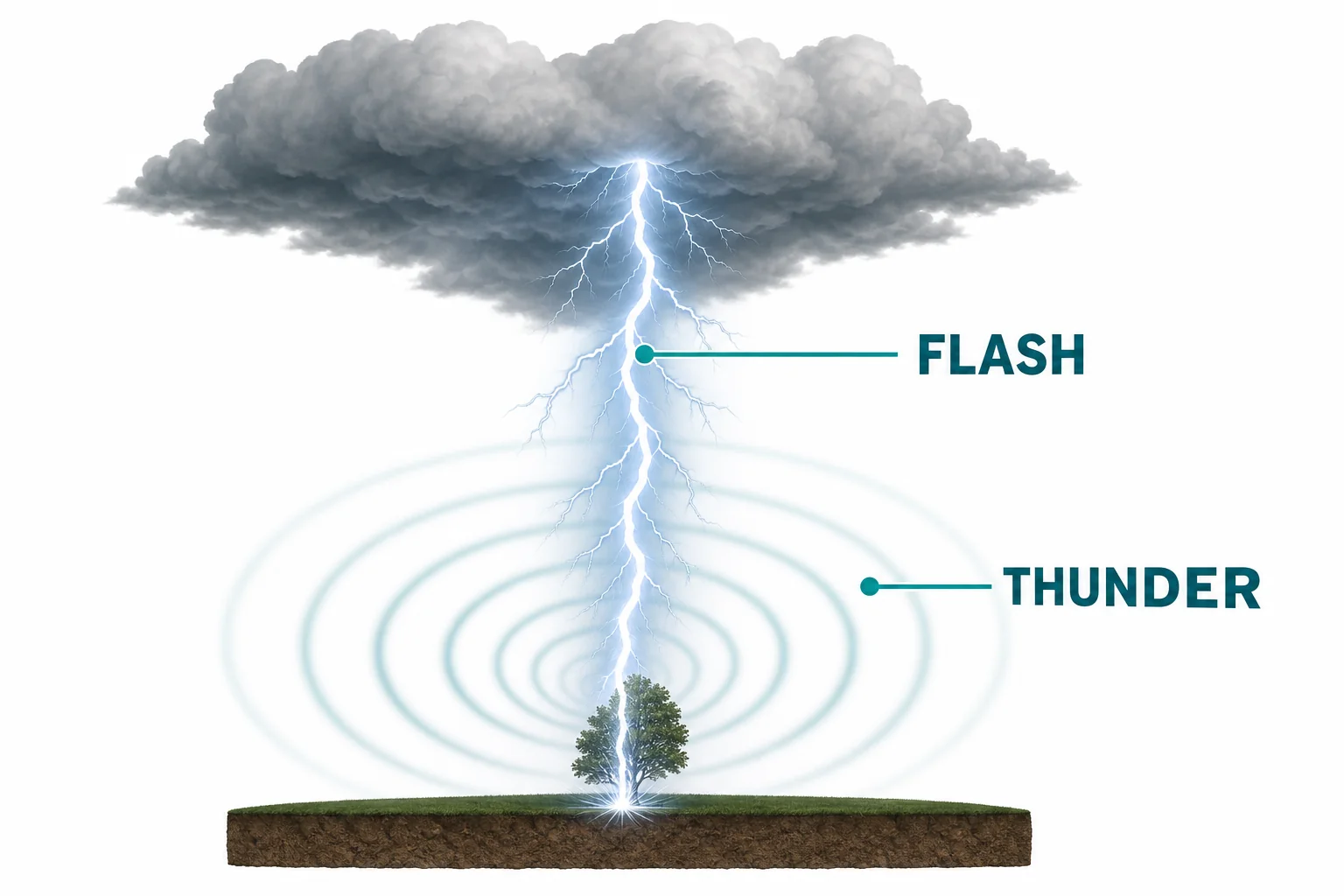
A bright lightning return stroke following a completed channel between a cloud and the ground, with expanding air rings
The return stroke is the bright part of the strike.
Once a leader and streamer connect, charge rushes through the channel. This rapid flow is the bright lightning flash. It often travels upward from the ground along the prepared path, even though the leader first moved downward. The current heats the air to temperatures hotter than the surface of the Sun for a very short time. The heated air expands suddenly. That expanding air creates a pressure wave that we hear as thunder. The light reaches your eyes almost instantly, but sound moves much more slowly. That is why thunder arrives after the flash. A single strike can include several pulses along the same channel. To your eyes, they may look like one flickering flash.

Lightning is the flash, thunder is the air’s response.

Not all lightning hits the ground
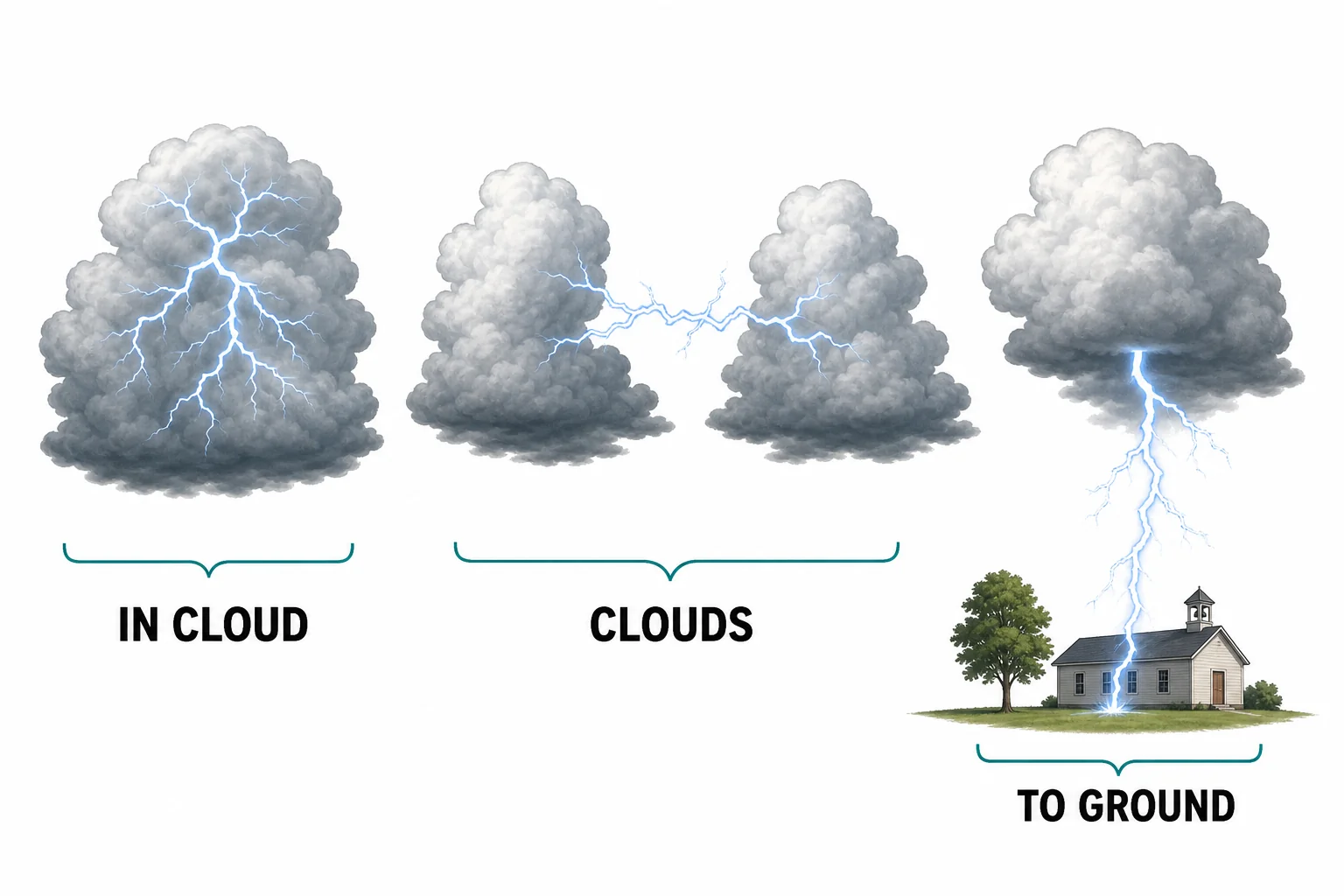
Different lightning paths including cloud-to-cloud, within-cloud, and cloud-to-ground lightning
Lightning can happen inside clouds, between clouds, or between a cloud and the ground.
Many lightning flashes stay inside a cloud or jump between clouds. Cloud-to-ground strikes are the ones most people worry about because they can hit trees, buildings, power lines, or open fields. Lightning follows paths shaped by charge, distance, air conditions, and the shape of nearby objects. Tall objects can be more likely to connect with a leader, but lightning can also hit open ground. Safety rules come from the same science. During a thunderstorm, the best place is inside a sturdy building or a hard-topped car. Open fields, isolated trees, water, and metal fences are risky because they can become part of a path for current. If you hear thunder, the storm is close enough to be dangerous.

A strike is one possible path for built-up charge to move.

Vocabulary

electric charge
A property of matter that can make objects push or pull on each other electrically.
electric field
The region around charged objects where other charges feel an electric force.
insulator
A material that does not let electric charge flow through it easily.
stepped leader
A faint branching path of charged air that moves downward from a storm cloud in short steps.
return stroke
The bright, powerful flow of charge that travels through a completed lightning channel.
thunder
The sound made when lightning heats air so quickly that the air expands outward.

In the Classroom

Charge separation model

20 minutes | Grades 6-8

Students use two colors of paper dots to model positive and negative charge in a storm cloud. They move the dots during pretend collisions, then draw where charge builds up and predict where the electric field is strongest.

Lightning sequence cards

25 minutes | Grades 6-8

Give groups cards showing cloud charge separation, ground response, leader growth, streamer connection, return stroke, and thunder. Students arrange the cards in order and write one sentence for each step.

Thunder delay calculation

15 minutes | Grades 6-8

Students compare the speed of light with the speed of sound using simple data. They estimate how far away a storm is from the time between a flash and thunder.

Key Takeaways

  • Collisions among ice, water drops, and graupel help separate charge inside storm clouds.
  • Separated charge creates an electric field between parts of the cloud and the ground.
  • Air blocks current at first, but a strong electric field can make a conducting path.
  • The bright flash happens when charge rushes through the completed lightning channel.
  • Thunder is caused by air that heats and expands suddenly around the lightning channel.