Simple Weather Station Lab
Act as a meteorologist and log daily weather observations across a simulated two-week period. Track temperature, cloud cover, wind speed, and precipitation, then look for patterns in your data.
Guided ExperimentTwo-Week Weather Pattern Investigation
What do you think the connection is between cloud cover and precipitation? Will temperature change before or after a rainy day?
Write your hypothesis in the Lab Report panel, then click Next.
Controls
Day
1
Overall
Overcast
17°C
Temperature
Overcast
Cloud Cover
13
km/h Wind
Heavy Rain
Precipitation
Data Table
(0 rows)| # | Day | Temp(°C) | Cloud Cover | Wind(km/h) | Precipitation |
|---|
Weather Science Reference
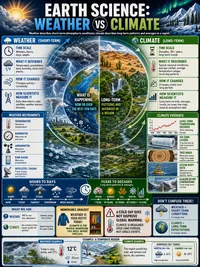
Weather vs. Climate
Weather is what is happening in the atmosphere right now or over the next few days. Climate is the long-term average of weather in a region over many years.
- Weather changes from day to day and is hard to predict far in advance.
- Climate changes slowly and can be described by seasonal averages.
- In this lab you are collecting weather data, not climate data.
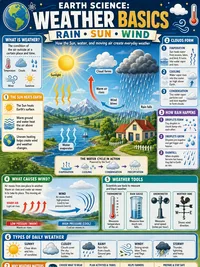
How Meteorologists Collect Data
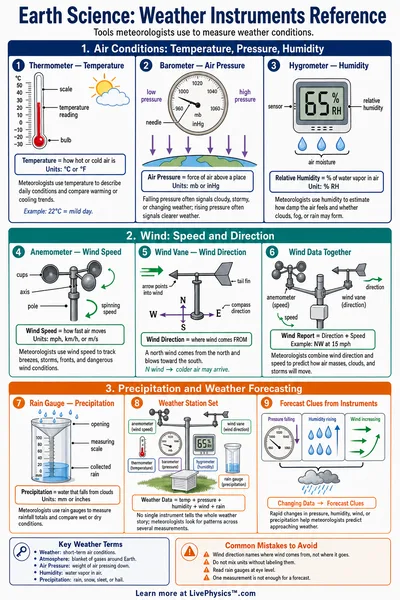
Professional weather stations measure four key variables every hour, every day.
- Temperature. Measured by a thermometer in Celsius or Fahrenheit. Placed in shade to avoid direct sun heating.
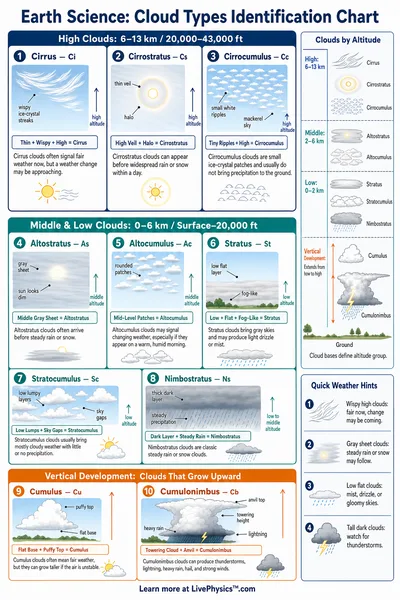
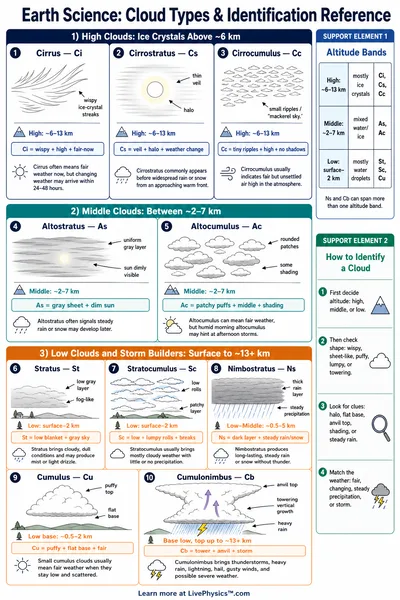
- Cloud Cover. Estimated visually or by satellite. Categories range from Clear to Overcast.
- Wind Speed. Measured by an anemometer in km/h or mph. Higher wind often signals a passing front.
- Precipitation. Measured by a rain gauge in millimetres. Types include rain, drizzle, and snow.
Reading Weather Patterns
Patterns in weather data help forecasters predict what comes next.
- Cloud buildup before rain. Skies typically shift from Clear to Partly Cloudy to Overcast before precipitation arrives.
- Temperature drops near fronts. A cold front brings cooler air. Temperatures often fall 3-8°C as a front passes.
- Wind speed increases. Wind tends to pick up ahead of a storm and calm down after it passes.
NGSS Connection
This lab connects to Next Generation Science Standards for grades 3-5
- 3-ESS2-1. Represent data in tables and graphical displays to describe typical weather conditions expected during a particular season.
- 3-ESS2-2. Obtain and combine information to describe climates in different regions of the world.
- ESS2.D. Weather and climate involve the interactions of Earth's atmosphere and surface.
By logging observations, building a data table, and identifying patterns, you are practicing the same skills real meteorologists use every day.