Sign in to save

Bookmark this page so you can find it later.

Sign in to save

Bookmark this page so you can find it later.

Earth Science middle-school May 21, 2026

Why Is the Sky Blue?

Sunlight, air, and scattered color
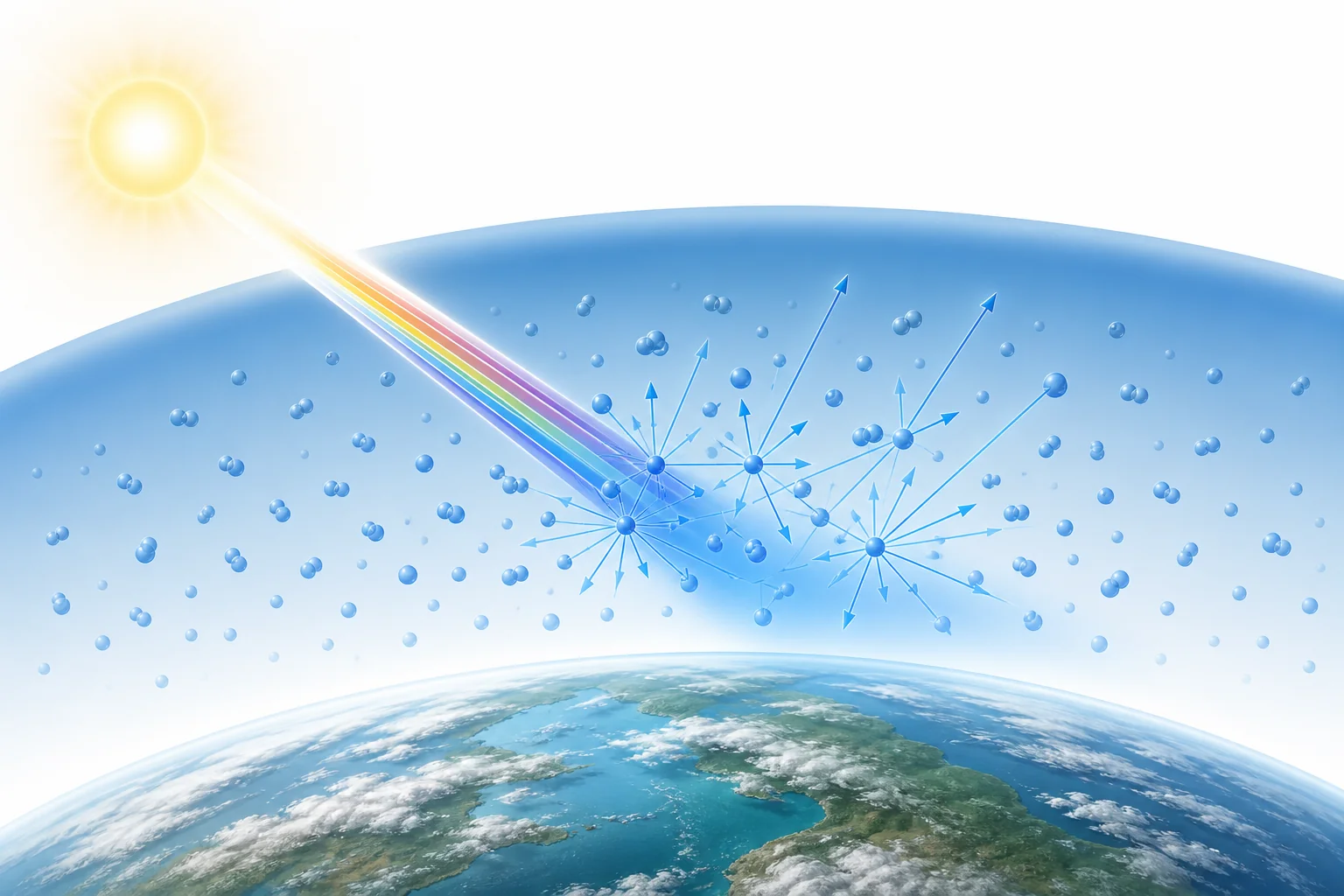
Sunlight entering Earth's atmosphere and scattering blue light in many directions while redder light travels more directly.

The sky looks blue because sunlight is made of many colors. Air spreads blue light around more than red light. That scattered blue light reaches your eyes from all directions in the daytime sky.

Big Idea. NGSS MS-PS4-2 connects sky color to how waves are absorbed, reflected, or transmitted by different materials.

The blue sky is a daily clue that light behaves like a wave. Sunlight may look white, but it contains all the colors our eyes can see. Each color has a different wavelength. Violet and blue light have shorter wavelengths than red and orange light. When sunlight enters the atmosphere, it meets tiny gas molecules, mostly nitrogen and oxygen. Those molecules scatter short wavelengths more strongly. Blue light gets redirected across the sky, so blue light reaches your eyes even when you are not looking toward the Sun. This same idea helps explain why sunsets look orange or red. By late day, sunlight travels through more air before it reaches you. Much of the blue light has been scattered away from the direct path, leaving more red and orange light. This topic fits the middle-school study of waves, matter, and Earth systems.

Sunlight is many colors
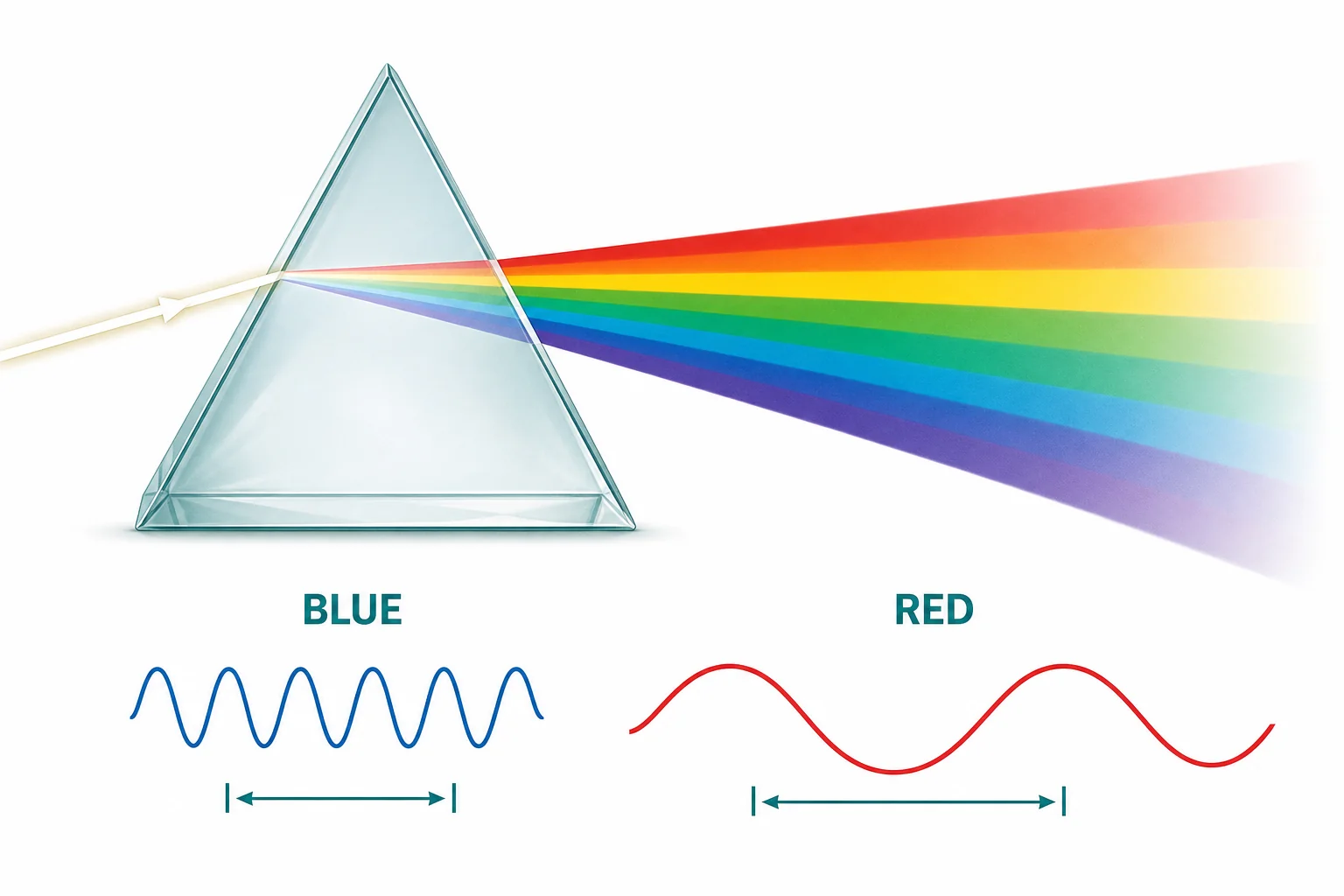
White sunlight entering a prism and separating into visible colors with shorter blue wavelengths and longer red wavelengths shown.
White light contains the visible colors.
White sunlight is not a single color. It is a mixture of the visible colors, from violet and blue through green, yellow, orange, and red. A prism or water droplet can separate these colors because each wavelength bends by a different amount. Shorter wavelengths, such as blue and violet, interact with matter differently than longer wavelengths, such as red. This matters in the atmosphere because the air is not empty. It is full of tiny gas molecules that are much smaller than visible light waves. When sunlight reaches those molecules, some of the light changes direction. The amount of scattering depends strongly on wavelength. Blue light is scattered much more than red light. The sky is not blue because air is blue like paint. It is blue because the air redirects more blue light into your line of sight.

Sunlight looks white, but it carries many wavelengths.

Air molecules scatter light
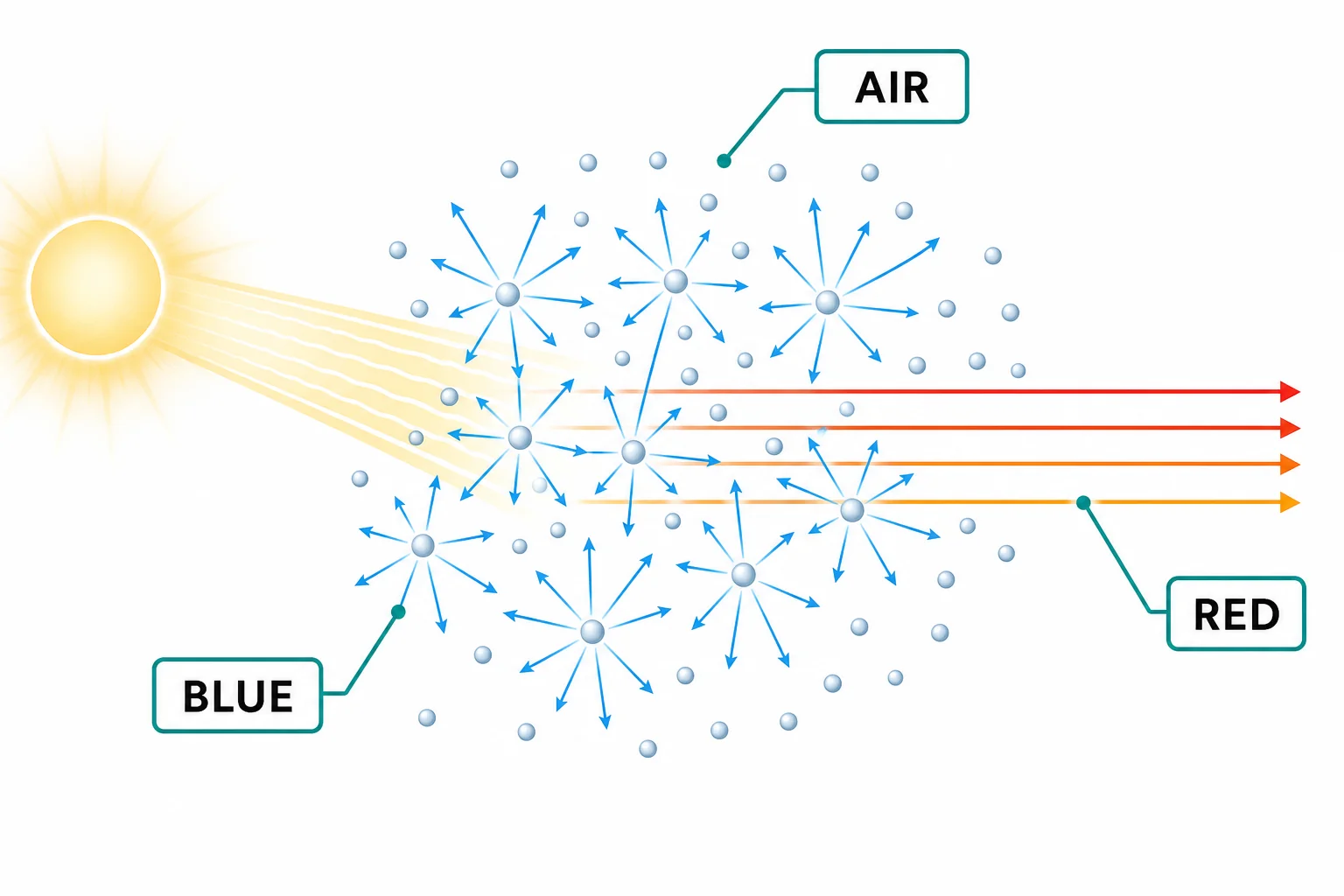
Tiny air molecules scattering incoming sunlight, with blue rays spreading in many directions and red rays traveling mostly forward.
Small molecules scatter shorter wavelengths more.
Earth's atmosphere is made mostly of nitrogen and oxygen gas. These molecules are far too small to see, but they still affect light. When a light wave reaches a molecule, the molecule can absorb a tiny bit of the wave's energy and then send light back out in many directions. This process is called scattering. The important pattern is that shorter wavelengths scatter more strongly than longer wavelengths. Blue light is scattered many times more than red light. That is why blue light can reach your eyes from the whole sky, not just from the direction of the Sun. The Sun itself still looks bright because a huge amount of light continues forward. The scattered part is weaker, but it fills the dome of the sky. This is called Rayleigh scattering, named after the scientist who described the pattern mathematically.

Blue light is redirected by air more often than red light.

Why the sky is not violet
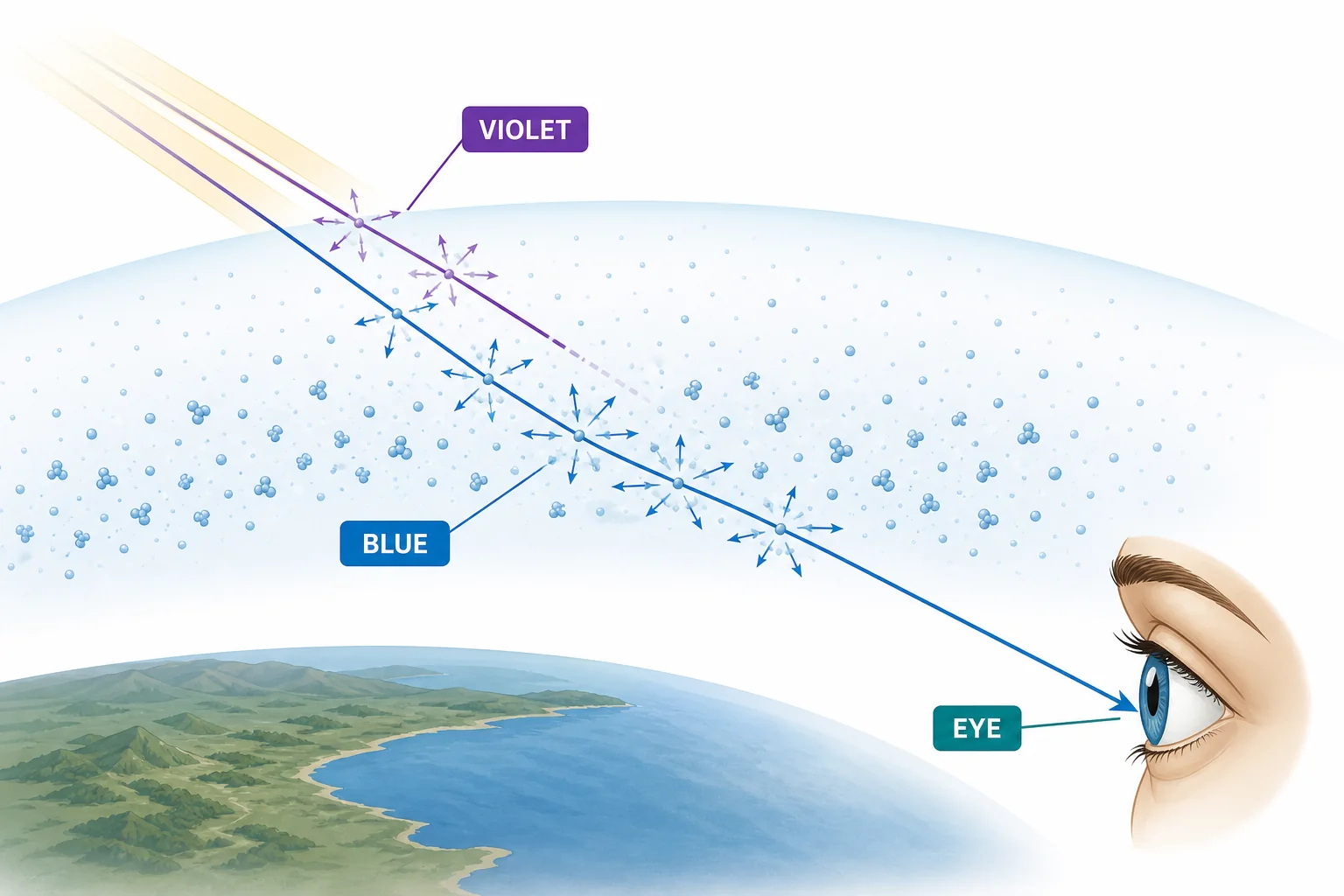
Comparison of violet and blue light in the atmosphere, showing less violet reaching an eye and more blue being detected.
Scattering, sunlight, and vision work together.
Violet light has an even shorter wavelength than blue light, so it scatters very strongly. That might seem to make a violet sky. It does not, for three main reasons. First, sunlight contains less violet light than blue light. Second, the upper atmosphere absorbs some violet and ultraviolet light before it reaches the ground. Third, human eyes are much more sensitive to blue than to violet in daylight. Our color vision mixes the light coming from the sky, and the result looks blue. The sky color we see is therefore not controlled by scattering alone. It also depends on the Sun's color mix, the atmosphere, and the way our eyes and brain respond to light. Science explanations often combine more than one cause. In this case, physics and biology work together to shape a familiar Earth science observation.

The sky looks blue because our eyes detect blue strongly.

Sunsets take a longer path
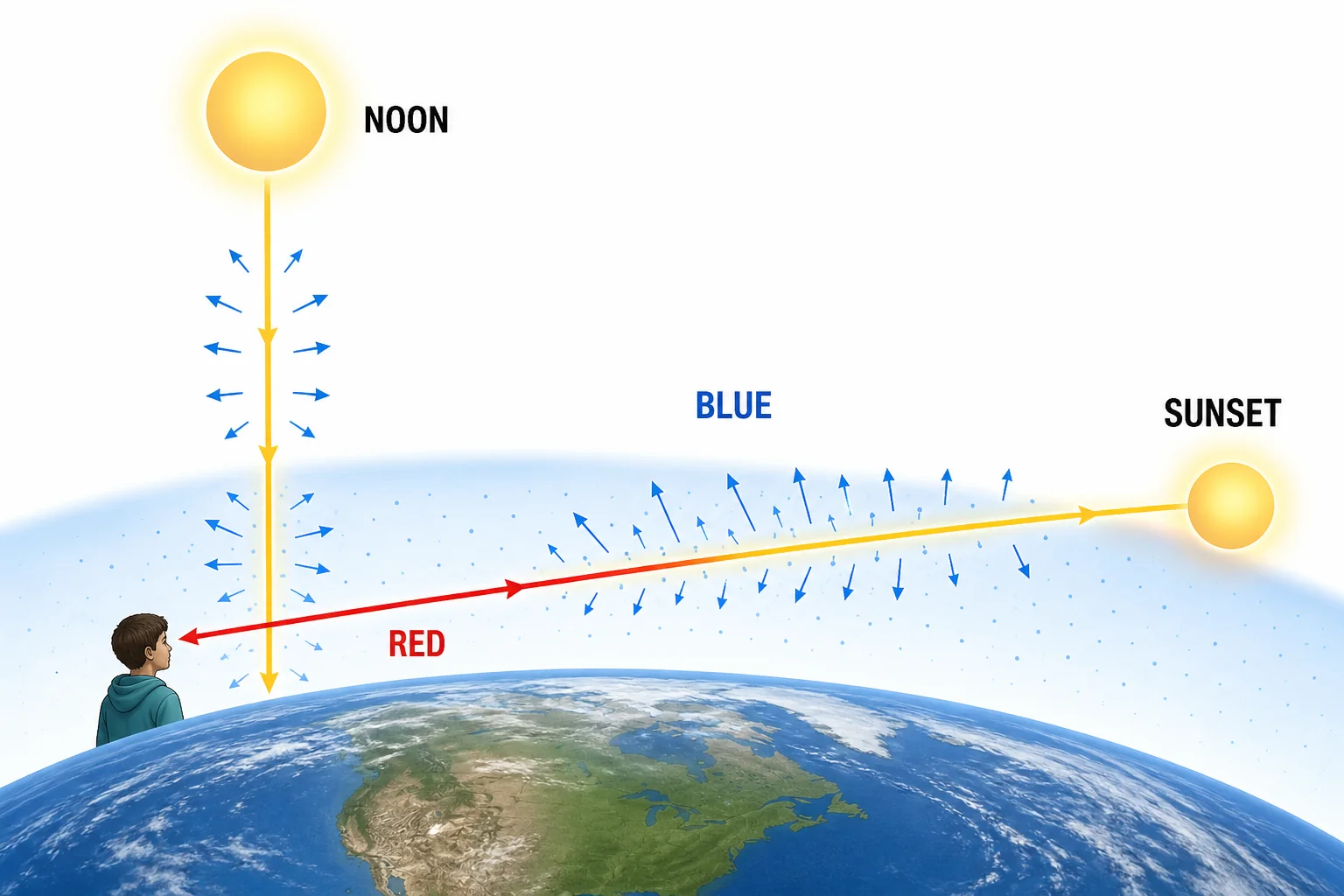
Two sunlight paths through Earth's atmosphere, with a short overhead path and a longer sunset path that loses more blue light.
Low Sun angle means a longer trip through air.
At noon, sunlight takes a shorter path through the atmosphere before reaching the ground. Near sunset, the Sun is low in the sky, so its light travels through a much longer slice of air. Along that longer path, molecules scatter a lot of blue light out of the direct beam. Some of that blue light still goes off in other directions, but less of it reaches your eyes from the Sun's disk and the bright area near the horizon. The remaining direct light is richer in red and orange wavelengths. Dust, smoke, and water droplets can change sunset colors too. Larger particles scatter light in different ways than gas molecules do. That is why some sunsets look pale yellow, while others look deep orange or red. The same atmosphere that makes a blue day sky also helps make warm sunset colors.

Sunset light is redder because it has crossed more air.

The atmosphere is a filter
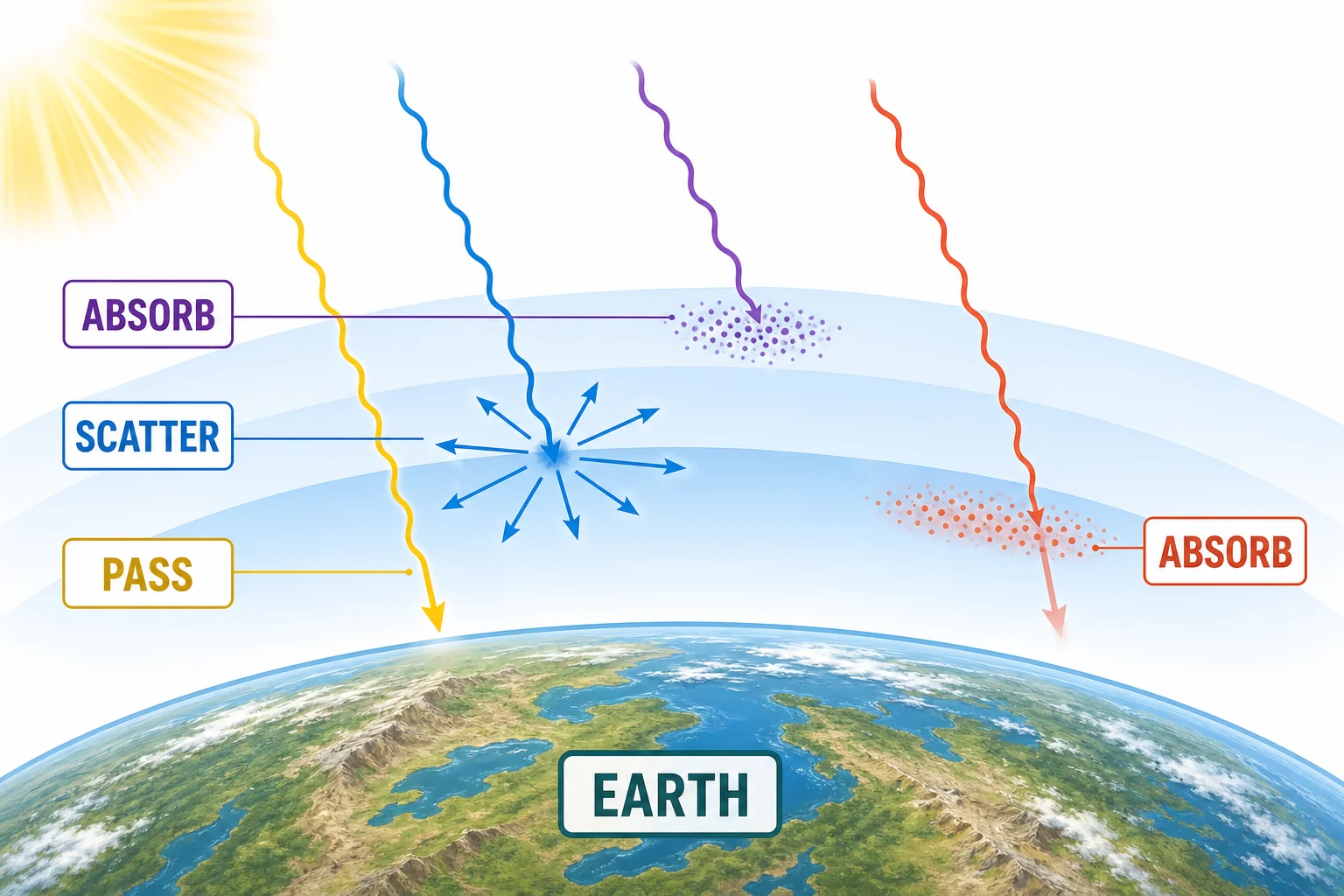
Atmosphere shown as a layer that transmits some visible light, scatters blue light, and absorbs some ultraviolet and infrared energy.
Air can transmit, scatter, and absorb light.
The atmosphere does not simply block light like a wall. It transmits some light, absorbs some light, and scatters some light. Visible light passes through air well enough for us to see the Sun, clouds, land, and water. At the same time, gas molecules scatter enough short-wavelength light to color the sky. Other parts of sunlight behave differently. Ozone high in the atmosphere absorbs much ultraviolet light, which helps protect living things. Water vapor and carbon dioxide absorb some infrared light, which is part of Earth's energy balance. The blue sky is one example of a larger rule. When waves meet matter, their behavior depends on wavelength and on the material they meet. That is the core idea behind many wave phenomena, from colored glass to sound insulation to remote sensing of Earth from satellites.

Wave behavior depends on both wavelength and material.

Vocabulary

Wavelength
The distance from one crest of a wave to the next crest.
Visible light
The part of the electromagnetic spectrum that human eyes can detect.
Scattering
A change in the direction of light after it interacts with matter.
Rayleigh scattering
Scattering by particles much smaller than the wavelength of light, which affects shorter wavelengths more strongly.
Atmosphere
The layer of gases surrounding Earth.

In the Classroom

Milk and flashlight scattering model

20 minutes | Grades 6-8

Mix a few drops of milk into a clear container of water and shine a flashlight through it from the side. Students observe bluish scattered light from the side and warmer light through the long path.

Visible spectrum wavelength map

15 minutes | Grades 6-8

Students make a simple color strip from violet to red and label shorter and longer wavelengths. They connect each color to how strongly it scatters in air.

Noon and sunset path diagram

25 minutes | Grades 6-8

Students draw Earth, the atmosphere, and two Sun angles. They compare the length of the light paths and explain why more blue light is removed near sunset.

Key Takeaways

  • Sunlight contains all visible colors, not just white light.
  • Air molecules scatter shorter wavelengths more strongly than longer wavelengths.
  • Blue light reaches your eyes from many parts of the daytime sky.
  • The sky does not look violet because sunlight, the atmosphere, and human vision all matter.
  • Sunsets look redder because sunlight travels through more air near the horizon.
Content generated with AI assistance and reviewed by the LivePhysics editorial team. See sources below for original references.