What's Directly Above You?
Allow location access (or enter lat/lng manually) and see a live sky dome showing every visible star, planet, and ISS pass overhead right now. Positions update every 10 seconds as Earth rotates.
Enter your location to see the sky above you
Uses your local time and coordinates to calculate star positions in real time
No stars above the horizon yet. Enter your location to see stars.
Your Location
Requires browser permission, click Allow when prompted.
or enter manually
Quick presets
How it works
- Calculates Local Sidereal Time from your longitude and UTC
- Converts star RA/Dec to altitude and azimuth
- Updates every 10 seconds as Earth rotates
- Shows objects above the horizon on the sky dome
Reading the dome
- Center = directly overhead (zenith)
- Edge = horizon (altitude 0°)
- N, E, S, W = compass directions
- Larger dots = brighter stars
- Dashed circles = 30° and 60° altitude
Reference Guide
How the Sky Works
The celestial sphere is an imaginary shell surrounding Earth onto which all stars appear projected. Because Earth rotates from west to east, the entire sky appears to rotate from east to west once every 23 hours 56 minutes (a sidereal day).
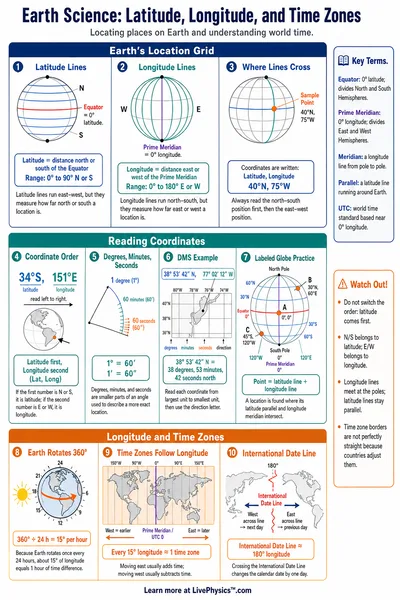
Each star's fixed position on the sphere is described by right ascension (RA) and declination (Dec) - the celestial equivalents of longitude and latitude. Your zenith is the point directly overhead, which changes continuously as Earth rotates.
Local Sidereal Time (LST) tells you which RA is crossing your meridian right now. When a star's RA equals your LST it is at its highest point in the sky (transit). An object is visible above the horizon when its altitude - calculated from LST, RA, Dec, and your latitude - is greater than zero.
Navigating by Stars
Polaris (the North Star) sits less than 1 degree from the north celestial pole, so it barely moves in the sky. From any location in the Northern Hemisphere, Polaris appears at an altitude equal to your latitude - a reliable true-north reference.
In the Southern Hemisphere, the Southern Cross (Crux) points toward the south celestial pole. Extending the long axis of the cross about 4.5 times leads you to the pole position.
Key navigational stars and their constellations
- Polaris (Ursa Minor) - north at any hour
- Sirius (Canis Major) - rises nearly due east, sets nearly due west
- Orion's Belt - three stars that always rise within 1 degree of due east
- Acrux (Crux) - pointer to the south celestial pole
Planets in the Night Sky
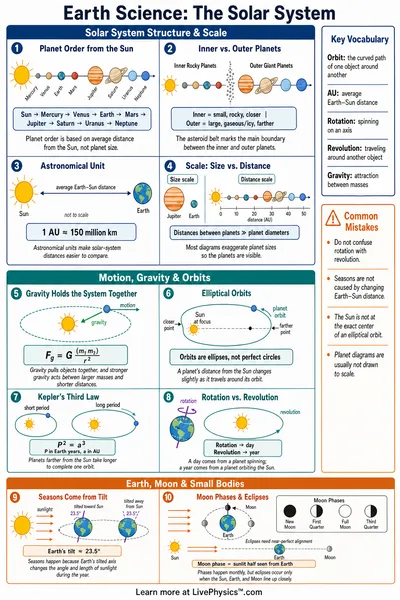
Planets look different from stars in a few key ways. They do not twinkle because they are close enough to show a tiny disk rather than a point source. They also move noticeably against the star background over days and weeks, and they are always found along or near the ecliptic (the path of the Sun across the sky).
The inner planets (Mercury and Venus) are never far from the Sun in the sky. Venus is the brightest natural object after the Sun and Moon. Mercury is only visible near the horizon around dusk or dawn.
The outer planets (Mars, Jupiter, Saturn) can appear anywhere along the ecliptic. Jupiter and Saturn are bright and have slow apparent motion. Mars has a reddish color and brightens dramatically near opposition (when Earth is between it and the Sun).
The International Space Station
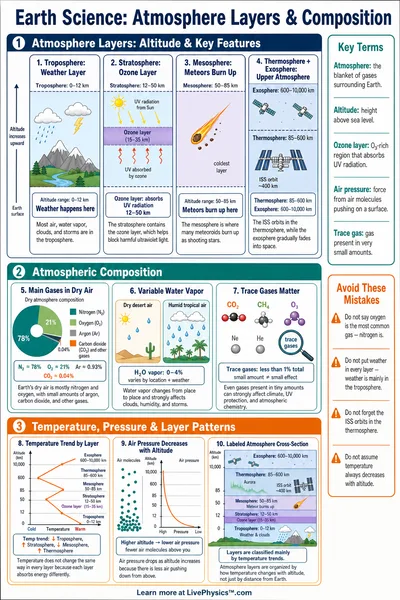
The ISS orbits Earth at an altitude of roughly 408 km, completing one orbit every 90 minutes at a speed of about 28,000 km/h (17,500 mph). Its orbital inclination of 51.6 degrees means it passes over locations between 51.6 degrees south and 51.6 degrees north latitude.
The ISS appears as a bright, fast-moving point of light with no flashing - like an aircraft but faster and steadier. It is the third brightest natural object in the sky when passes are favorable, reaching magnitude -5.9. It is visible only during twilight, when the station is in sunlight but the observer is in darkness.
A typical visible pass lasts 2 to 6 minutes. The ISS position shown here is live from the tracking API, updated every 10 seconds. If the ISS is within 2000 km it may be visible or approaching your sky within the next few minutes.