Sign in to save

Bookmark this page so you can find it later.

Sign in to save

Bookmark this page so you can find it later.

Physics middle-school May 24, 2026

Why Do Hot Air Balloons Rise?

Warm air makes the balloon less dense
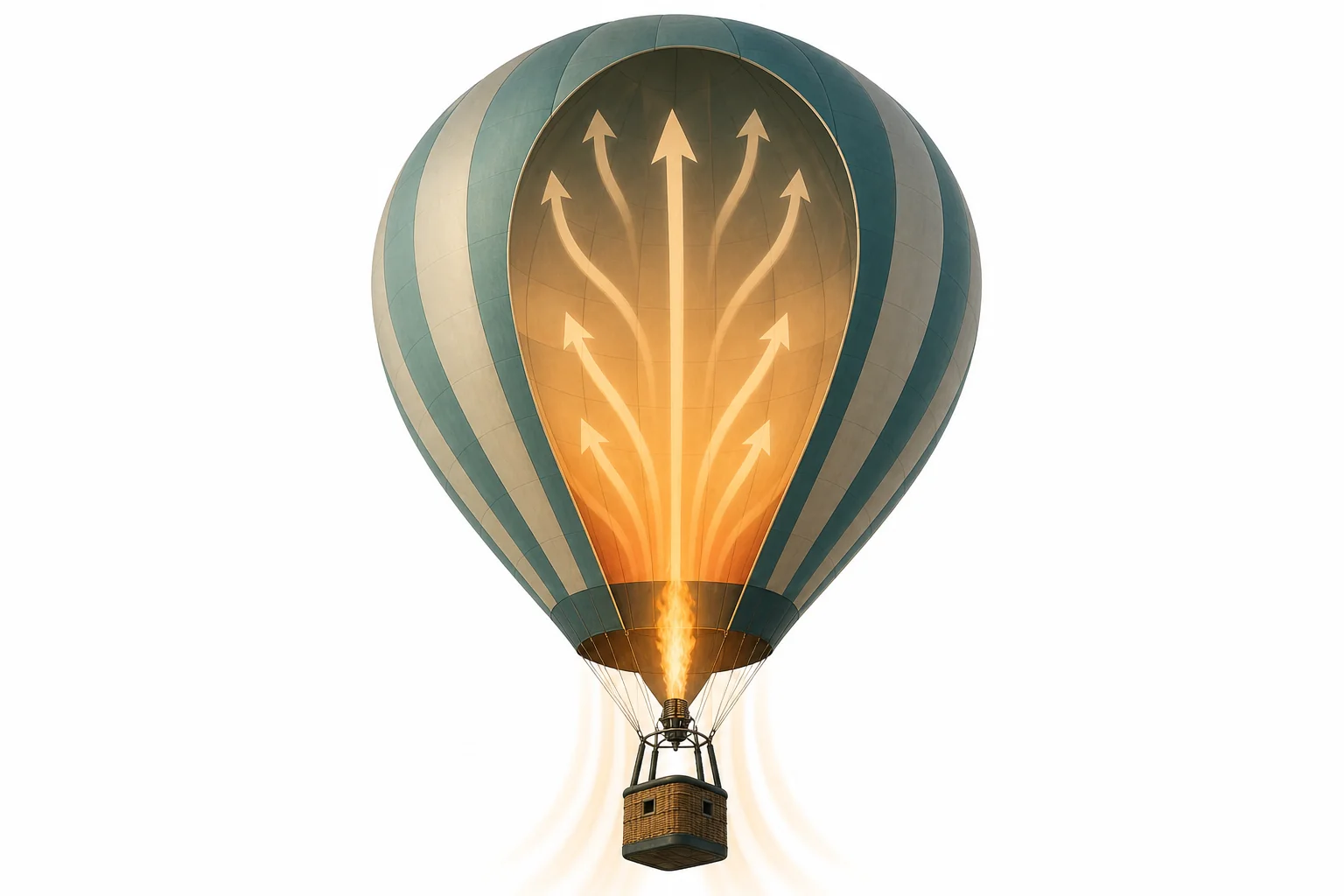
A hot air balloon rising because the heated air inside the envelope is less dense than the cooler air around it

A hot air balloon rises because heating the air inside makes that air spread out. The spread out air weighs less than the same amount of outside air filling the same space. The outside air pushes up harder than the balloon pulls down, so the balloon lifts.

Big Idea. NGSS MS-PS2-2 connects the balloon’s motion to the balanced and unbalanced forces on it.

A hot air balloon looks simple from the ground. A burner heats the air inside a huge fabric envelope. Then the whole balloon, basket, people, and fuel can rise into the sky. The science is a mix of matter and force. Air is matter, even though it is invisible. It has mass and takes up space. When air is heated, its particles move faster and spread farther apart. The same balloon volume then holds less mass of air than it did before. That makes the air inside the envelope less dense than the cooler air outside. The surrounding air pushes upward on the balloon. Gravity pulls downward on the balloon. If the upward push is larger than the total weight, the balloon rises. Pilots control height by changing temperature, not by flapping or steering like a plane.

Heating spreads air out
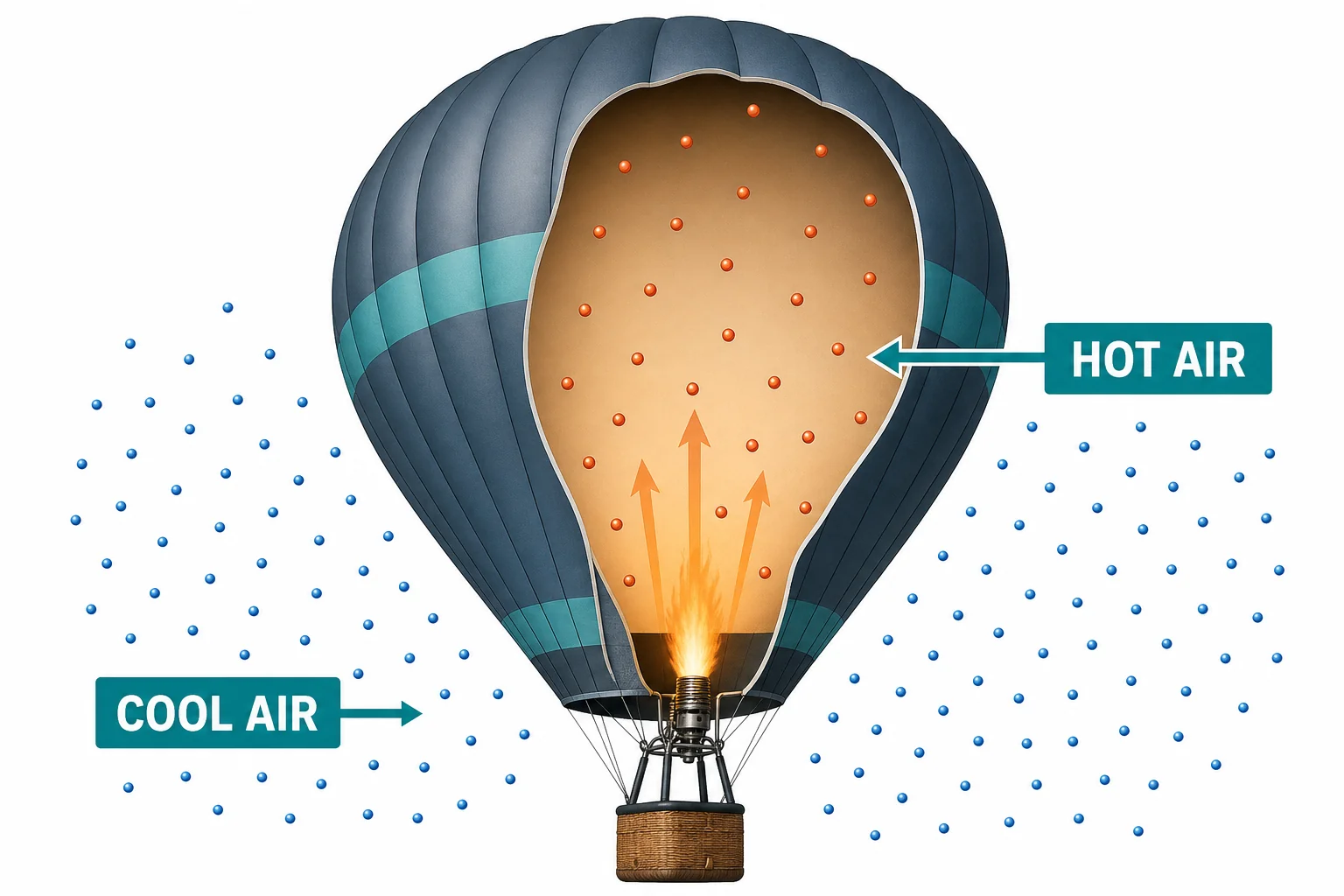
A burner heating air particles inside a balloon envelope, with particles spread farther apart near the top
Heating air makes its particles spread out.
Air is made of tiny particles that are always moving. When the burner adds thermal energy, those particles move faster. They bump into each other and the inside of the balloon more often. Because the fabric envelope is open at the bottom, some air can leave as the heated air expands. The balloon does not need to get much bigger. Instead, the air inside becomes a warmer sample with fewer particles in the same large space. Fewer particles means less mass inside the envelope. The outside air has more particles packed into the same amount of space because it is cooler. This difference is the start of the lift. Heating does not make air weightless. It only lowers the amount of air mass inside the balloon’s volume.

Warm air has fewer particles in the same volume.

Density is the key
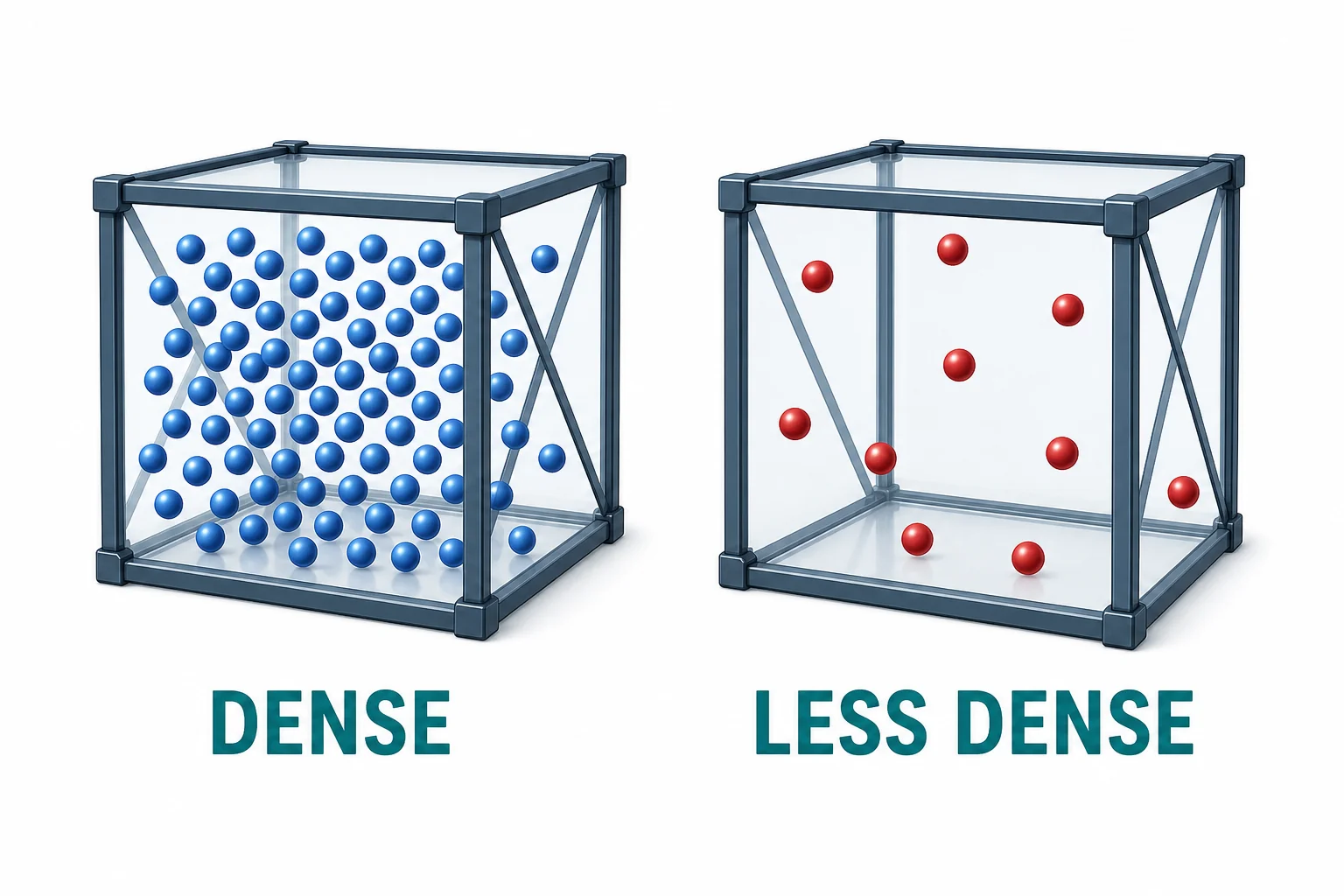
Two equal size boxes of air showing fewer particles in warm air and more particles in cool air
Same volume, different mass.
Density means mass divided by volume. A bowling ball and a beach ball can take up similar space, but the bowling ball has much more mass. Air can also have different density. In a hot air balloon, the inside air and outside air fill the same kind of space, but they do not contain the same amount of mass. The warmer inside air has a lower density. The cooler outside air has a higher density. This matters because the balloon is surrounded by a fluid. A fluid is anything that flows, including liquids and gases. The air outside the balloon behaves a lot like water around a floating object. A lower density object can be supported by a higher density fluid around it.

Lower density means less mass in each cubic meter.

Air pushes upward
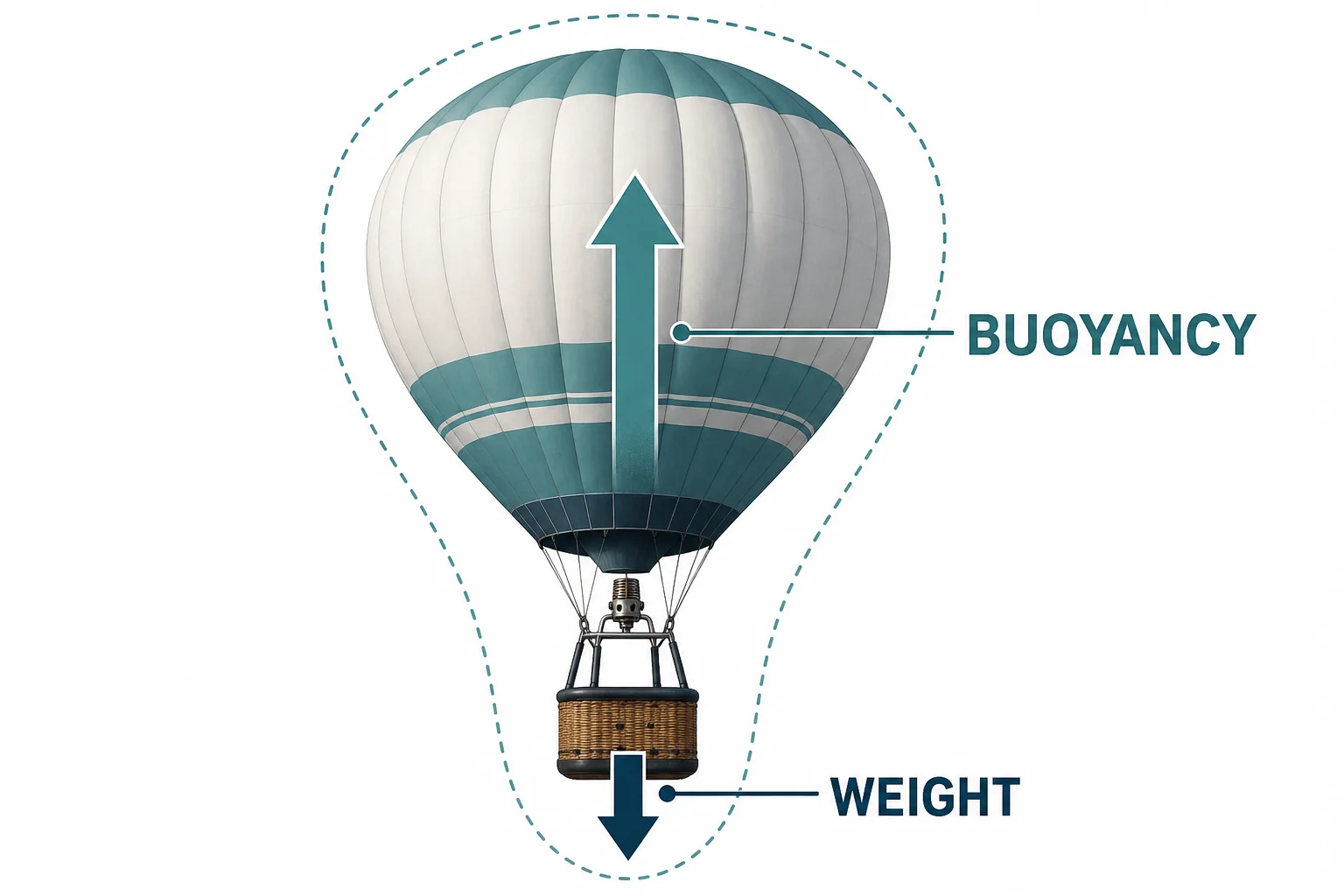
Forces on a hot air balloon with a larger upward buoyant force arrow and a smaller downward weight arrow
Lift depends on the air pushed aside.
A balloon rises because of buoyancy. Buoyancy is the upward force from the air around the balloon. The outside air pushes on every side of the envelope. Pressure is a little greater lower down because more air sits above that level. That makes the upward push on the bottom of the balloon slightly stronger than the downward push on the top. The difference is the buoyant force. The size of that force depends on how much outside air the balloon pushes out of the way. If the balloon displaces a huge volume of air, the upward force can be large. This is why hot air balloons are so big. The envelope must move aside enough outside air to support the weight of the fabric, basket, burner, passengers, and the warm air inside.

The balloon rises when the upward force is larger than weight.

Rising, floating, and sinking
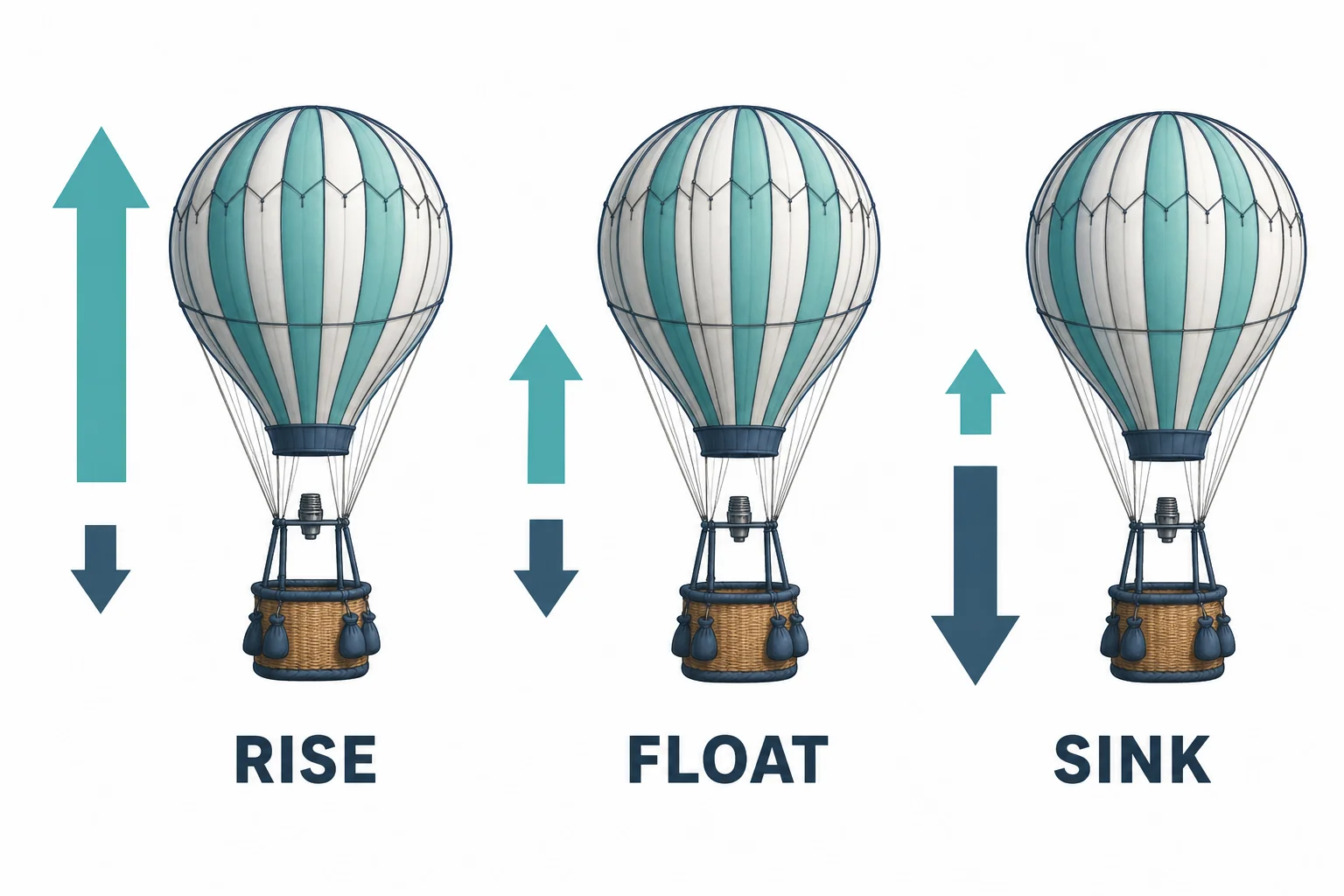
Three hot air balloons showing rising, floating, and sinking based on force arrow sizes
Changing heat changes the force balance.
The motion of the balloon depends on the balance of forces. If buoyancy is greater than weight, the balloon speeds upward. If buoyancy and weight are equal, the balloon can float at nearly the same height. If weight is greater than buoyancy, the balloon sinks. A pilot changes this balance by changing the temperature of the air inside. Turning on the burner heats the air and lowers its density. Opening a vent lets hot air escape, so cooler outside air replaces it. That makes the inside air denser and reduces lift. The pilot cannot steer the balloon in the usual way. Instead, the pilot rises or descends to find winds moving in different directions at different heights.

Balanced forces mean steady height, not no forces.

The gas rule behind it
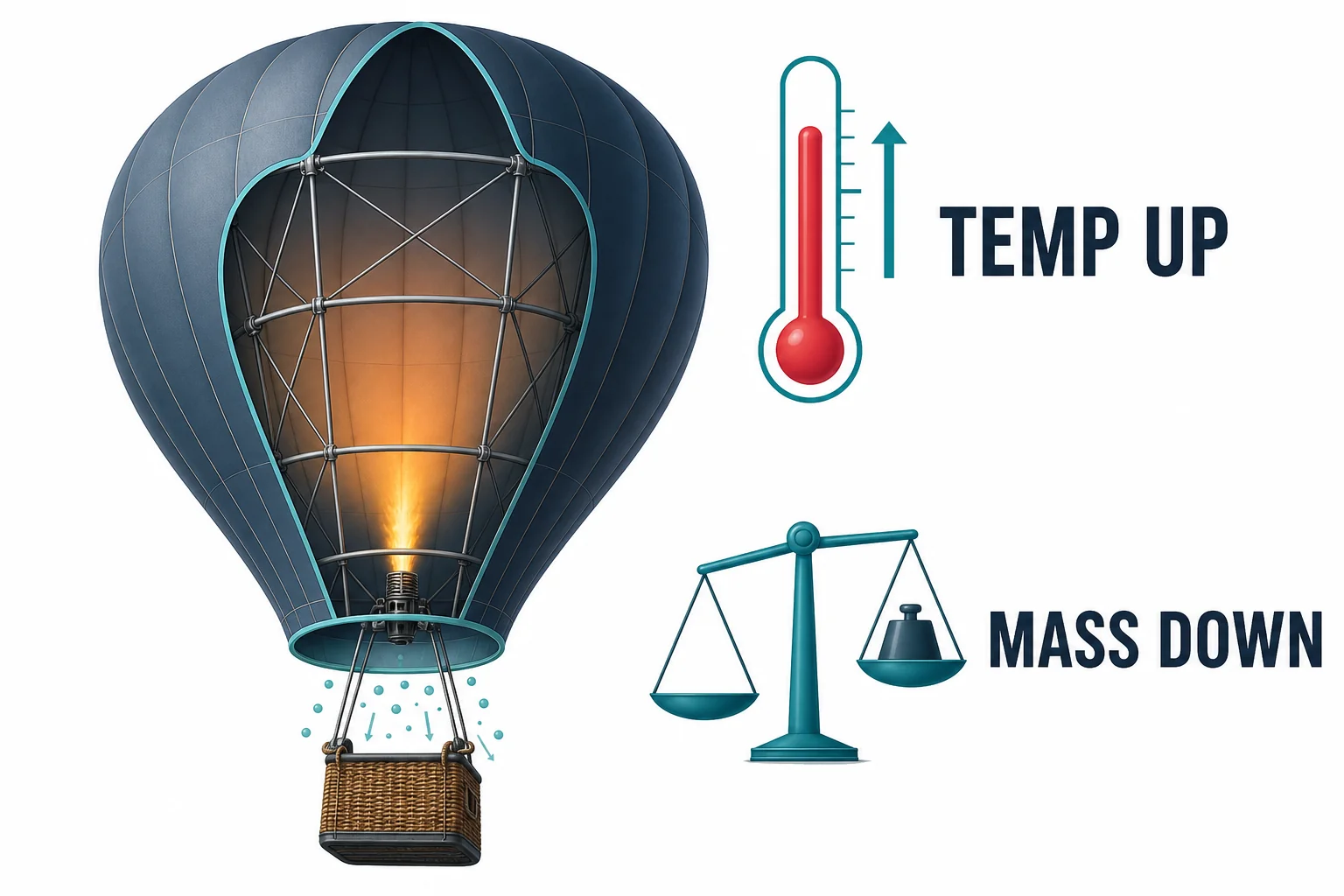
A simple diagram showing temperature increasing as the number of particles inside a balloon envelope decreases
Higher temperature can mean fewer particles inside.
Scientists can describe the air inside the balloon with the ideal gas relationship. In simple terms, pressure, volume, temperature, and number of particles are connected. A hot air balloon is open at the bottom, so its pressure stays close to the outside air pressure. Its envelope volume is also nearly fixed during flight. When temperature increases, the number of air particles inside that volume decreases because some air leaves the opening. The mass inside drops, so density drops. This model is not perfect because real air has water vapor, wind, and changing weather. Still, it explains the main effect well. Heating the gas changes how much air mass is trapped inside the envelope.

For nearly fixed volume and pressure, hotter air means less air mass inside.

Vocabulary

Density
The amount of mass in a certain volume of a substance.
Buoyancy
The upward force from a fluid that helps support an object in it.
Thermal expansion
The spreading out of matter as its particles move faster when heated.
Volume
The amount of space an object or sample of matter takes up.
Weight
The downward force of gravity on an object.

In the Classroom

Warm air bag demo

20 minutes | Grades 6-8

Use a teacher-led safety setup with a thin plastic bag and a warm air source to show lift. Students draw force arrows before and after heating, then explain why the bag rises.

Density cubes model

25 minutes | Grades 6-8

Students compare equal-size paper cubes filled with different numbers of dot stickers. They connect the model to warm and cool air inside and outside a balloon.

Force balance cards

15 minutes | Grades 6-8

Give groups cards showing different upward and downward force arrows. Students sort each case into rising, floating, or sinking and justify each choice with one sentence.

Key Takeaways

  • Heating air makes its particles spread farther apart.
  • Warm air inside the balloon is less dense than cooler outside air.
  • The outside air provides an upward buoyant force.
  • A balloon rises when buoyancy is greater than the total weight.
  • Pilots change altitude by heating air or letting hot air escape.