Sign in to save

Bookmark this page so you can find it later.

Sign in to save

Bookmark this page so you can find it later.

Physics middle-school May 21, 2026

Why Does Ice Make Roads Slippery?

A thin water layer changes tire grip
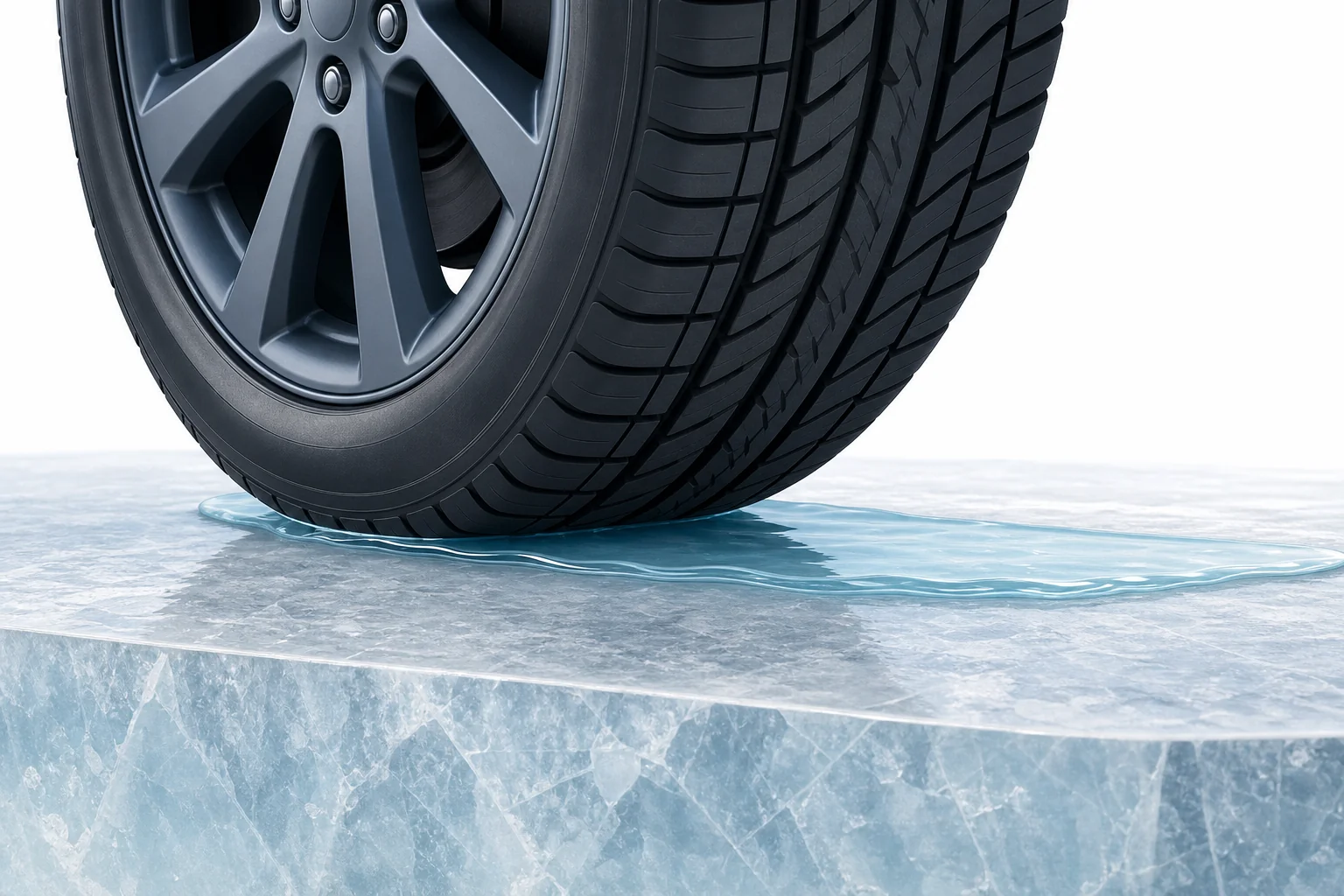
A car tire on an icy road showing a thin water film between the rubber and the ice surface.

A very thin layer of water can sit on top of ice, so tires slide instead of grabbing the road. Ice is also smooth, which gives rubber fewer tiny bumps to push against. Sand, salt, and tire tread help by adding grip or changing the ice.

Big Idea. NGSS MS-PS2-2 connects slippery roads to evidence that forces between surfaces change motion.

A dry road feels ordinary because tires can push against tiny bumps in the pavement. That push is friction. Friction helps a tire start, stop, and turn. Ice changes the contact. It is smoother than pavement, and its surface can have a thin liquid layer. The tire no longer gets the same grip, so the same push can lead to sliding. This is why drivers need more distance to stop on icy roads. The science is not just that ice is cold. It includes surface texture, temperature, pressure, and the way rubber meets the road. In physics, we describe this with forces and with a number called the coefficient of friction. A higher value means more grip. A lower value means easier sliding. Icy roads are a real-life example of how contact forces affect motion.

Friction is the grip force
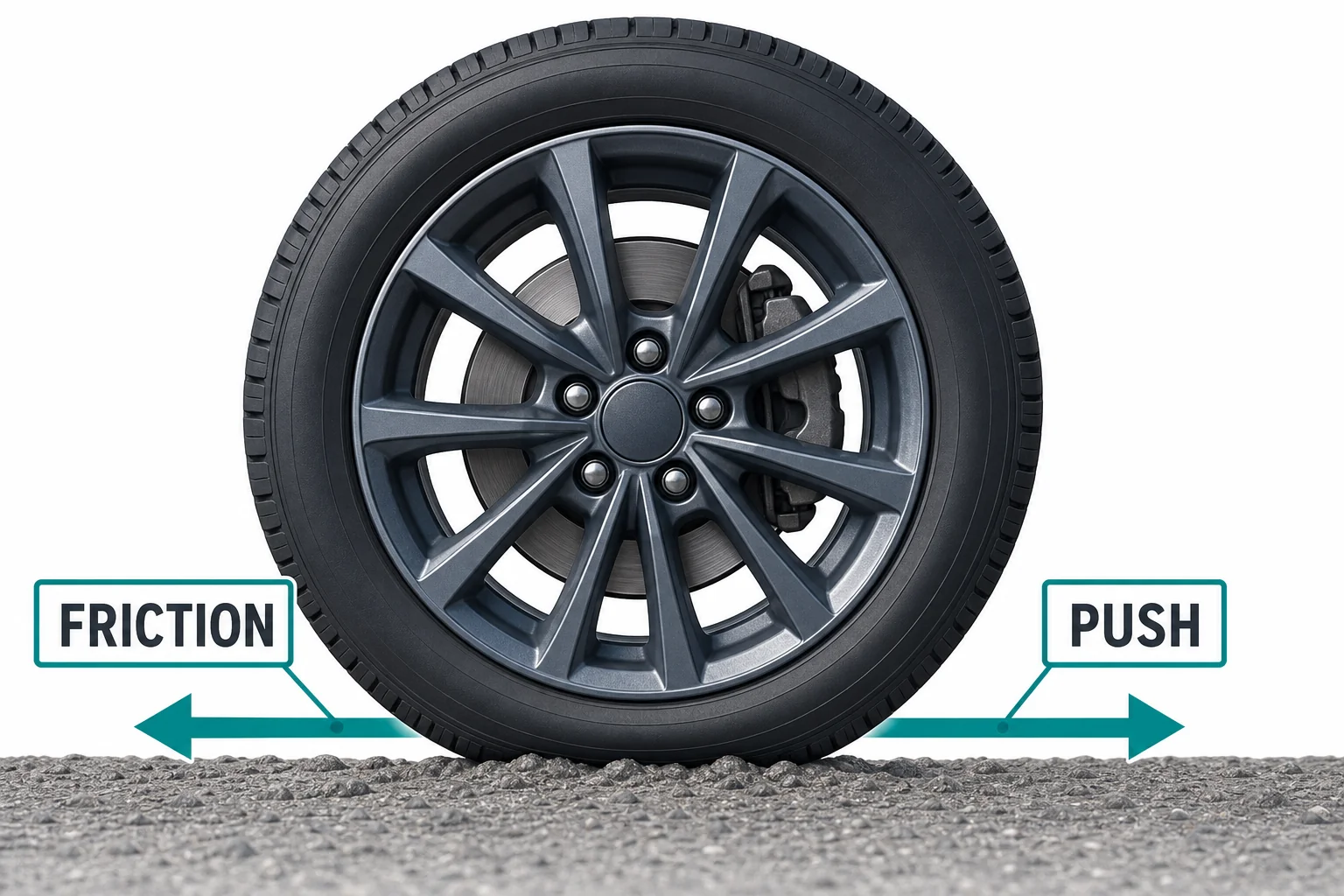
A tire touching dry pavement with arrows showing the tire push and the friction force from the road.
Friction lets a tire push against the road.
Friction is a force that acts where two surfaces touch. It points opposite the way an object is sliding or trying to slide. On a dry road, rubber presses into tiny dips and bumps in the pavement. Those tiny contact points help the tire push backward on the road. The road pushes the tire forward. That forward push moves the car. The same kind of contact helps the tire stop when the brakes are used. Ice changes this contact. Its surface is smoother, so there are fewer rough places for rubber to catch. Less friction means the tire can slide more easily. Scientists compare surfaces using the coefficient of friction, often written as $\mu$. A larger $\mu$ means stronger grip for the same weight pushing the surfaces together. A smaller $\mu$ means less grip.

Friction is the contact force that gives tires grip.

Ice is smooth and hard
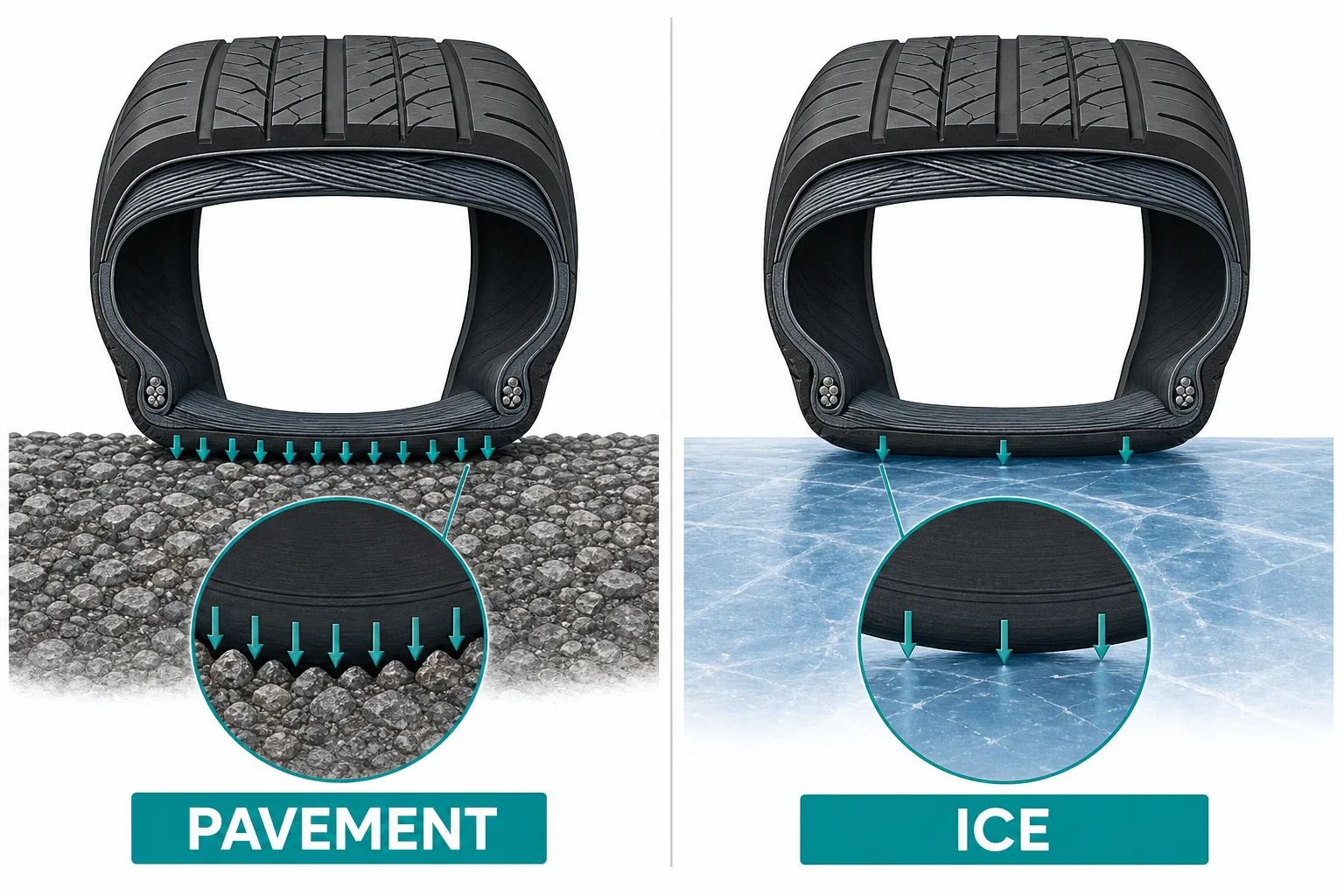
A comparison of rough pavement and smooth ice under a tire showing more contact points on pavement and fewer on ice.
Smooth ice gives rubber fewer places to catch.
Ice looks solid, but its surface is different from pavement. Pavement has grains, cracks, and rough edges. Ice can form a flatter surface, especially after traffic polishes it. A tire touching polished ice meets fewer high spots. The rubber may press down, but it does not interlock with the surface as well. This lowers the friction force. The result is not just slower stopping. It also makes steering harder. A turning car needs sideways friction to change direction. If that sideways force is too small, the car keeps moving more straight ahead than the driver wants. This is why even low speed turns can be risky on ice. A road does not need to be covered in deep ice to become slippery. A thin smooth glaze can reduce contact enough to matter.

Smooth surfaces usually give less grip than rough surfaces.

A water film can help sliding
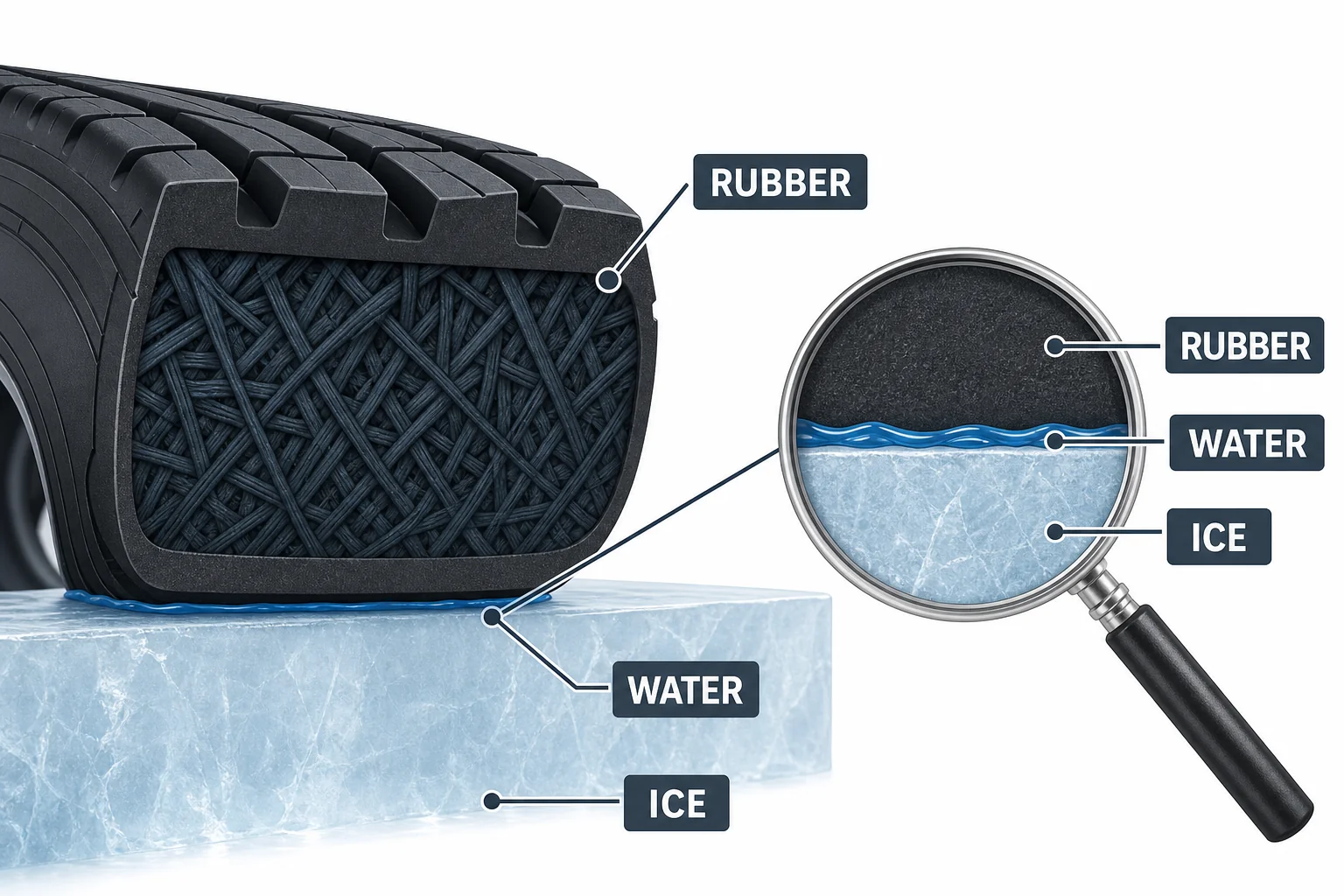
A close-up of rubber above ice with a thin blue water layer between them.
A thin water film can separate rubber from solid ice.
Ice can have a very thin layer of liquid water on its surface. This layer may exist even when the air is below freezing. Molecules at the surface are not locked in place as strongly as molecules deep inside the ice. Rubbing can also warm the contact area for a moment. Pressure from a tire can matter too, but it is not the whole story for road ice. The thin water film acts like a separator. Instead of rubber touching solid ice at many points, rubber may ride over a tiny wet layer. That makes sliding easier. The film can be extremely thin, so it is not the same as driving through a puddle. It is enough to change the contact between tire and ice. Temperature matters because warmer ice usually has a thicker surface layer than very cold ice.

A tiny wet layer can lower friction even when the road looks dry.

The coefficient of friction
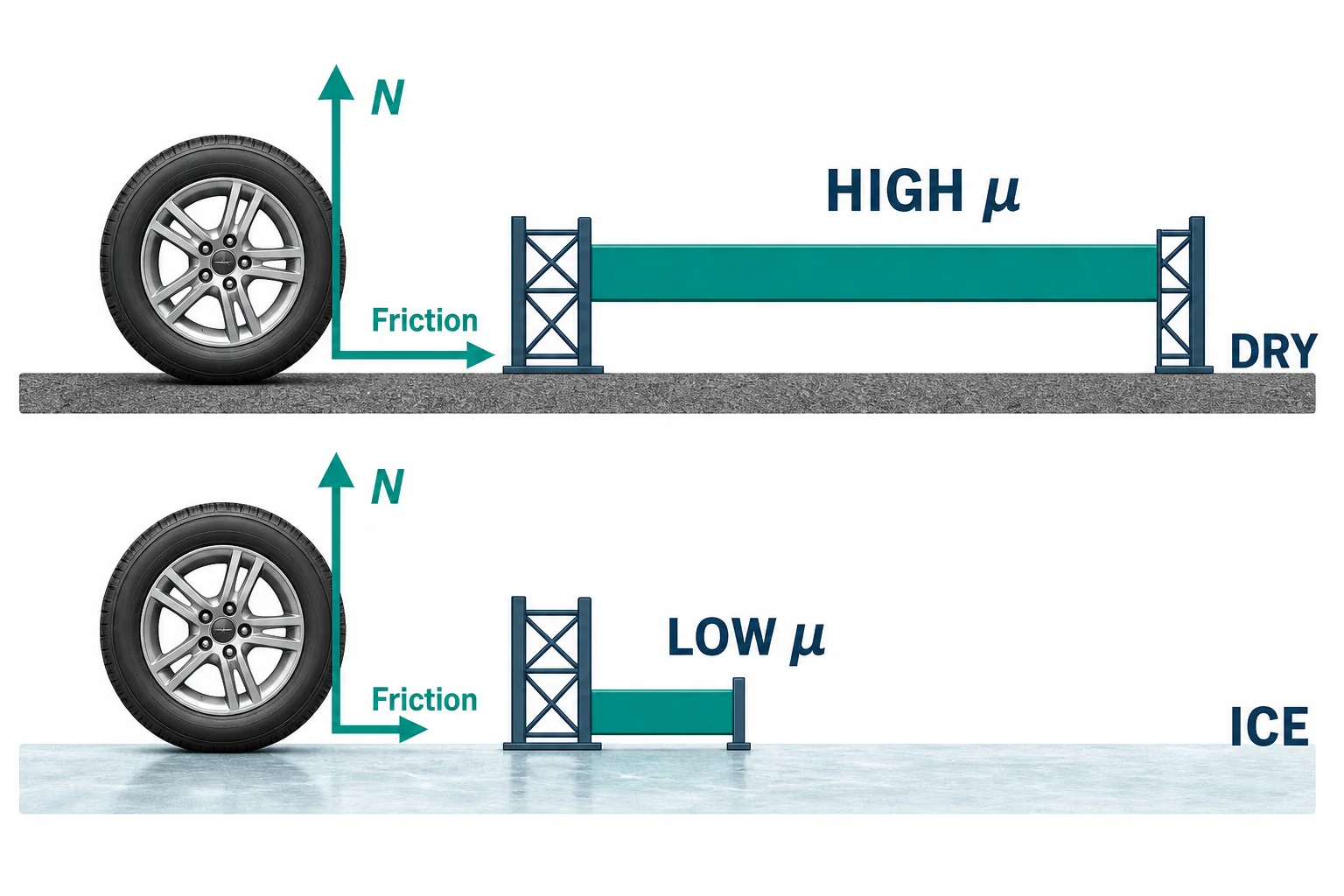
A simple bar comparison showing high grip for dry pavement and low grip for ice, with a tire beside each bar.
Different surfaces have different friction values.
The coefficient of friction is a number that compares grip between two surfaces. It does not have units. For a simple model, the friction force is $F_f = \mu F_N$. Here $F_N$ is the normal force, which is the support force from the road. If the car is on level ground, the normal force is related to the car's weight. The important idea is that $\mu$ changes with the surfaces. Rubber on dry pavement has a higher value than rubber on ice. That means the same car can stop in a shorter distance on dry pavement than on ice. The model is useful, but real tires are more complicated. Tire material, tread, road texture, speed, and temperature all change the result. Still, $\mu$ helps explain why icy roads need slower speeds and larger following distances.

Lower $\mu$ means less friction for the same push between surfaces.

Traction is a design problem
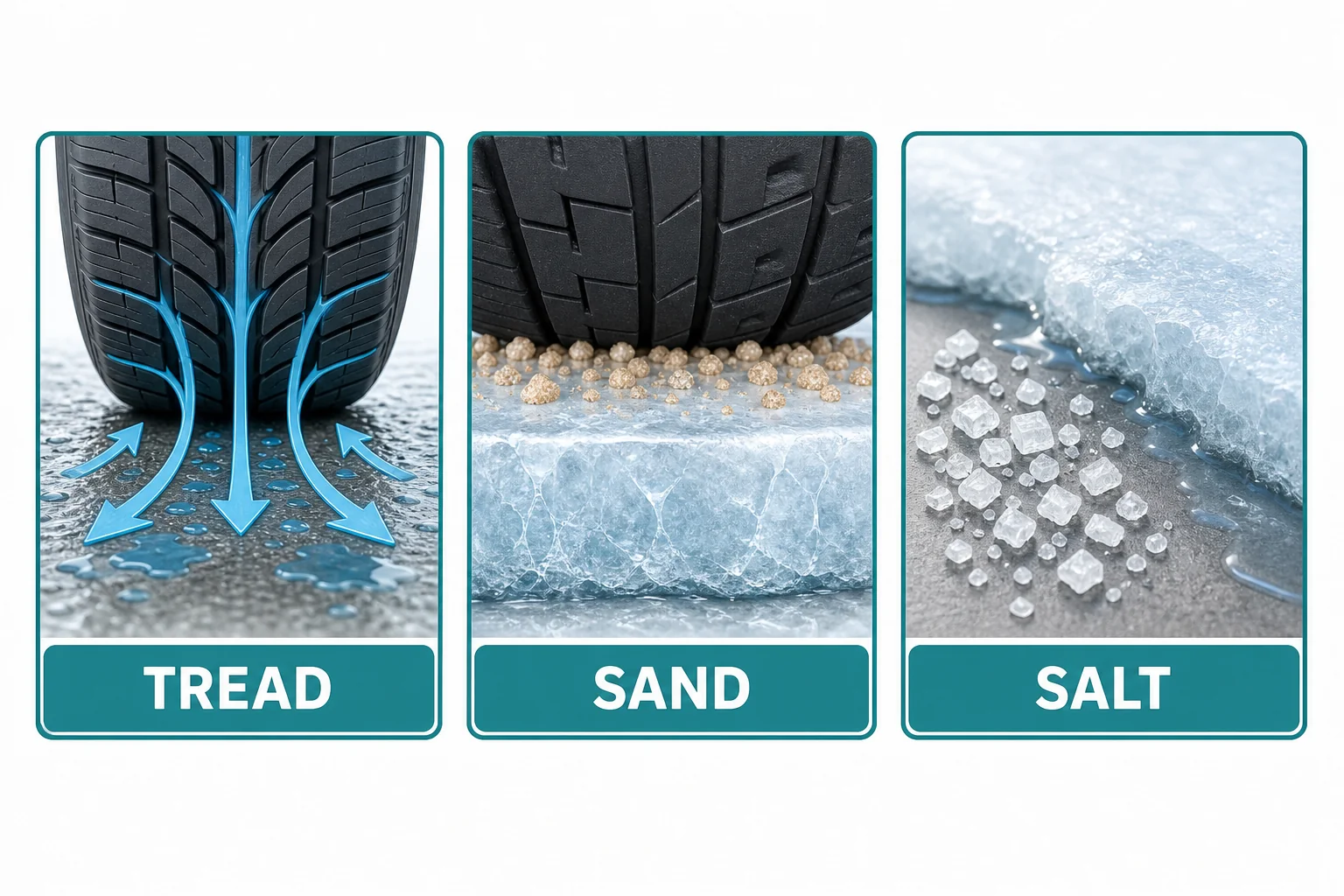
Three ways to improve traction on ice showing tire tread, sand grains, and salt melting ice.
Tread, sand, and salt change the contact with ice.
Traction means useful grip. Drivers, engineers, and road crews try to increase traction in several ways. Tire tread helps by moving water and slush away from the contact patch. Winter tires use rubber that stays softer in cold weather, so it can press into small surface details. Sand adds rough grains on top of the ice. Those grains give tires something to push against. Salt works differently. It lowers the freezing point of water, so ice can melt at temperatures near freezing. That can remove the icy surface, but it also creates salty water that must drain away or be cleared. None of these methods makes ice act exactly like dry pavement. They only raise the available friction. Good traction depends on the surface, the tire, and the conditions at that moment.

Traction improves when the tire can make better contact or push against rough material.

Vocabulary

Friction
A force between touching surfaces that resists sliding or the start of sliding.
Coefficient of friction
A number that compares how strongly two surfaces grip each other.
Normal force
The support force from a surface that acts perpendicular to the surface.
Traction
Useful friction that helps a wheel, shoe, or object grip a surface.
Water film
A very thin layer of liquid water on ice that can reduce direct contact.
Pressure melting
Melting caused by pressure lowering the melting point of ice, an effect that is limited for many road conditions.

In the Classroom

Compare sliding surfaces

25 minutes | Grades 6-8

Students pull the same object across sandpaper, cardboard, plastic, and a chilled smooth surface using a spring scale. They record the force needed to start motion and compare which surface gives the most grip.

Model tire tread

20 minutes | Grades 6-8

Students press a smooth rubber eraser and a grooved rubber piece onto a wet tray and drag each one slowly. They observe how grooves move water away and discuss why tread can improve contact.

Stopping distance discussion

30 minutes | Grades 6-8

Students use a simple data table with stopping distances on dry pavement, wet pavement, and ice. They make a bar graph and explain the pattern using friction and coefficient of friction.

Key Takeaways

  • Ice is slippery because it gives tires less friction than dry pavement.
  • A thin water film on ice can reduce direct contact between rubber and solid ice.
  • Smooth polished ice gives tires fewer tiny bumps to push against.
  • The coefficient of friction helps compare grip between different surfaces.
  • Tread, sand, salt, and slower speeds all help manage low traction.