Friction Ramp Lab
Place different objects on a ramp, choose a surface material, and adjust the angle. Discover what conditions cause an object to slide and how surface roughness affects speed. Collect data across multiple trials to find patterns in friction and motion.
Guided Experiment Surface Friction Investigation
If you place the same object on different surfaces at the same angle, which surface do you predict will let the object slide? Which will hold it in place?
Write your hypothesis in the Lab Report panel, then click Next.
Controls
Object
Surface Material
Ramp View
Data Table
(0 rows)| # | Trial | Object | Surface | Angle(deg) | Slides? | Acceleration(m/s^2) | Speed(m/s) |
|---|
Reference Guide
What is Friction?
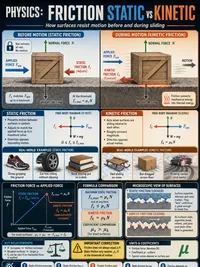
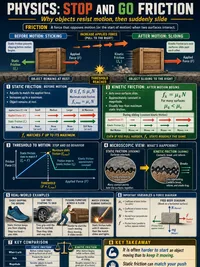
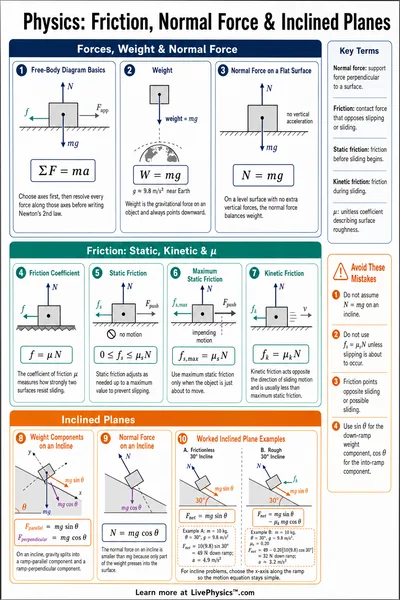
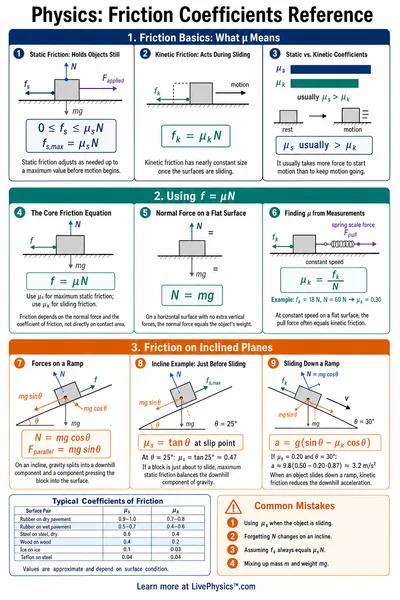
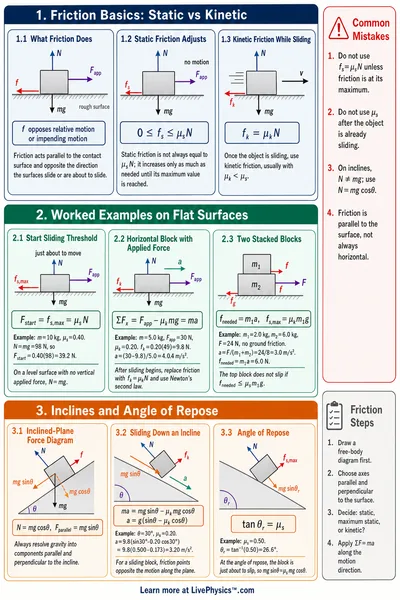
Friction is a force that resists motion between two surfaces in contact. It acts opposite to the direction of motion (or attempted motion).
Static friction keeps an object stationary. It adjusts up to a maximum value before the object starts to slide.
Kinetic friction acts on a moving object. It is usually smaller than the maximum static friction, which is why objects continue to accelerate once they start sliding.
Normal Force and Friction
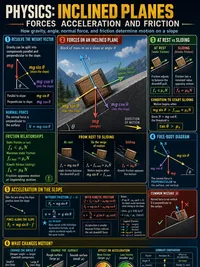
On a ramp at angle theta, the normal force (N) is perpendicular to the surface and equals
N = m g cos(theta)
The maximum static friction force is
f_s(max) = mu_s * N
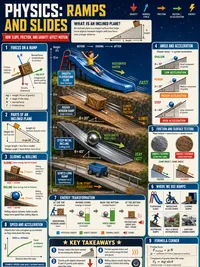
The object slides when the gravity component along the ramp (m g sin(theta)) exceeds f_s(max).
Newton's Second Law on a Ramp
Once an object slides, the net force along the ramp is
F_net = m g sin(theta) - mu_k * m g cos(theta)
Dividing by mass gives the acceleration
a = g (sin(theta) - mu_k * cos(theta))
Notice that mass cancels out. A heavier and a lighter object on the same surface and angle accelerate at exactly the same rate.
Real-World Friction Examples
- Car brakes. Friction between brake pads and rotors converts kinetic energy into heat to slow the vehicle.
- Rock climbing. Rubber shoe soles have a high friction coefficient against rock, allowing climbers to stand on steep faces.
- Ice skating. Ice has an extremely low friction coefficient, letting skaters glide with almost no resistance.
- Conveyor belts. Engineers choose belt surface materials to control whether items slide or stay in place during transport.