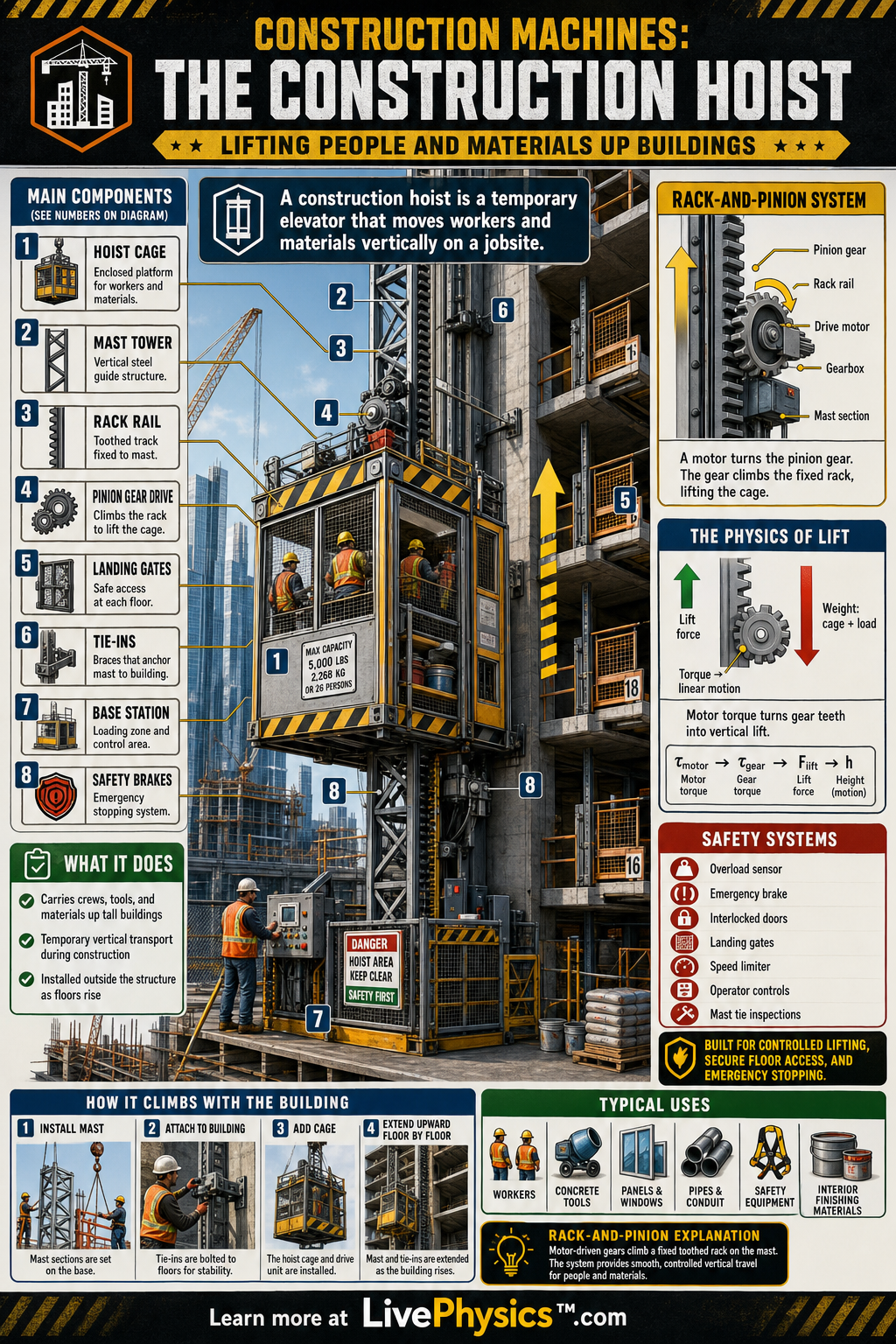
A construction hoist is a temporary elevator used on building sites to move workers, tools, and materials up the side of a structure. It matters because high-rise construction depends on safe, repeated vertical transport that is faster than stairs and more controlled than lifting everything by crane. A rack-and-pinion hoist is especially useful because it climbs on a fixed mast without needing a tall overhead machine room.
Its motion is easy to show with forces, gears, power, and safety systems.
Understanding Construction Machines, The Construction Hoist
The cage is only one part of the system. A steel mast is built upward in sections as the building grows. Each section must line up accurately so the pinion gear can run smoothly on the rack.
The mast is tied to the building at planned intervals. These ties prevent sideways movement caused by wind, vibration, or the changing pull from the moving cage.
Near the base, the machine needs a firm foundation that spreads its load into the ground. A small error in alignment can increase friction, wear down gear teeth, and make the ride rough.
The motor does more than hold up a load. It must first accelerate the cage, its passengers, and its cargo. During this short period, the upward force is greater than the total weight and friction.
When the cage reaches its set speed, the required force becomes lower because it mainly balances weight and friction. Before stopping at a landing, the drive slows the cage in a controlled way.
Braking converts the moving cage's kinetic energy into heat or electrical energy, depending on the system. Sudden starts and stops create larger forces, which is why hoists use gradual acceleration and deceleration.
Load limits are based on more than the mass written on a sign. Workers must place heavy items so the cage stays balanced. A load concentrated near one side can make guide rollers press harder against the mast.
Loose materials can shift during travel, creating a dangerous change in balance. The total load includes people, tools, pallets, and the cage itself. Operators use load charts and clear signals at landing gates.
They must never carry people in a cage intended only for materials. Doors and gates are interlocked so the hoist should not move when an entrance is open.
Electric power is an important practical limit. Raising a heavy load quickly needs a large rate of energy transfer. If the speed doubles while the lifting force stays similar, the power needed roughly doubles.
This helps explain why a hoist may move more slowly when heavily loaded. Construction sites must provide cables, control panels, and protection devices that can handle the motor current. Students learning this topic should separate force, energy, and power.
Force determines whether the load can be lifted. Energy describes the work done over a height.
Power describes how fast that work is done. Pay attention to friction, changing speed, and safety margins because real machines are not ideal textbook systems.
Key Facts
- Weight of the loaded cage, W = mg
- Lifting power for steady motion, P = Fv, where F is lifting force and v is vertical speed
- For steady upward motion at constant speed, motor force must approximately balance weight plus friction, Fmotor = mg + Ffriction
- Rack-and-pinion motion converts gear rotation into straight vertical motion along the mast.
- Gear tooth force creates torque on the pinion, τ = Fr, where r is the pinion radius
- Safety brakes and overspeed governors stop the cage if it moves too fast or loses drive control.
Vocabulary
- Construction hoist
- A temporary elevator system used on construction sites to lift people, materials, or equipment vertically.
- Rack
- A straight toothed rail fixed to the mast that the rotating pinion gear climbs.
- Pinion
- A small gear driven by a motor that meshes with the rack to move the hoist cage up or down.
- Mast
- The vertical tower section attached to the building that guides and supports the hoist.
- Rated load
- The maximum safe weight of people and materials that the hoist is designed to carry.
Common Mistakes to Avoid
- Ignoring the mass of the cage, workers, and materials, which is wrong because the motor must lift the total loaded mass, not just the cargo.
- Treating the hoist like a free-flying crane load, which is wrong because the cage is guided by a mast and driven by gear teeth on a rack.
- Assuming constant speed means no force is needed, which is wrong because the motor must still balance weight and friction even when acceleration is zero.
- Overloading the hoist beyond its rated load, which is wrong because extra weight increases gear force, braking demand, and structural stress beyond safe limits.
Practice Questions
- 1 A construction hoist cage carries 900 kg of workers and materials. If the empty cage has a mass of 700 kg, what is the total weight of the loaded hoist? Use g = 9.8 m/s².
- 2 A loaded hoist has a total mass of 1800 kg and moves upward at a constant speed of 0.60 m/s. Ignoring friction, what power must the motor provide? Use g = 9.8 m/s².
- 3 Explain why a rack-and-pinion hoist can climb the side of a building without a cable pulling it from above, and describe one safety feature that helps prevent a fall.