Earthquake-Proof Building Lab
Design a building by selecting its height, width, and foundation system. Set the earthquake magnitude and run the simulation to see whether your structure survives. Record data across multiple configurations to find the safest design principles.
Guided ExperimentFoundation System Investigation
If you change the foundation from rigid to base isolation, how will that affect the building's ability to survive a major earthquake?
Write your hypothesis in the Lab Report panel, then click Next.
Controls
Data Table
(0 rows)| # | Trial | Storeys | Width | Foundation | Magnitude(M) | Max Sway(%H) | Result | Notes |
|---|
Reference Guide
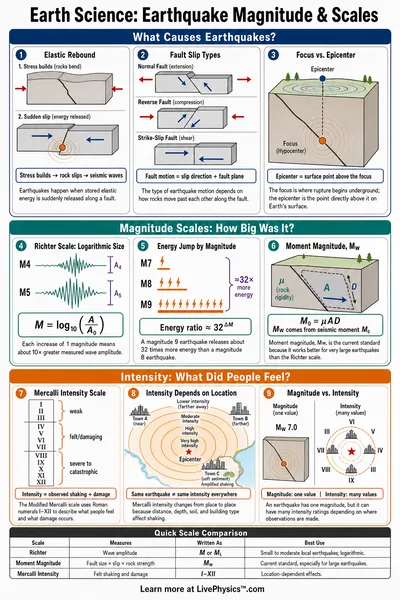
Richter Scale
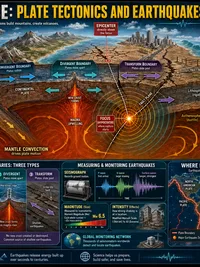
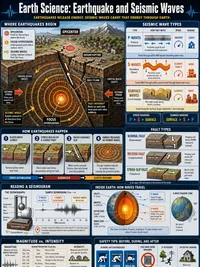
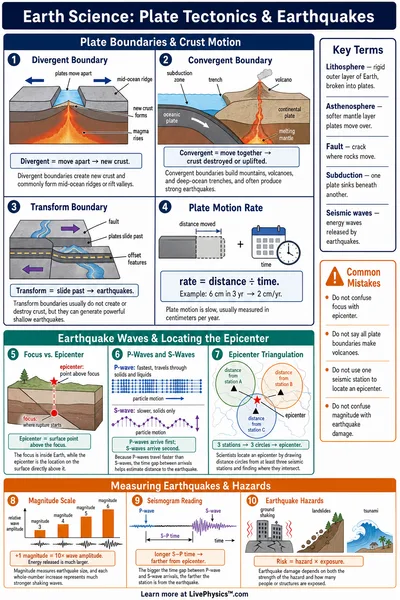
The Richter scale measures earthquake energy on a logarithmic scale. Each whole-number increase represents roughly 31.6 times more energy released.
- M1-2 - Micro, not felt by people
- M3-4 - Minor, felt indoors, little damage
- M5 - Moderate, damage to weak structures
- M6 - Strong, significant damage in populated areas
- M7 - Major, widespread serious damage
- M8 - Great, severe damage over hundreds of km
- M9+ - Catastrophic, total destruction near epicenter
Peak ground acceleration (PGA) is the key engineering parameter that links earthquake magnitude to structural forces. PGA scales exponentially with magnitude.
Seismic Engineering
Engineers use three main strategies to protect buildings from earthquake damage
- Base Isolation - Rubber and steel bearing pads placed between the foundation and the structure absorb horizontal ground movement. The building effectively floats above the shaking ground, reducing transmitted forces by 50-70%.
- Viscous Dampers - Hydraulic cylinders installed in the structure convert kinetic energy into heat, similar to car shock absorbers. They reduce building sway by 35-50%.
- Moment Frames - Rigid beam-column connections that resist lateral forces through structural stiffness alone. Used in most conventional buildings.
Building Slenderness
Slenderness ratio (height divided by width) is one of the most important factors determining earthquake vulnerability. Taller, narrower buildings experience greater lateral sway for the same ground shaking.
A slenderness ratio above 5 is considered high-risk without advanced damping. Typical safe design targets
- Ratio below 2 - Low risk, rigid foundation sufficient
- Ratio 2-4 - Moderate risk, dampers recommended
- Ratio 4-6 - High risk, base isolation required
- Ratio above 6 - Very high risk, multiple systems needed
The 2011 Tohoku earthquake (M9.0) caused the Sendai Mediatheque, a building designed with base isolation and ductile steel tubes, to survive with minimal damage while surrounding structures collapsed.