Build-It-from-Pieces Lab
Stack triangles and squares to build towers, bridges, and pyramids. Adjust the base width and height to see how each choice affects stability.
Guided ExperimentBuild-It-from-Pieces Investigation
Before building, predict whether triangles or squares make a structure more stable. Explain your prediction.
Write your hypothesis in the Lab Report panel, then click Next.
Choose a Structure
Adjust Your Tower
Stability Score
33%
Unstable33% of pieces are triangles
Controls
Data Table
(0 rows)| # | Structure | Triangles | Squares | Base Width | Height | Stability (%) | Rating |
|---|
Reference Guide
Why Triangles?
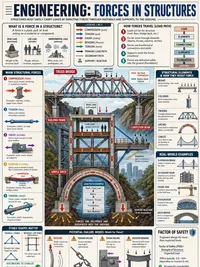
Triangles are rigid shapes. They cannot bend or collapse like squares can. Engineers use triangles in bridges and roofs because a triangle holds its shape even when forces push on it from different directions.
A square can turn into a parallelogram when pushed from the side. A triangle resists this completely. That is why roof trusses and bridge frames are full of triangles.
Base Width and Stability
A wide base lowers the center of gravity. Wide bases make structures harder to tip over because the weight is spread across a larger area.
Think about a pyramid compared to a thin spike. The pyramid stays in place while the spike falls over easily. The same idea applies to towers and bridges.
Height and Balance
Taller structures have a higher center of gravity. A tall narrow structure tips more easily than a short wide one because the weight sits far above the base.
Engineers balance height against base width. Skyscrapers use very wide foundations and internal bracing to stay safe even when they are extremely tall.
Engineering Design
Engineers test many designs before picking the best one. Recording results helps compare designs fairly. In real life, engineers use computer models and physical prototypes to find the strongest, lightest, and safest design.
The engineering design process is a loop. Test, measure, improve, and test again until the design meets all the requirements.