
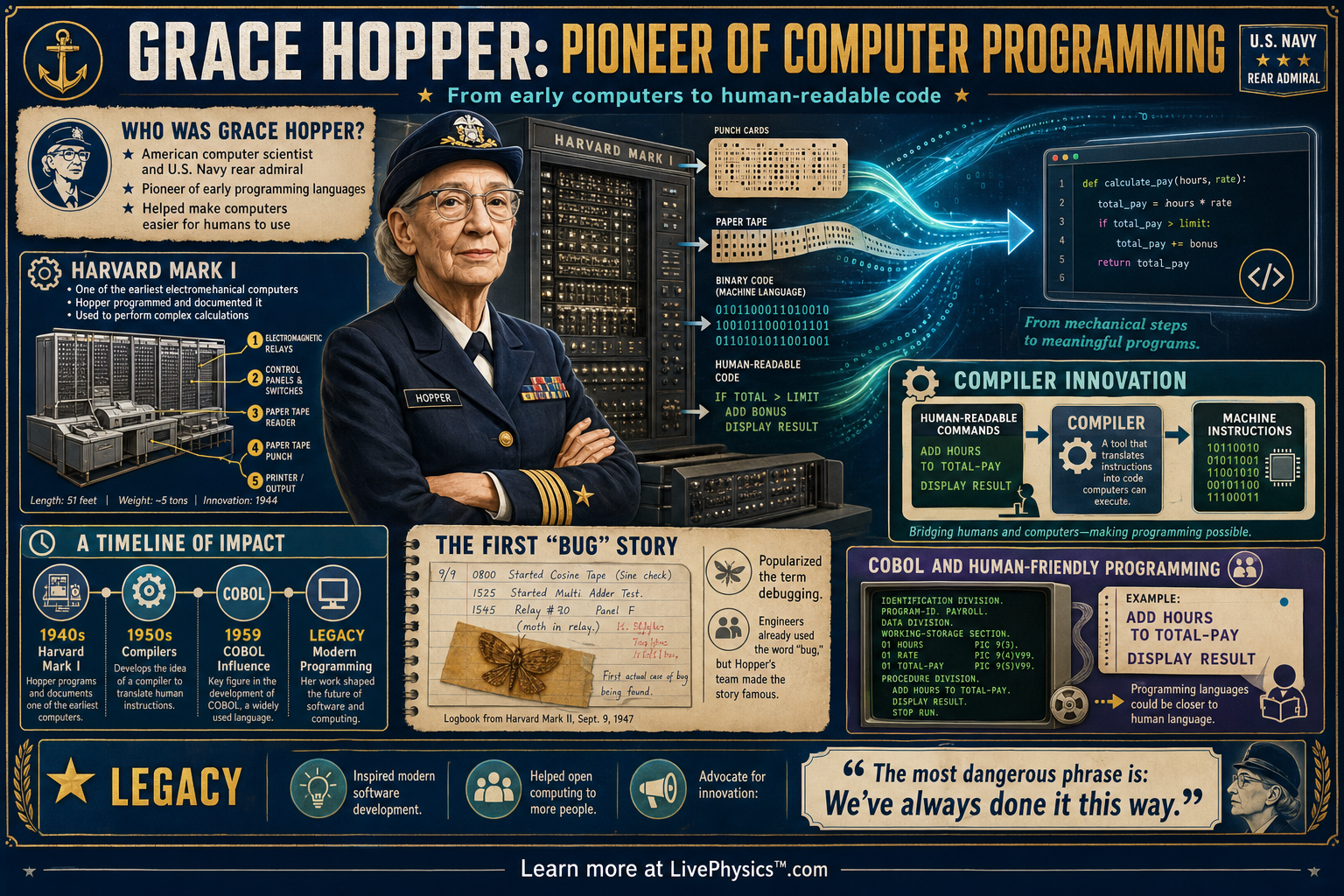
Grace Hopper was a pioneering computer scientist and U.S. Navy officer who helped turn early computers from rare calculating machines into practical tools for science, business, and government. Born in 1906, she worked on the Harvard Mark I during World War II and later became one of the most influential figures in programming language design. Her work matters because modern software depends on the idea that people can write instructions in readable languages instead of only machine code.
She showed that good engineering can make powerful technology usable by many more people.
Understanding Grace Hopper, Pioneer of Computer Programming Languages
A programming language is more than a set of English-like words. It has strict rules for spelling, order, meaning, and data types. A compiler checks these rules before producing instructions for a particular processor.
This process usually has several stages. It reads the source text, identifies its structure, checks whether operations make sense, improves parts of the program, then generates low-level instructions. The same source program may need different compiled versions for different processors.
This is why portability is valuable. Engineers can preserve the main program logic while adapting the final output to new hardware.
Business software created a strong need for readable programs. A payroll system must track names, hours, tax rates, deductions, and totals without losing records. A bank system must treat money carefully.
Computers often store numbers in binary, and some decimal amounts cannot be represented exactly in that form. Tiny rounding differences can become serious when millions of transactions are processed. Languages designed for business work encouraged clear record layouts and words that described actions.
Readability helps teams inspect programs years later, when the original programmers may be gone. It also reduces the chance that a small misunderstanding changes an important calculation.
The famous computer bug story is useful because it shows that failures have physical causes as well as logical causes. In 1947, workers found a moth trapped in a relay of the Harvard Mark II. The moth was attached to the work log.
The word bug had already been used for technical faults, but this event helped make the term memorable. Debugging is not guessing until something works. Good debugging starts by reproducing the failure.
The programmer then narrows the possible causes, changes one thing, tests the result, and checks that the repair did not break another feature. Students should learn to read error messages, make small test cases, and keep notes on what they changed.
Hopper used short pieces of wire to help people picture computer timing. A signal moving at the speed of light travels about three hundred metres in one microsecond. Signals in real wires move more slowly, yet the comparison makes a tiny interval easier to imagine.
Modern processors complete many operations within nanoseconds, while sending data across a network can take millions of nanoseconds. This difference explains why a program can calculate quickly but still feel slow when it waits for storage, a website, or another computer.
When learning programming, pay attention to both correctness and timing. A correct program must produce the right result, but engineers must understand where it spends time and why.
Key Facts
- Grace Hopper lived from 1906 to 1992 and became a U.S. Navy Rear Admiral.
- She helped program the Harvard Mark I, an electromechanical computer used during World War II.
- Hopper developed the A-0 system in 1952, often described as the first compiler.
- A compiler translates human-readable source code into machine code that a computer can execute.
- COBOL, first specified in 1959, was designed to make business programming more readable and portable.
- Basic time conversion used in computing, 1 microsecond = 0.000001 s and 1 nanosecond = 0.000000001 s.
Vocabulary
- Compiler
- A compiler is a program that translates source code written by humans into machine code that a computer can run.
- COBOL
- COBOL is a high-level programming language designed for readable business data processing.
- Machine code
- Machine code is the low-level set of binary instructions directly executed by a computer processor.
- Debugging
- Debugging is the process of finding, explaining, and fixing errors in hardware or software.
- Harvard Mark I
- The Harvard Mark I was an early electromechanical computer used for large numerical calculations during the 1940s.
Common Mistakes to Avoid
- Saying Grace Hopper invented all programming languages is wrong because many people contributed to programming, but Hopper was central to compiler design and readable high-level languages.
- Treating a compiler as the same thing as a programming language is wrong because a language is a set of rules for writing programs, while a compiler is a tool that translates those programs.
- Thinking the famous moth created the word bug is wrong because engineers used the word bug earlier, but the Mark II moth became a famous example of a real hardware fault.
- Assuming early computers were just slower versions of laptops is wrong because machines like the Harvard Mark I used electromechanical parts, physical switches, and very different programming methods.
Practice Questions
- 1 Grace Hopper was born in 1906 and died in 1992. How old was she when she died, assuming her birthday had already occurred that year?
- 2 If a computer operation takes 12 microseconds, how many seconds is that? Write your answer in decimal notation and scientific notation.
- 3 Explain why the invention of compilers was important for making computers useful outside a small group of hardware specialists.