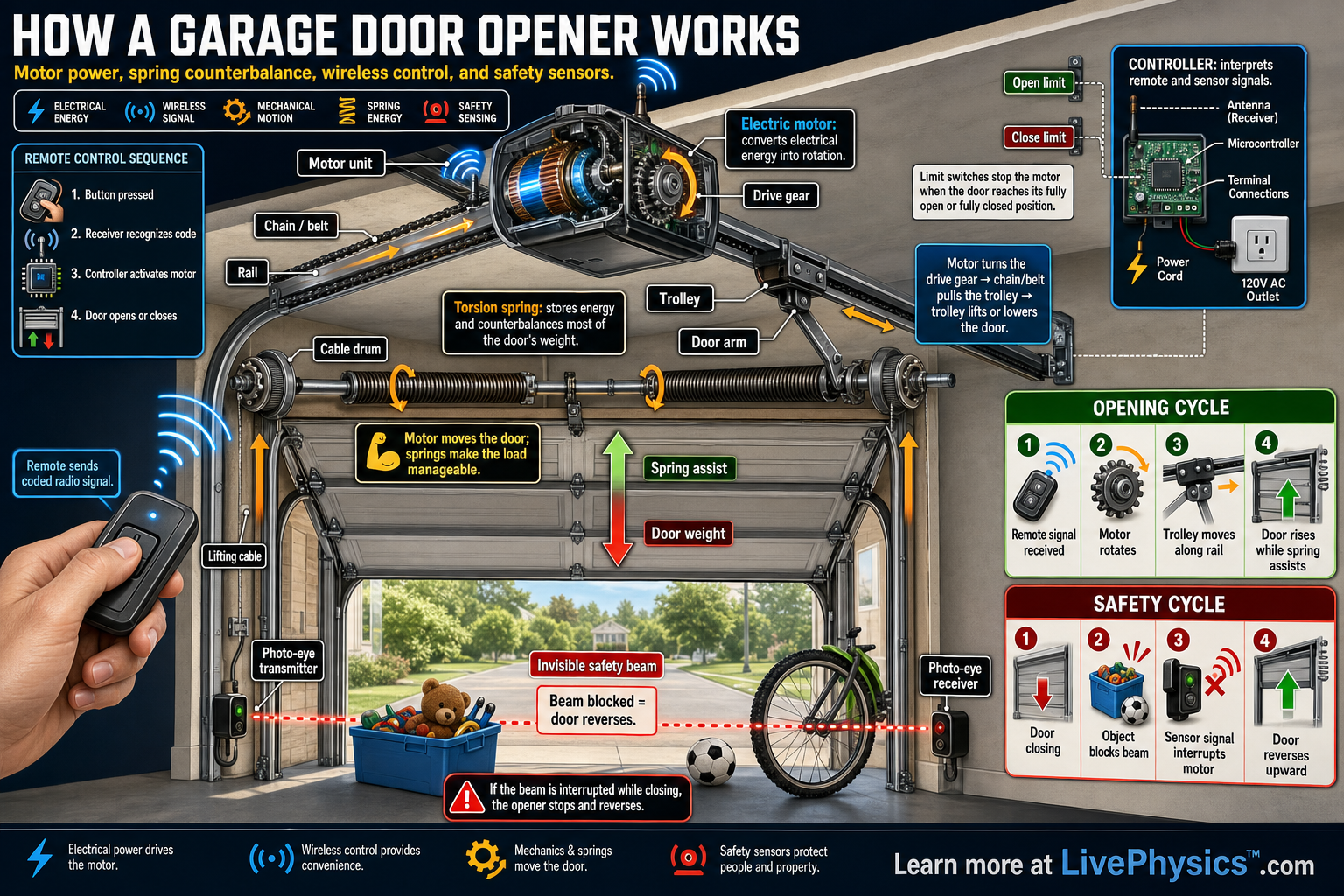
A garage door opener combines electrical, mechanical, and safety systems to move a heavy sectional door reliably. The electric motor does not lift the full weight of the door by itself because a torsion spring provides most of the balancing force. This system matters because garage doors can weigh more than 100 kg, so controlled motion and automatic safety features are essential.
The opener converts energy from household electricity into the motion needed to open and close the door.
Understanding Engineering, How a Garage Door Opener Works
The door itself is a moving structure, not a single solid slab. Its horizontal panels are connected by hinges, so they can bend around the curved part of the track. Rollers at the panel edges guide this movement.
Near the floor, the door moves mostly upward. Near the ceiling, it moves mostly backward. This change in direction affects the pulling force needed from the opener.
A properly set spring makes the door feel much lighter, but it does not remove the door's mass. The opener still has to overcome friction in rollers, tracks, hinges, and the drive system.
The motor is controlled by a small electronic unit. This unit receives a command from a wall button, remote control, or keypad. It then runs the motor in the correct direction for opening or closing.
It must know when to stop, because a motor that keeps pulling after the door reaches the floor or ceiling can damage parts. Many openers use travel limits. Older models may use adjustable screws or switches.
Newer models often store travel positions electronically. The controller may measure motor rotation to estimate door position. If the trolley moves farther than expected, the system can detect a problem and stop.
Closing needs more safety checks than opening. The infrared beam near the floor protects people, pets, and objects that may be hard to see from inside a car. The receiver must get a clear beam from the sender.
Dirt on a lens, loose wiring, sunlight, or a sensor that points slightly away from its partner can interrupt the signal. The door should not close normally when the safety beam is blocked or misaligned. Openers also monitor resistance while closing.
If the door hits an object, the motor must work harder than normal. The controller can treat this extra force as an obstruction and reverse the door. This force setting needs careful adjustment because too much allowed force reduces safety.
A useful engineering idea here is load sharing. When the door is balanced, the upward spring force plus the motor pull is close to the downward weight plus friction. If a spring weakens or breaks, the motor suddenly faces a much larger load.
The door may move slowly, stop, or strain the drive parts. A disconnected opener can help reveal balance problems, but spring systems are dangerous because they store large amounts of energy.
Students should understand the test without trying to adjust a torsion spring. A trained technician should handle spring repair.
When learning this system, trace the path of energy and information separately. Energy moves from the electrical supply to the motor, then through the drive mechanism to the door. Information moves from buttons and sensors to the controller, which decides whether the motor should run, stop, or reverse.
This separation explains common faults. A door that does not move may have an electrical or command problem. A door that moves unevenly may have a mechanical problem.
A door that refuses to close often has a sensor alignment problem. Good engineering depends on checking each subsystem before replacing parts.
Key Facts
- Electrical energy powers the motor, which produces rotational mechanical energy.
- The motor turns a sprocket or pulley that drives a chain or belt along the overhead rail.
- A trolley attached to the moving chain or belt pulls the door arm, causing the hinged door panels to travel along curved tracks.
- A torsion spring stores energy when the door closes and releases it as the door opens, counterbalancing much of the door's weight.
- For a balanced door moving at nearly constant speed, F_motor + F_spring approximately equals F_weight + F_friction.
- Photo-eye sensors send an infrared beam across the doorway; a blocked beam causes the controller to stop or reverse a closing door.
Vocabulary
- Torsion spring
- A tightly wound spring on a shaft that stores twisting energy to help counterbalance the garage door.
- Trolley
- The sliding connector on the opener rail that transfers the chain or belt motion to the door arm.
- Track
- A metal guide that uses rollers to direct the garage door from vertical motion to horizontal motion.
- Photo-eye sensor
- A safety sensor that detects whether an infrared beam across the doorway has been interrupted.
- Counterbalance
- A system that supplies an opposing force or torque so a heavy object requires less force to move.
Common Mistakes to Avoid
- Assuming the electric motor lifts the entire door weight is wrong because the torsion spring counterbalances most of the gravitational force. A properly balanced door should be movable with relatively little force.
- Thinking the chain or belt directly pulls each door panel upward is wrong because it pulls the trolley and door arm. The rollers and curved tracks guide the connected panels through their path.
- Treating photo-eye sensors as motion detectors is wrong because they usually detect interruption of a light beam near the floor. They are designed mainly to prevent the door from closing on an obstruction.
- Trying to adjust or remove a torsion spring without training is dangerous because the spring can store a large amount of mechanical energy. Spring adjustment should be done by a qualified technician.
Practice Questions
- 1 A garage door has a mass of 120 kg. Calculate its weight using g = 9.8 m/s^2.
- 2 The torsion spring supplies an upward force of 1000 N while the door weighs 1176 N. Ignoring friction, what additional upward force must the motor system provide to hold or raise the door at constant speed?
- 3 A door begins closing, but a box blocks one photo-eye sensor beam. Explain the signal path from the sensor to the controller and why reversing the motor improves safety.